By most accounts, Paul Manship is a master of his craft. During his lifetime, he was recognized for creating sculptures that were filled with energy and movement, but influenced by narratives and techniques of the past. Manship’s early art education in Rome and travels around Europe where he viewed ancient artwork were inspirations that lasted throughout his career. February 11 through July 4, the exhibition Paul Manship: Ancient Made Modern at Wadsworth Atheneum Museum of Art in Hartford, Connecticut, will explore the artistic trajectory that led Manship to be one of the most sought-after sculptors of his time.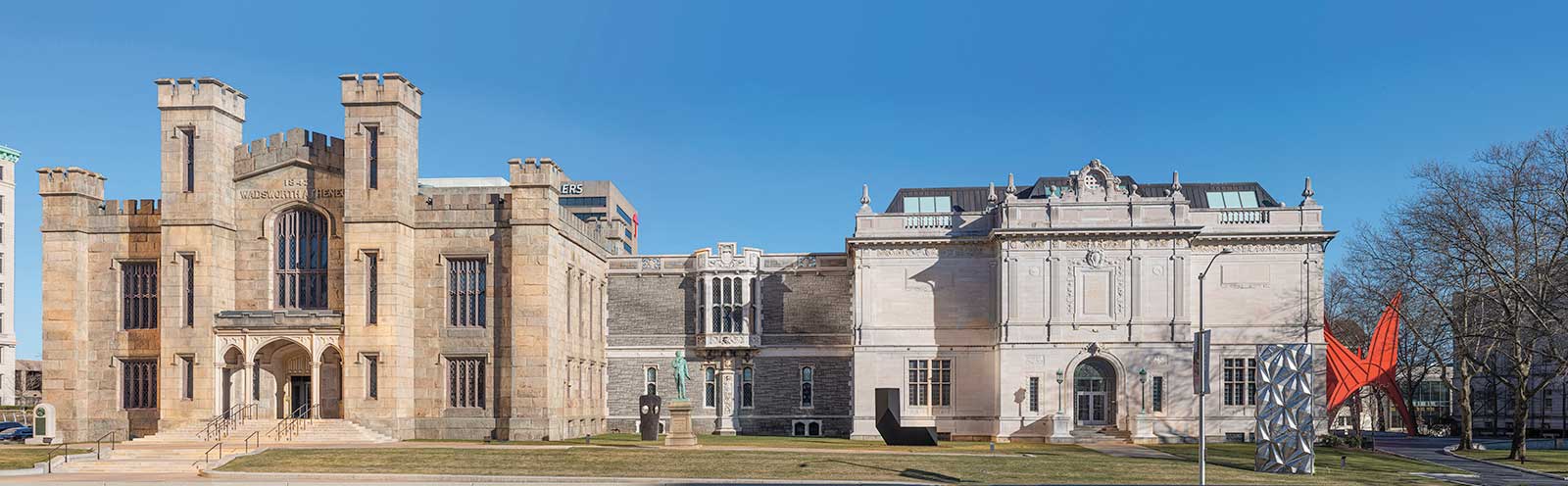
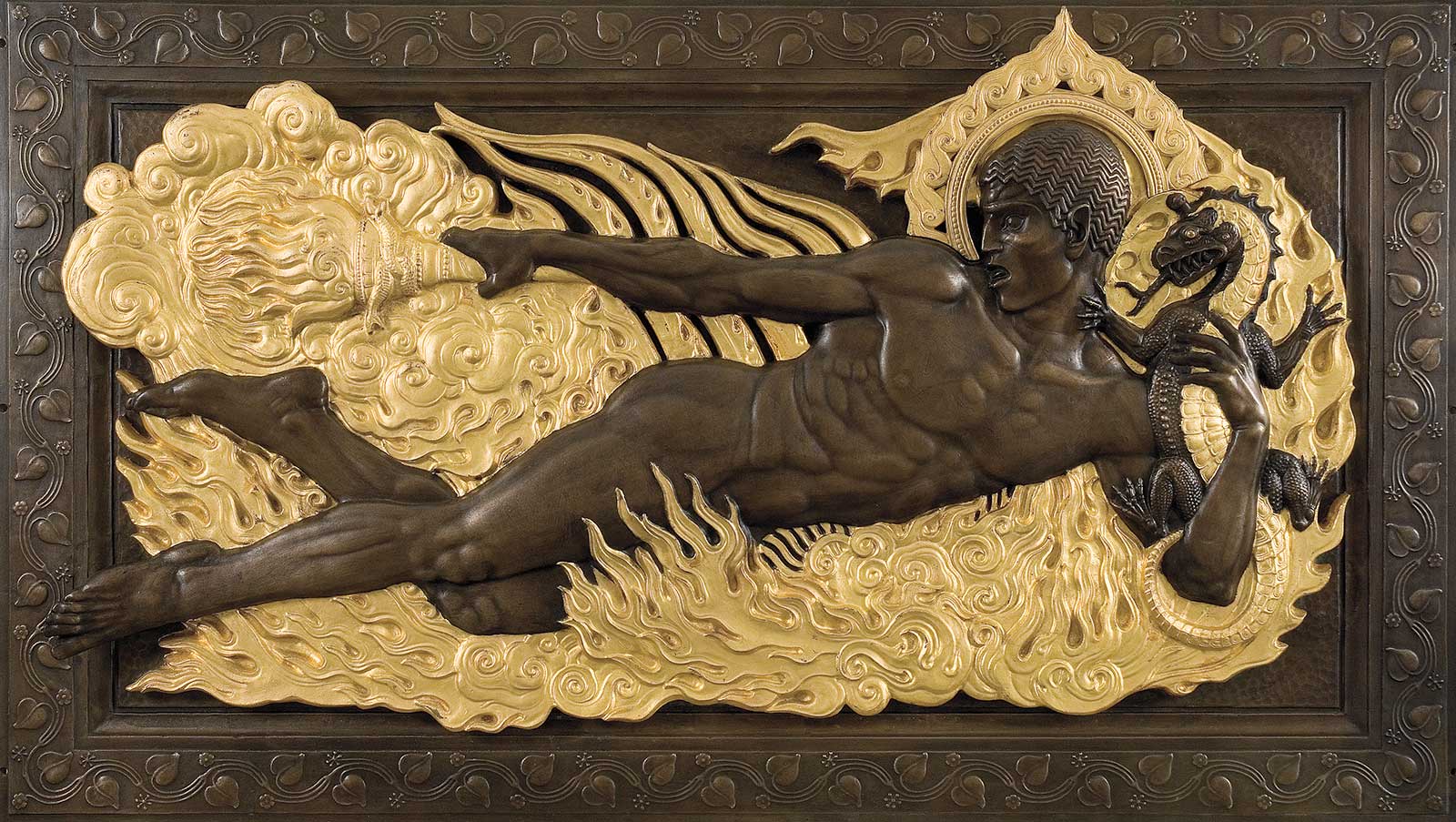 Paul Manship (1885-1966), (Fire) from the Four Elements, commissioned in 1914, installed 1921 in the American Telephone and Telegraph Building, 195 Broadway, New York (designed by Wm Welles Bosworth). Parcel-gilt bronze relief. Courtesy of Gerald Peters Gallery. Private collection. © Estate of Paul Manship.
The idea for the exhibition came when Erin Monroe, the museum’s Robert H. Schultz Jr. Associate Curator of American Paintings and Sculpture, began studying the six Manships in the Wadsworth collection. What started as a small show that brought together works of ancient art in conversation with the six by the sculptor, seemed like a natural fit for a special exhibition. The show has added more than two dozen loan pieces providing additional context and breadth to the presentation.
“The Wadsworth collection has six sculptures by Manship that are bronze and about 12 to 18 inches high,” says Monroe, “but he worked in a range in scale and subject. I wanted to make sure that we had a presentation of larger architectural works as well as some of the incredible bronzes he did on a larger scale.”
Diving into his early and innovative aesthetics and then moving to public artwork, Monroe curated a show that covers three main segments of the artist’s career. On view will be both sculptures and preliminary sketches by Manship as well as ancient works from the museum that add framework to his inspirations.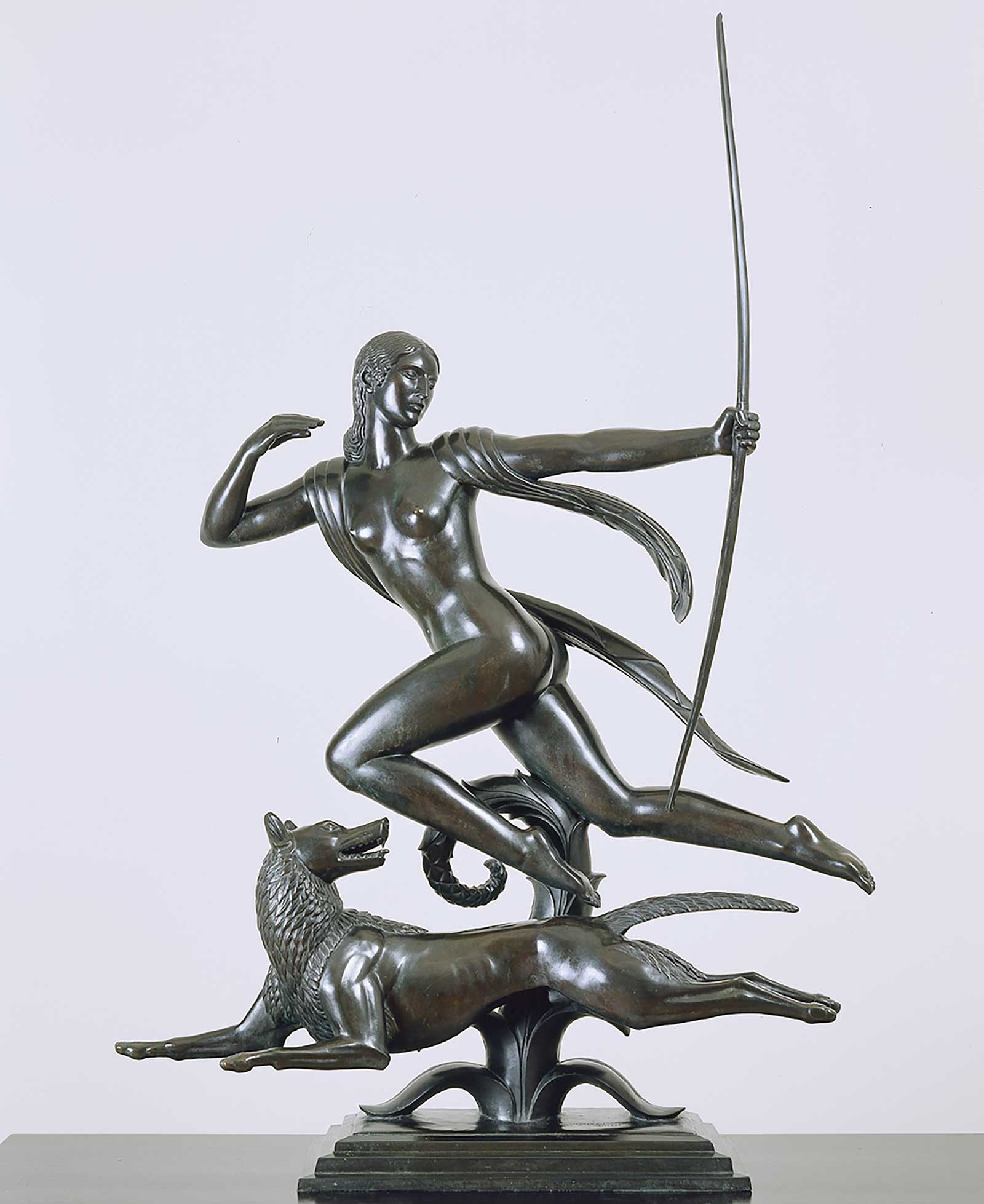 Paul Manship (1885-1966), Diana, cast 1925 (one of a pair). Bronze on marble base. Addison Gallery of American Art, Phillips Academy, Andover, MA. Gift of anonymous donor. © Estate of Paul Manship.
The show begins with the section “Breaking Through in Bronze,” which includes some of Manship’s earliest sculptures that were made after his three years at the American Academy in Rome. “The concept of ‘Breaking Through in Bronze’ is that he takes a few art classes before he ended up in Rome. He’s a student and hasn’t hit on his hallmark medium,” says Monroe. “This time in Italy is foundational to his career. It’s where he’s being immersed in the past, in Rome specifically, but he also travels throughout Greece and Egypt, where he’s introduced to ancient art and statuary. That emerges and when he returns to the United states in 1913 and has his first exhibition, it’s a smashing success.”
Included in the first segment of the exhibition is his pair of sculptures Kneeling Indian Warrior and Pronghorn Antelope. “It was meant to be displayed together and it was a pretty bold take on what might appear to be somewhat classically inspired art,” explains Monroe. “What I mean is, by positioning them with a bit of space between, you have an Indian warrior who just pierced the antelope with his bow. There’s drama and intention that is exceedingly modern, which defined him as changing the path of American sculpture.”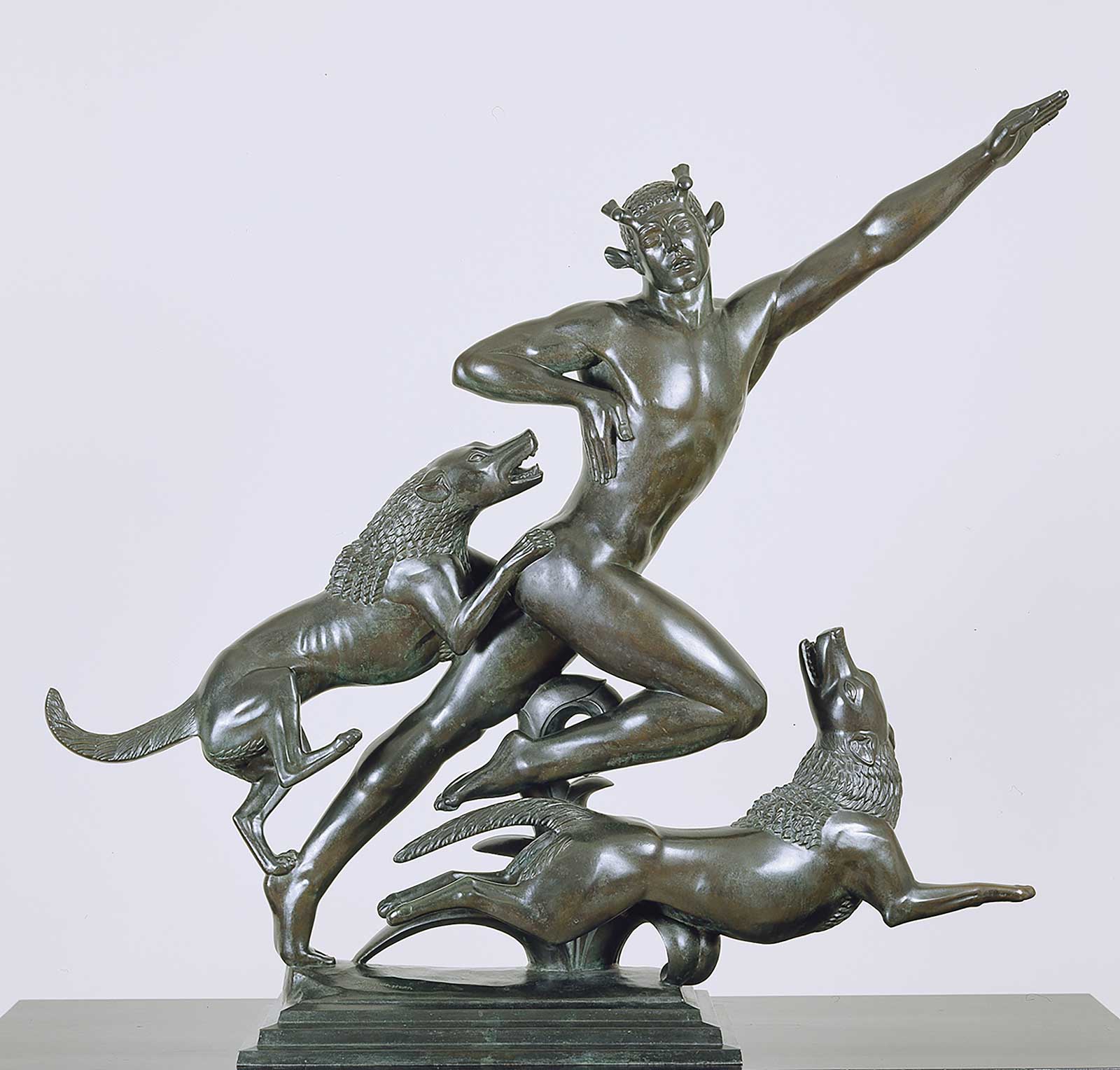 Paul Manship (1885-1966), Actaeon, cast 1925 (one of a pair). Bronze on marble base. Addison Gallery of American Art, Phillips Academy, Andover, MA. Gift of anonymous donor. © Estate of Paul Manship.
Moving to the “Modernizing Mythology” category, visitors to the show will find some of Manship’s most recognized sculptures that often have allegorical themes or tell stories of Roman or Greek mythology. “From the Wadsworth collection is Flight of Night, an allegorical depiction of Diana. She has this beautifully silhouetted form and she’s positioned about her attribute, the moon. That sense of motion and that beautiful, wisping drapery is just one example of how the figure from ancient times comes to life and looks like she’s about to take flight,” says Monroe.
Also in this section are some of the architectural moments from Manship’s career. Included is his The Four Elements series that was commissioned by the AT&T Building in New York City. Measuring 6-feet wide each, the four panels in the series show the grandeur at which Manship worked for some of his commissions and monumental bronzes. They also include a combination of styles highlighting his interests from his travels—Greek art, ancient art, as well as Indian and Asian art. One of the major sources of inspiration was the Tower of the Winds in Athens, which has carved horizontal reliefs with a direction of the wind depicted in each.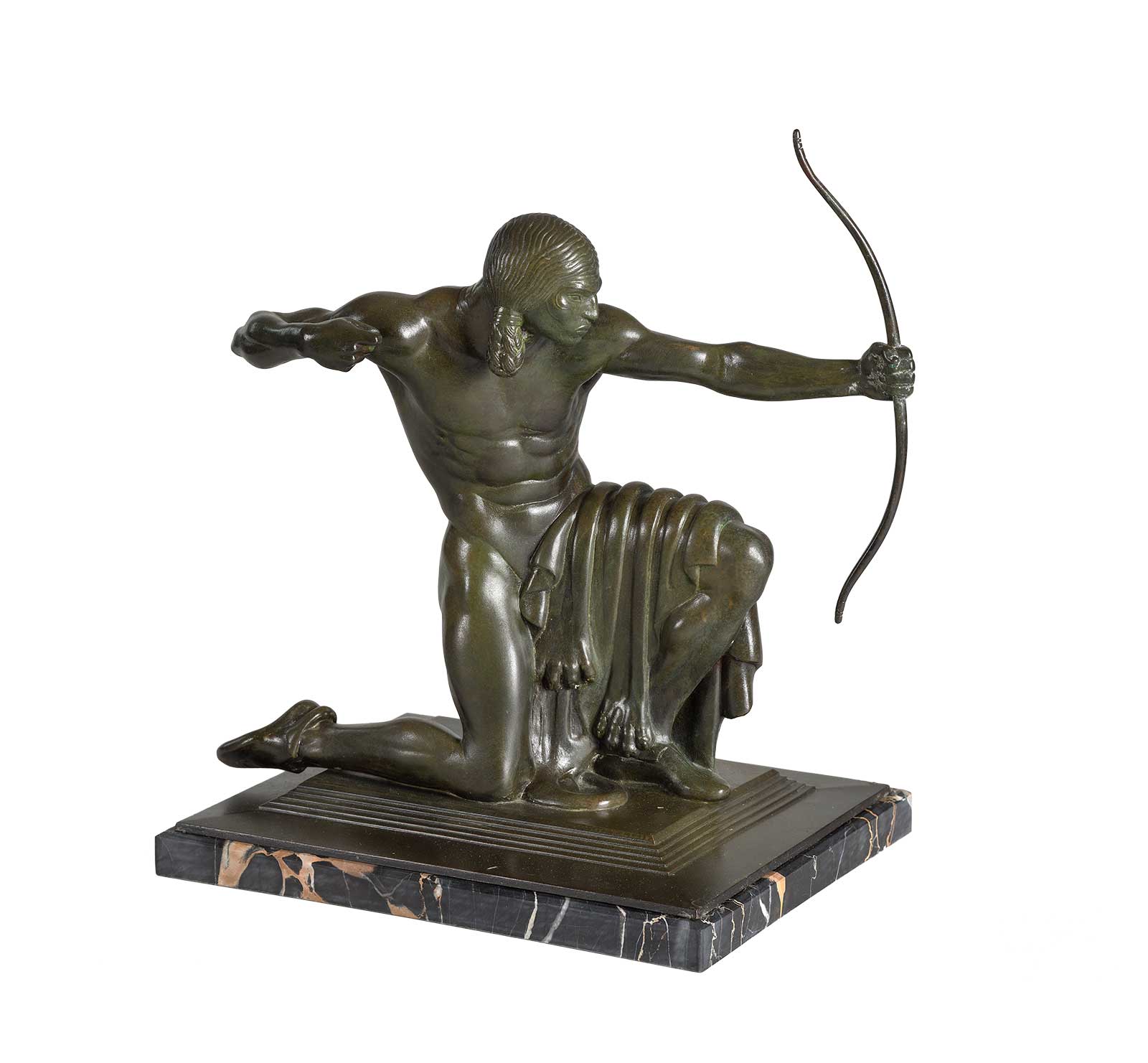 Paul Manship (1885-1966), Kneeling Indian Warrior, 1914. Bronze, black-brown patina. Wadsworth Atheneum Museum of Art. Bequest of Honora C. Robertson © Estate of Paul Manship.
“What’s fascinating is [Manship’s] reliefs were for the façade of a building and he had some freedom in determining the subject matter,” Monroe says. “He does these beautiful allegorical depictions of fire, wind, earth and water that have partial gilds on them that lend an art deco glitziness. There is also this wonderful crossover of artist, sculptor and architectural designer in this moment in the later 1910s and ’20s.”
Closing out the exhibition is the segment “Art for the Public,” which highlights some of his monumental works. “It’s the end moment, the modern moment, of the show. It’s the 1930s when Manship receives the commissions for Rockefeller and for the Bronx Zoo gates,” Monroe shares. Also included are his large-scale bronzes that he has continued, such as the paired Diana and Actaeon. “These are paired together, where she is purposefully in line, but separate, from Actaeon. She’s released an arrow and his right arm is clutching his side and that’s where it’s pierced him,” Monroe describes. “We see this beautiful, powerful female, who is the heroin of the story. She caught him spying on her while bathing and her retaliation was to shoot him with an arrow and turn his dogs against him and transform him into a stag…they’re so energetic when displayed in the configuration.”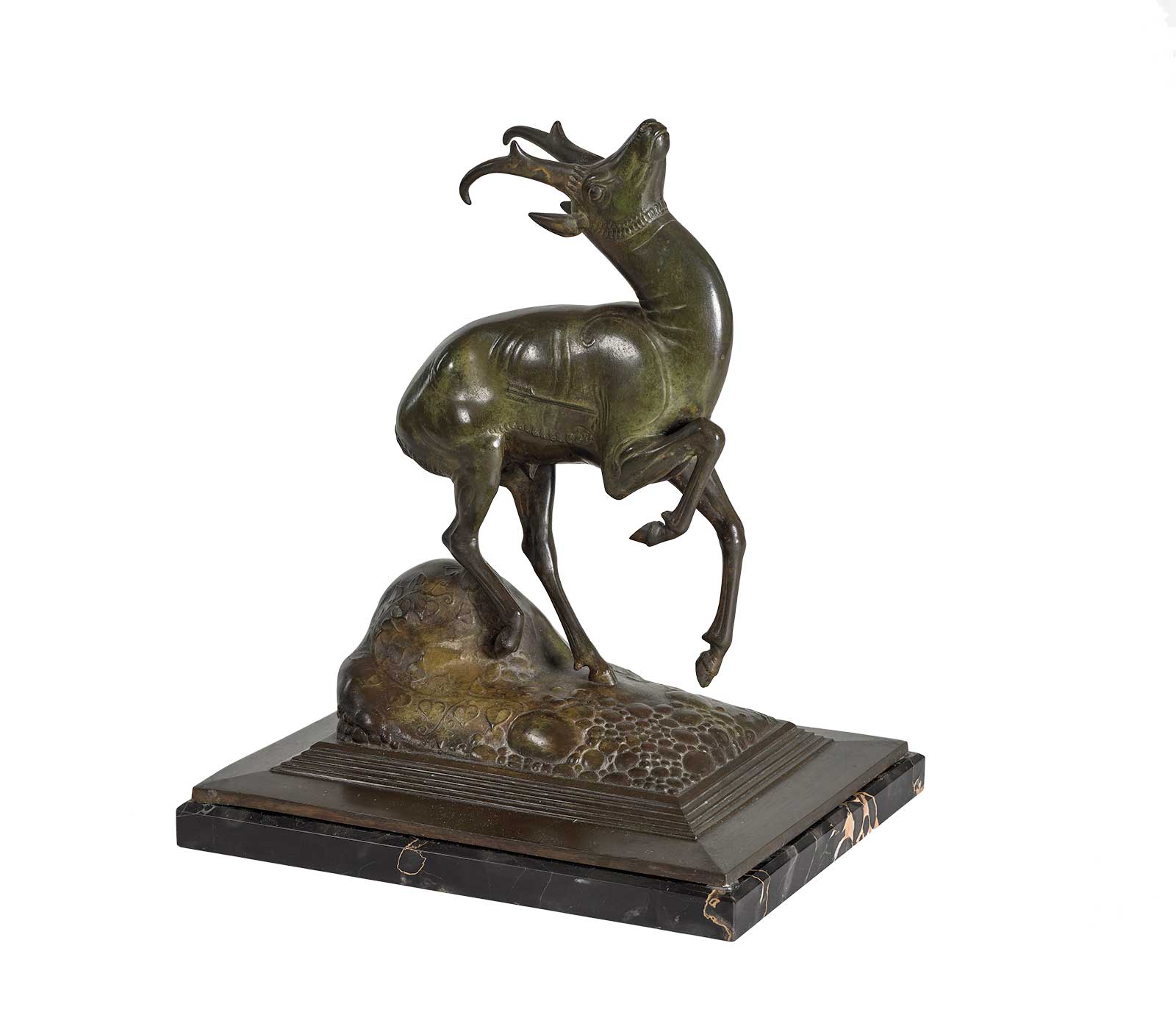 Paul Manship (1885-1966), Pronghorn Antelope, 1914. Bronze, black-brown patina. Wadsworth Atheneum Museum of Art. Purchased through the gift of Henry and Walter Keney and the Krieble Family Fund for American Art. © Estate of Paul Manship.
There also will be a virtual component to the exhibition available on the Wadsworth website that includes archival images of Manship during his travels, slideshows, letters he wrote abroad and more. “Manship is someone we are looking at who worked about 100 years ago. It might seem like a completely different time, but the more I spend time getting to know his process and artwork, the more I see connections to present day,” Monroe says, adding, “We’re in a different mode where you can’t only just retell a story of art history. You want to connect it to today’s world and language.” —
Powered by Froala Editor