Part of the joy of art is that it’s not predictable. The artists, the markets, the -isms, the ideas—it all ebbs and flows, undulating through the world in a chaotic pattern that defies explanation. This occasionally produces magic. But there can also be cruelty in that unpredictability.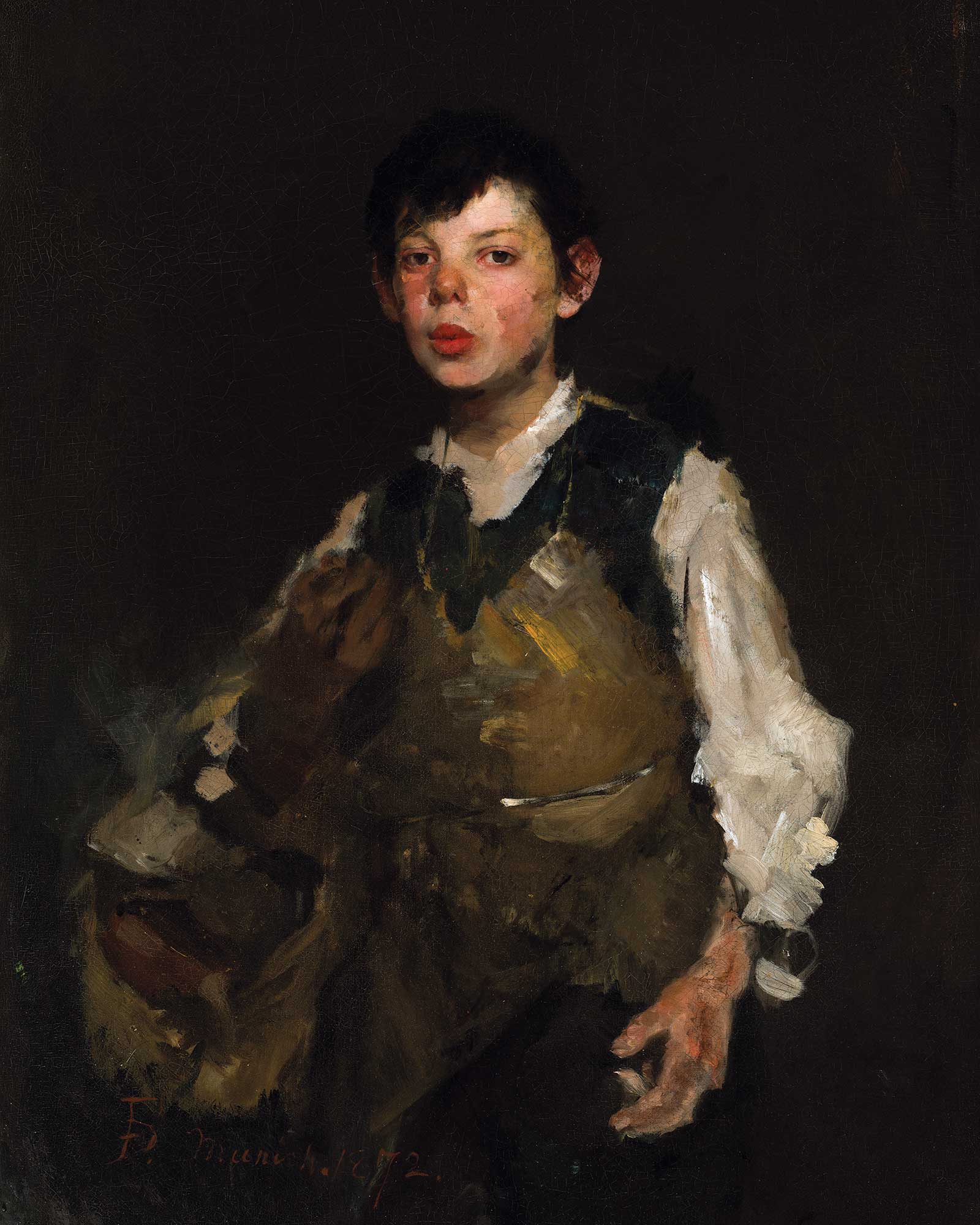 Frank Duveneck (1848-1919), The Whistling Boy (detail), 1872. Oil on canvas, 277⁄8 x 211⁄8 in. Cincinnati Art Museum. Gift of the Artist, 1904.196.
“Writing in 1969, the art historian Mahonri Sharp Young declared that Frank Duveneck’s paintings ‘stole the show’ when they were on view in the groundbreaking exhibition The Triumph of Realism,” author and curator Barbara Dayer Gallati notes in the introduction to the catalog for Frank Duveneck: American Master. “After pointing out Duveneck’s rise to international fame during his lifetime, Young continued, ‘When he died in 1919 he was worshipped locally and completely forgotten everywhere else.’”
Revered in his day, collected early by museums, friends with some of the top American artists, a world traveler, a teacher with adoring students—Duveneck was positioned to be part of the fabric of American art for decades to come. And yet it never happened.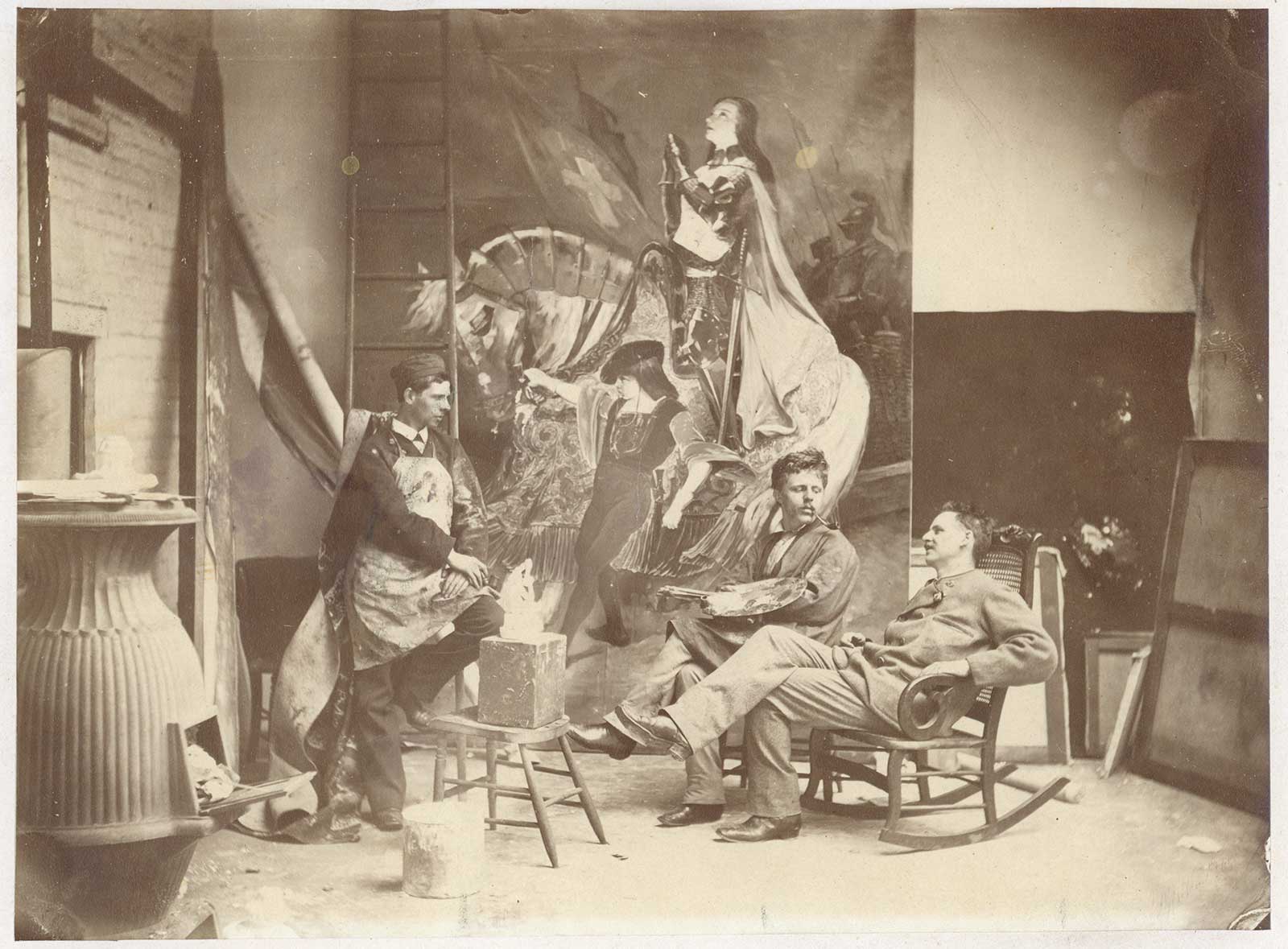 Frank Dengler, Frank Duveneck and Henry Farny in the studio, Cincinnati, c. 1874-75. Photograph, 6 x 8 in. Frank Duveneck Collection, Mary R. Schiff Library & Archives, Cincinnati Art Museum.
“Duveneck was not alone in this circumstance,” Gallati continues. “Many of his contemporaries had suffered similar neglect, among them John Singer Sargent and William Merritt Chase, whose reputations have since been resuscitated in academia and on the art market. Solid efforts have also been made to reinstate Duveneck’s art in the canon of American art historical studies…” Gallati goes on to name several important publications that attempted to place Duveneck higher up in the hierarchy of American art, with modest results. “Since then, however, Duveneck’s art has remained at the margins of art historical inquiry; not absent, but treated almost as if it were a given that needs little further exploration.”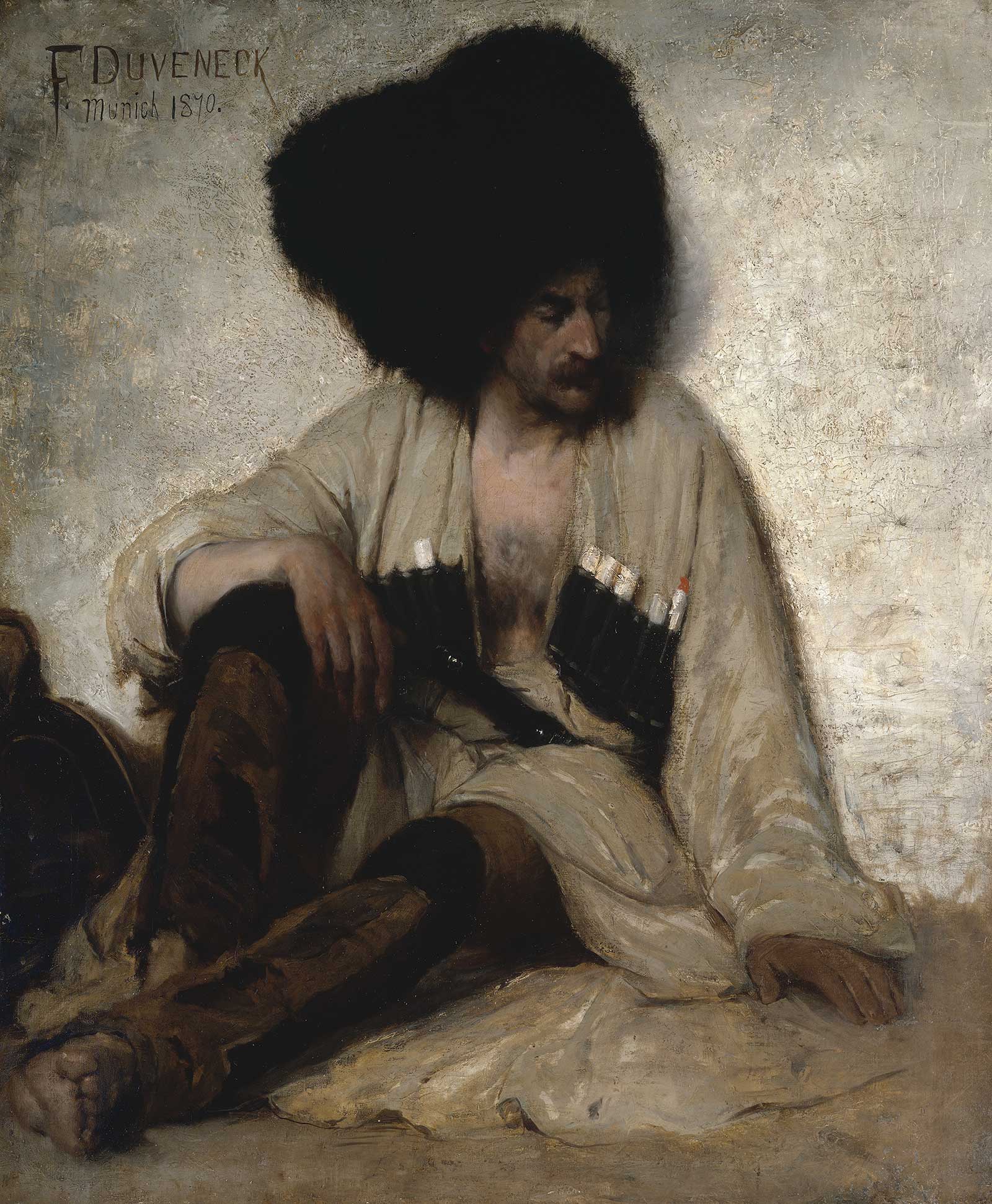 Frank Duveneck (1848-1919), A Circassian, 1870. Oil on canvas, 50½ x 41½ in. Museum of Fine Arts, Boston. Gift of Miss Alice Hooper, 76.296. Photograph © 2020 Museum of Fine Arts, Boston.
With Frank Duveneck: American Master, the stunning new exhibition opening December 18 at Ohio’s Cincinnati Art Museum, the painter will get another nudge out of the margins. And in some cases, less nudge and more shove.
“This exhibition is very important for reinstating him where he belongs,” says Julie Aronson, curator of American paintings, sculpture and drawings at the Cincinnati Art Museum. “Historians of American art are very aware of his importance, but in the general scheme of things, including with the general public, he is not known. He was one of the great teachers of American painters—John Henry Twachtman, Robert Blum, Kenyon Cox, Joseph DeCamp—and yet he tends to get forgotten.”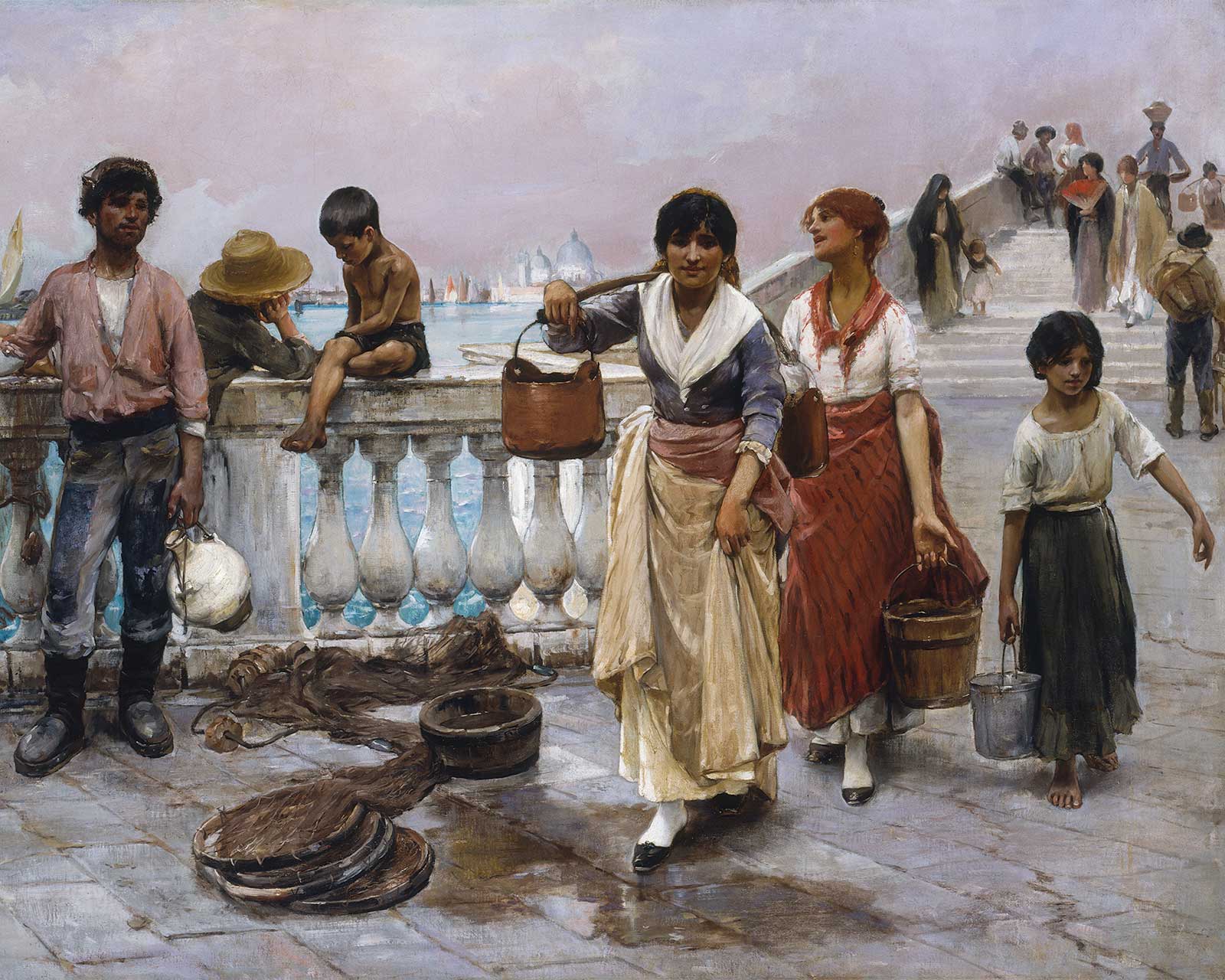 Frank Duveneck (1848-1919), Water Carriers, Venice (detail), 1884. Oil on canvas, 48 3⁄8 x 73 1⁄8 in. Smithsonian American Art Museum; Bequest of Reverend F. Ward Denys, 1943.11.1.
The exhibition’s fascinating catalog, in which Aronson writes the first chapter, pins some of this on Duveneck’s rapid ascent in the art world. Born Frank Decker in 1848 in Covington, Kentucky—the artist would be given his step-father’s last name while still a toddler—Duveneck would start painting fully realized works at 12 years old. By 14 he was an artist apprentice in Covington. By 22 he was in Munich and excelling by every measure. Within a year he was in the advanced painting class. Within another year he had painted The Whistling Boy, his first and most famous masterpiece. When he finally returns to the United States, artists from across the Ohio River in Cincinnati threw him a welcome reception. He was only 25 years old.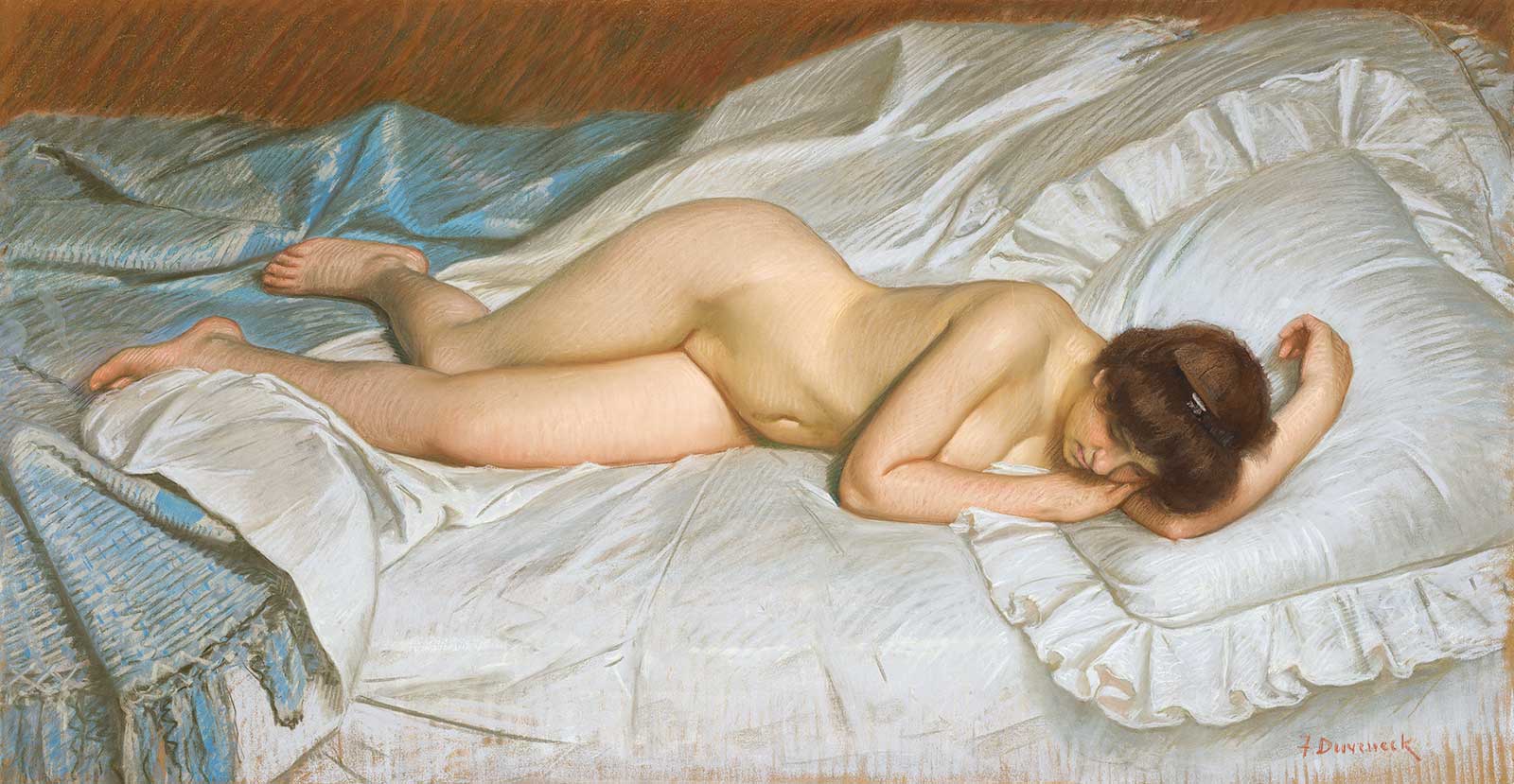 Frank Duveneck (1848-1919), Siesta, ca. 1900. Pastel on primed canvas, 34 1⁄16 x 64 9⁄16 in. Cincinnati Art Museum. Gift of Theodore M. Foucar, 1919.457.
Duveneck would eventually return to Munich, and that period in his studio and classroom is the most celebrated of his career. The Munich work is masterful, with its unflinching gaze on real people and black paint that is slathered around them—“Juiciness is the only word which will adequately express the result of his brush,” wrote painter Eugen Neuhaus in 1915. It was that juiciness and “painterly realism” which set him apart, but it was also the aspect of his work that positioned him furthest from whatever the next big movement would be.
“For Duveneck, who painted both impressionism and modernism, many of his finest works were from this Munich period. They had an Old Master feeling to them. While someone like William Merritt Chase would go on to become a full-blown impressionist, Duveneck evolved in a different way. He never fully embraced impressionism until late in life. So, because of the way we construct the history of American painting, that makes him look old fashioned even though he was at the forefront of things very early in his career,” says Aronson. “And he truly was doing some very exciting things. His Italian period has some beautiful, beautiful paintings, and he did pastel works late in life, and etchings. He was very experimental. And you see that throughout his career.”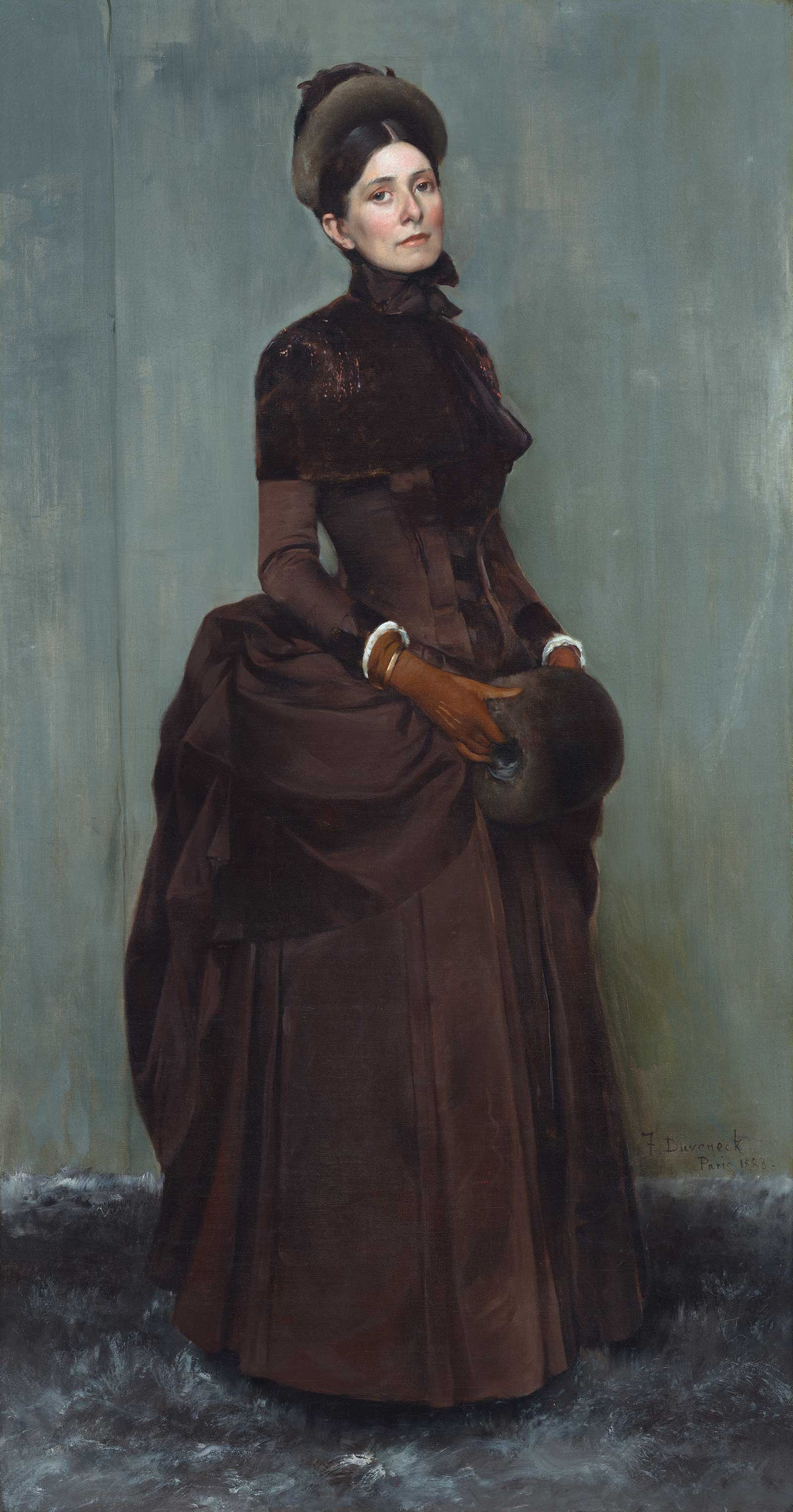 Frank Duveneck (1848-1919), Elizabeth Boott Duveneck, 1888. Oil on canvas, 65 1⁄8 x 34¾ in. Cincinnati Art Museum. Gift of the Artist, 1915.78.
The artist, who had achieved success early and who had frequently pushed his work in exciting new places, suddenly didn’t have a box to fit in anymore. It’s easy to see how he could get forgotten within the shuffling of history. At his death, though, the artists who sung his praise were passionate about his work. Robert Henri was quoted gushing about the artist and his accomplishments: “Duveneck is a great master; no student of painting if he were awake could go through that gallery and not be inspired by the great order of expression…and also not be inspired to develop for himself a technique of corresponding dignity. He is an extremely sensitive painter, a great draughtsman and every stroke of his brush manifests a consciousness of life, an intense conception of nature.” Sargent would tell a London dinner party, “After all’s said, Frank Duveneck is the greatest talent of the brush of this generation.”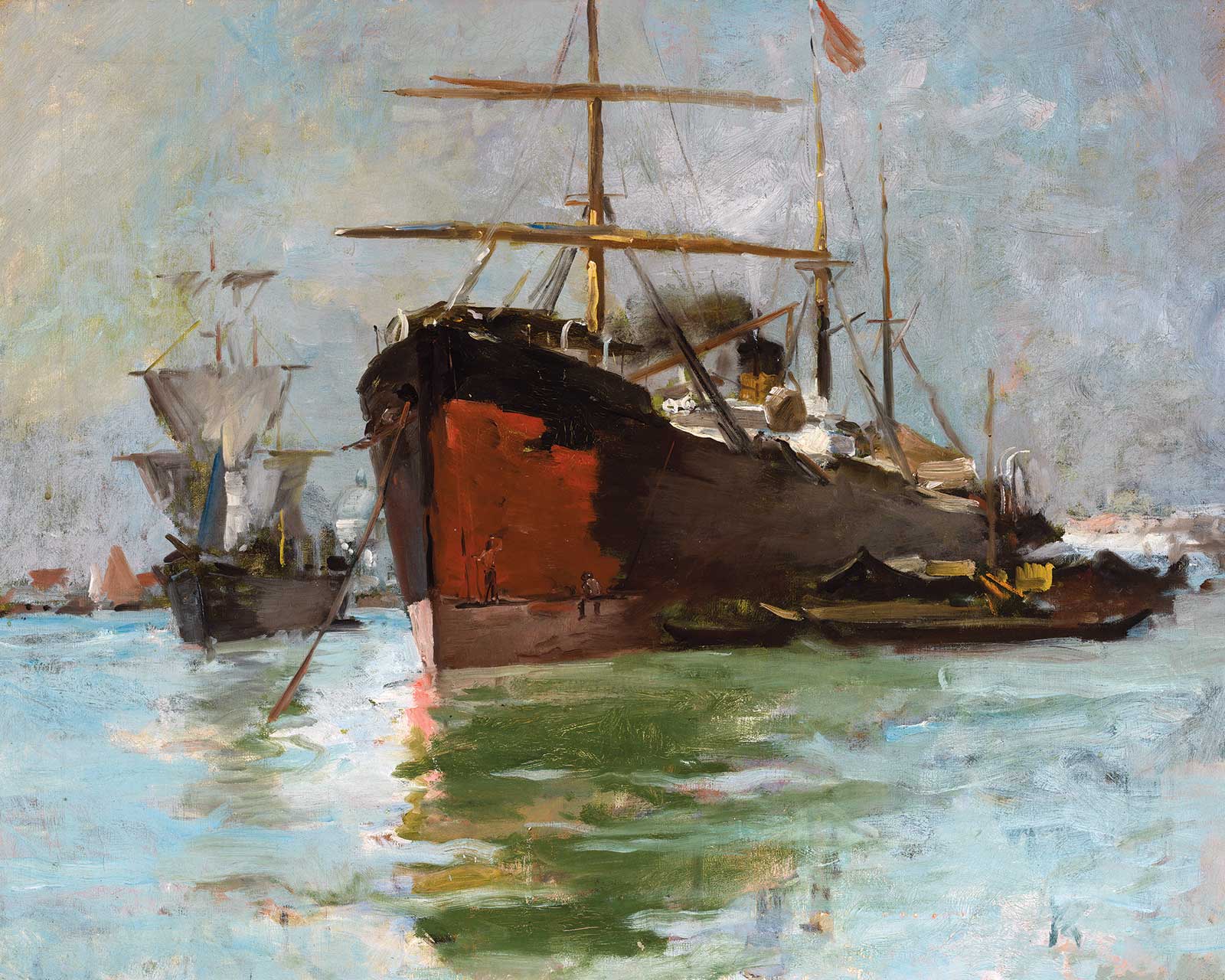 Frank Duveneck (1848-1919), At Anchor, Venice (detail), 1884. Oil on canvas, 24 1⁄16 x 30 in. Cincinnati Art Museum. Gift of the Artist, 1915.113.
Rising to the praise left by Henri and Sargent is Frank Duveneck: American Master, which will feature 90 pieces from the collection of the Cincinnati Art Museum and 35 works on loan. The Ohio museum is also the perfect venue for a Duveneck revival since its current holdings include 120 oil paintings, two sculptures, 79 prints, 52 drawings and two sketchbooks. Duveneck even contributed directly to the museum beginning in 1895 and then throughout his life. Prior to his death he donated his archives, ensuring Cincinnati, just a stone’s throw away from his Kentucky hometown, would be the keeper of his legacy.
Major pieces in the show include The Whistling Boy, his first masterpiece, and A Circassian, painted two years prior, in 1870, that is just as wonderful with its ominous light and brooding subject. Both pieces have beautifully dark paint that surround the figures. It’s this paint that would make the pieces look old fashioned by the time impressionism comes around, but it’s that dark paint that gives the pieces an almost contemporary edge today. Both paintings complement some of his more formal portraits, including Miss Mollie Duveneck, his half-sister, and Elizabeth Boott Duveneck, a full-length portrait of his beloved wife who died suddenly from pneumonia in 1888, the year this picture was completed. The exhibition will also display the plaster cast of Memorial to Elizabeth Boott Duveneck, which the artist created after her passing—it was his first sculpture. After seeing the memorial, sculptor Daniel Chester French wrote to Duveneck of his “deep admiration and respect for it…I have seldom been so moved and impressed by a work of art.”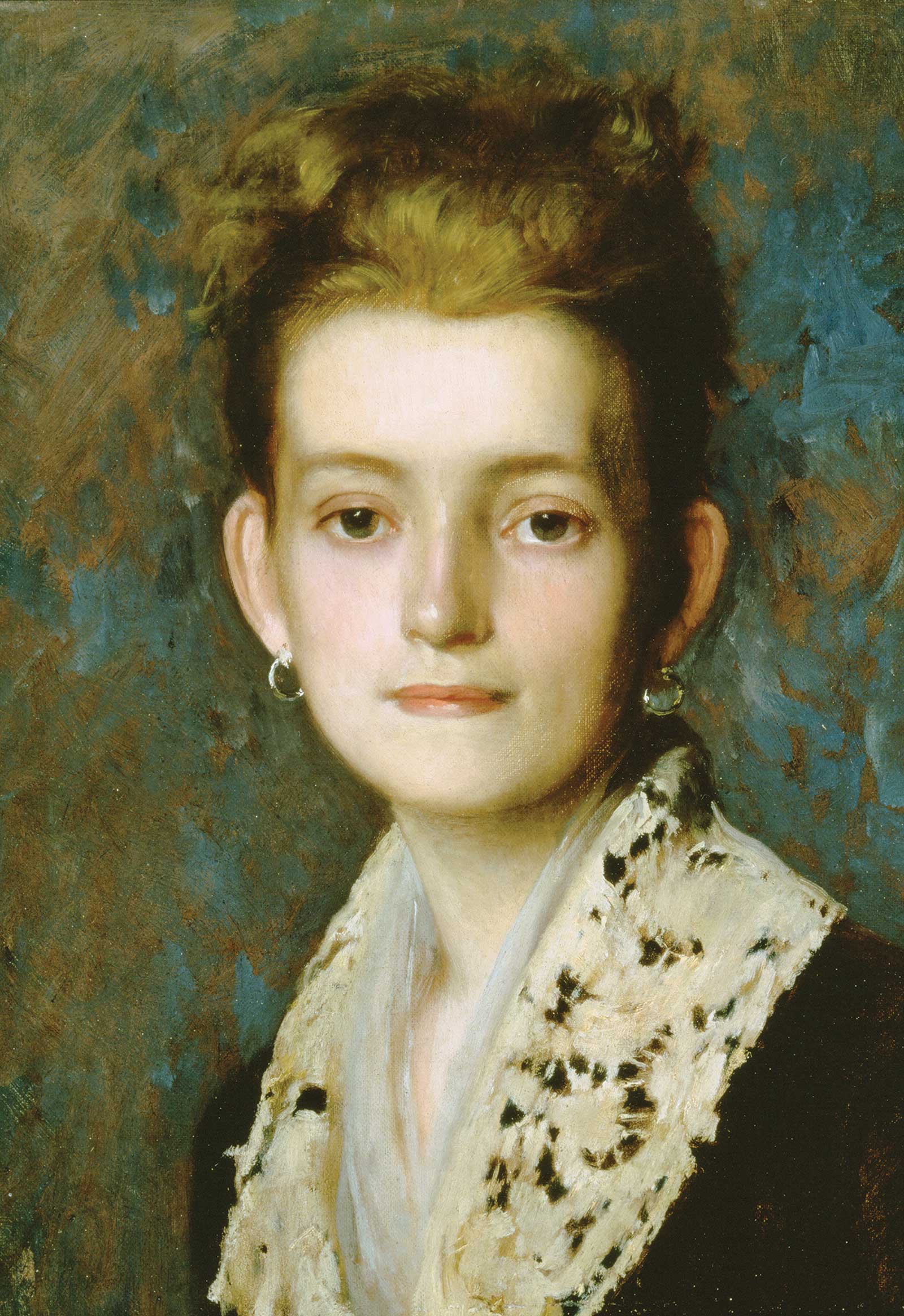 Frank Duveneck (1848-1919), Miss Mollie Duveneck, ca. 1888-90. Oil on canvas, 17 x 12 1⁄8 in. Collection of the Akron Art Museum. Bequest of Edwin C. Shaw, 1955.26.
Also on view will be the 1876 oil The Turkish Page, showing a young boy sitting with a white parrot perched on a brass bowl filled with fruit. Duveneck worked side by side with Chase while completing his work, and Chase’s version of the same scene, The Turkish Page (Unexpected Instrusion), will also be on view. As if that wasn’t enough, the museum descends one more level of meta-context with the inclusion of Chase’s painting Duveneck Painting “The Turkish Page.” All three works are part of the museum’s collection.
Another interesting pairing is Siesta and Siesta, Number 2. Both show a young girl lying in a field in various stages of relaxation. In Siesta, she peacefully sleeps next to a sickle and an overstuffed basket, suggesting a break from her workday. In the second painting, the subject gazes almost passionately at the viewer amid brighter colors and more pronounced light. (A third Siesta, unrelated to the other two, shows a magnificent nude completed in pastel.) Other works from around the same period include the landscape Villa Castellani, the harbor scene At Anchor, Venice, and several of his gorgeous Venice “street” scenes—notably Water Carriers, Venice and Canal Scene with Washerwomen, Venice—showing crowds of figures amid the Floating City’s stone plazas, bridges and waterways.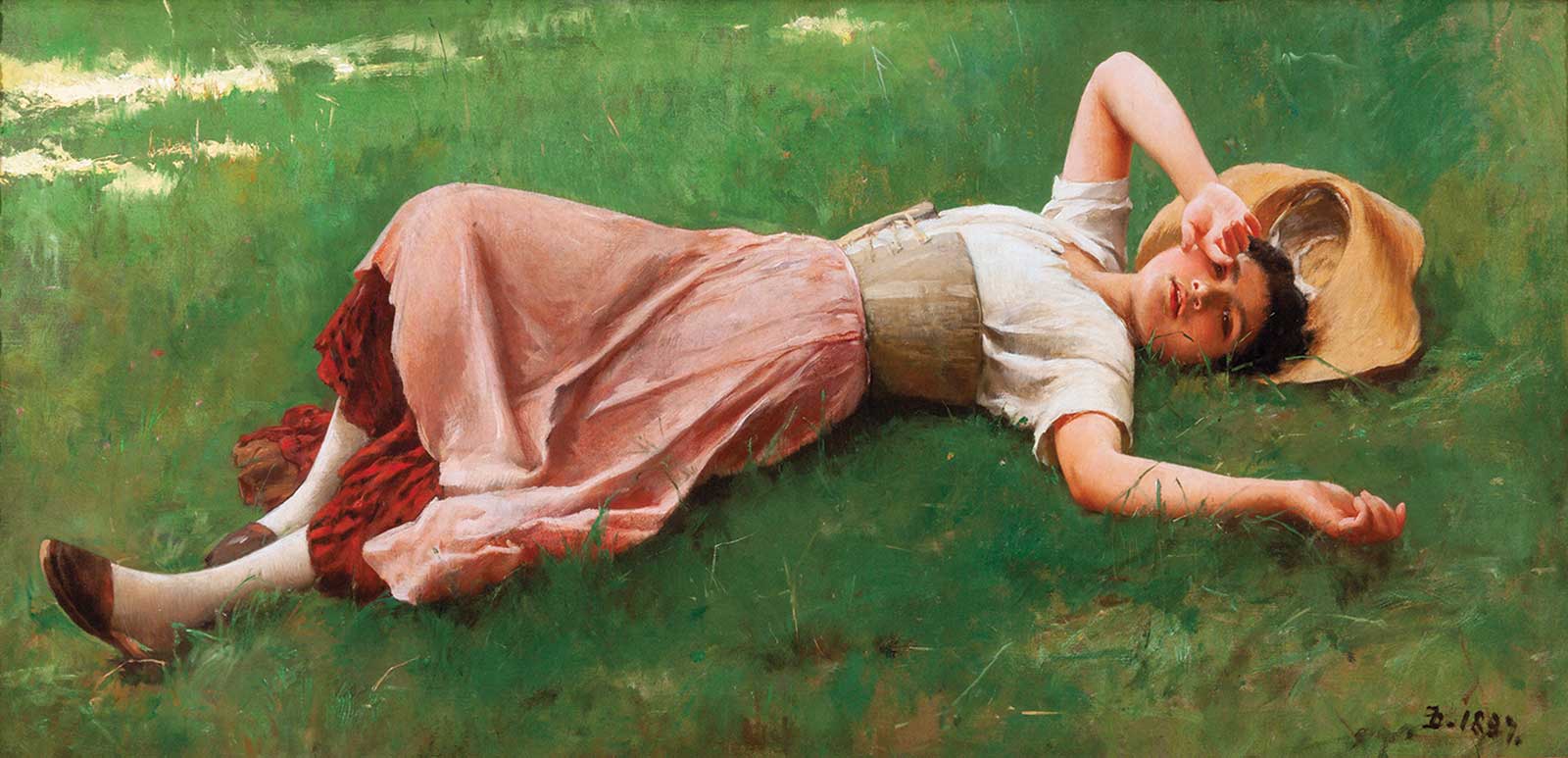 Frank Duveneck (1848-1919), Siesta, Number 2, 1887. Oil on canvas, 20 x 42 in. Collection of Martha and Carl H. Lindner III. Photograph provided by Tony Walsh.
Visitors might surprise themselves by recognizing more works than they anticipated, whether it’s the smirking menace of The Cavalier or The Cobbler’s Apprentice, which is a spiritual cousin to Whistling Boy. There are also still life pieces, drawings, etchings, nude figures, ephemera and photography, including images of the artist posing with some of his students, the Duveneck Boys.
“Given COVID, I was surprised we received every loan we asked for. Of course, we also already have a lot from Duveneck, but the loans really helped shape this into an exciting exhibition. Our own collection is so deep that
I was very judicious in what we chose to bring up from our collection and borrow,” says Aronson. “Now that it’s all together, though, I think it represents a remarkable story of one of the great American artists.”—
Powered by Froala Editor