
Gustave Baumann (1881-1971) moved to Santa Fe, New Mexico, in 1918 and spent the rest of his life there, producing colorful woodcut prints of the Southwest from intimate scenes of pueblo life to the vistas of the Grand Canyon.
The Cleveland Museum of Art will present Gustave Baumann: Colorful Cuts from December 20 through May 2, 2021, featuring prints from throughout his career. The exhibition will also show “how Baumann worked. He began by making tempera drawings in front of the subject. The outlines of the main forms were transferred to woodblocks, one for each color. The museum owns a set of blocks for his 1926 print Summer Clouds and the proofs, allowing visitors to understand how he printed layers of color to achieve rich effects.”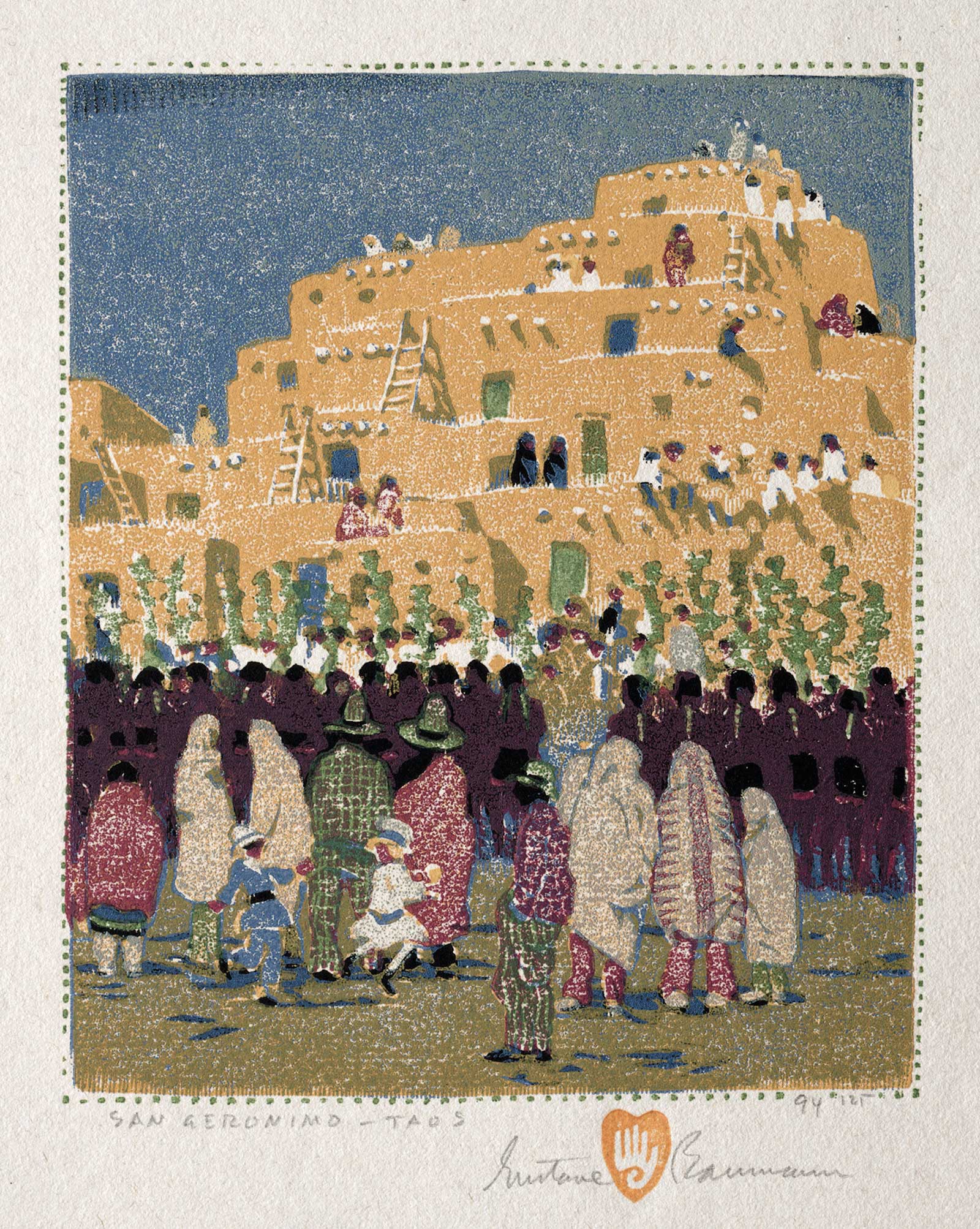 Gustave Baumann (1881-1971), San Geronimo Taos, 1924, printed after 1932. Color woodcut, 7.1 x 5.9 in. The Cleveland Museum of Art, Gift of Ann Baumann, 2005.437. © Ann Baumann Trust.
Baumann loved the materials of his art and espoused the hands-on ideals of the Arts and Crafts movement. He mixed his own inks, carved the blocks, and pulled the editions of, usually, 125 prints. Commenting on the blocks, he wrote, “There is something precious about a clean basswood plank properly seasoned. The gouge, sharpened to a hair’s edge, sinks in and comes out of the wood at just the right time.” He continued, “The charm of a color woodblock is usually a byproduct of good craftsmanship. It does not become apparent until the print is thoroughly dried and all the colors are amalgamated and set.”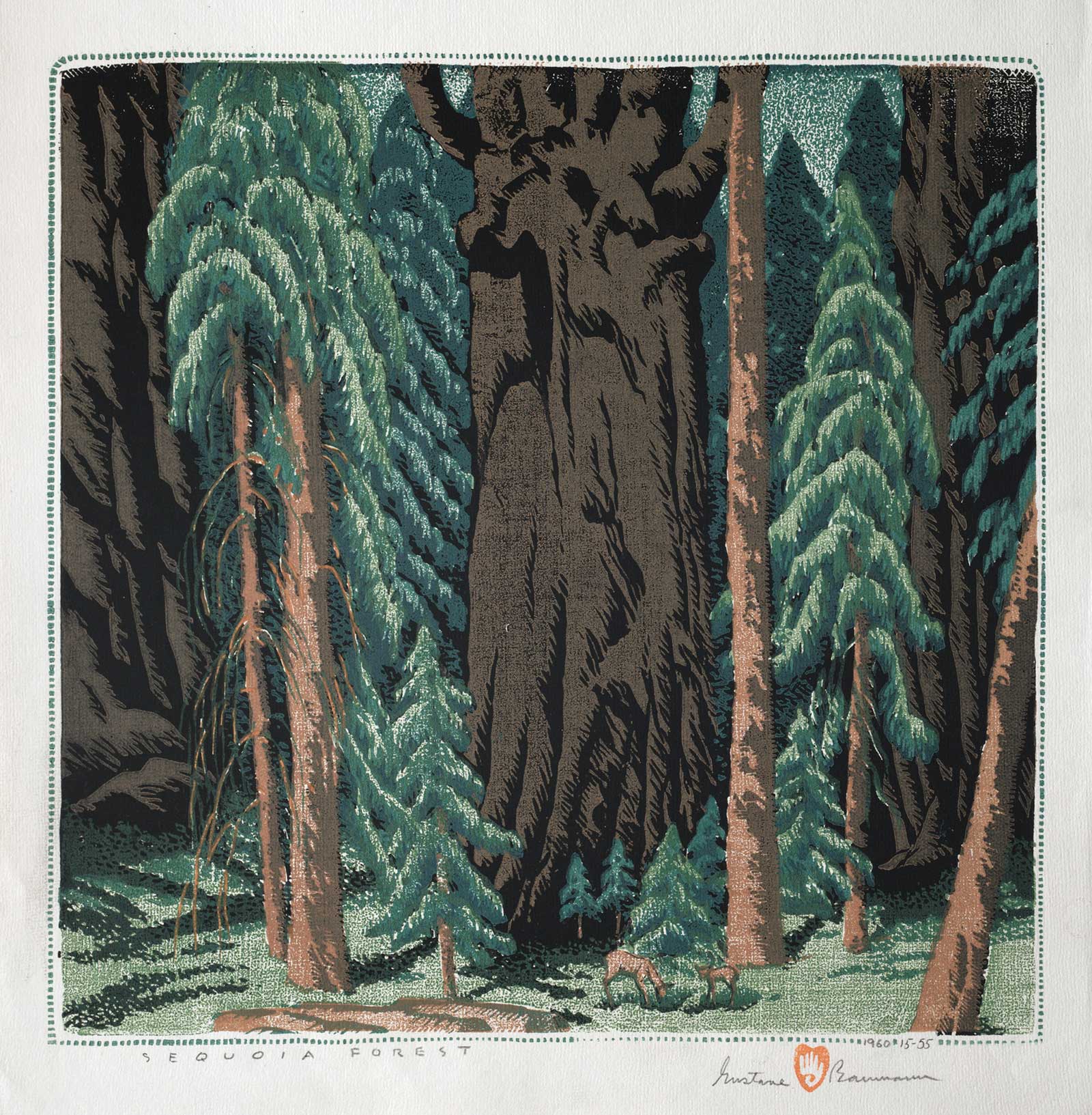 Gustave Baumann (1881-1971), Sequoia Forest, 1935, printed 1960. Color woodcut, 12.9 x 12.9 in. The Cleveland Museum of Art, Gift of Ann Baumann, 2005.439. © Ann Baumann Trust.
He often said, “What you put your hand to, put your heart behind.” When he signed his prints, he printed a small hand with a heart between his first and last name.
Baumann was born in Germany and came to the United States in 1891, settling in Chicago. He took classes in drawing and design at the Art Institute of Chicago while working at a commercial printer. He later returned to Germany to study at the Kunstgewerbeschule in Munich. He returned to the commercial world in Chicago but continued to work on his own unique prints.
Searching for subjects for his prints, he and his wife discovered Brown County, Indiana, in the summer of 1910. He fell in love with the bucolic setting and lived there for nearly six years. He flourished in Brown County and, in 1915, won the gold medal for a color woodcut exhibited at the Panama-Pacific International Exposition in San Francisco.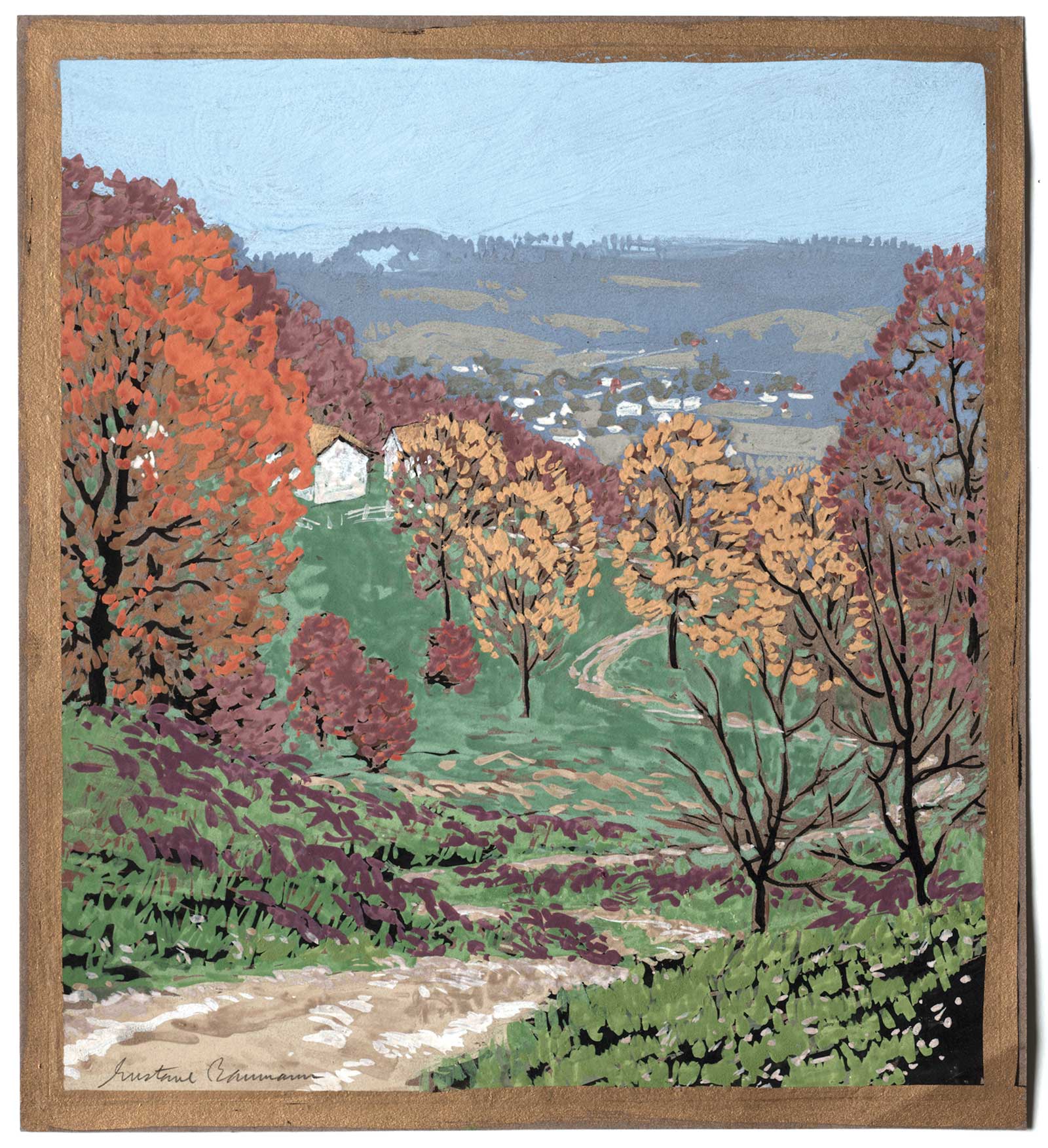 Gustave Baumann (1881-1971), Brown County, ca. 1915. Tempera on brown paper, 11 x 10 in. The Cleveland Museum of Art, Gift of Ann Baumann, 2005.456. © Ann Baumann Trust.
After a visit to Santa Fe and Taos he wrote that he had “learned too late that a palette and theories regarding color east of the Mississippi should all be tossed in the river as you cross the bridge. My summer’s work looked very sad indeed. I felt I wanted another try at this obstreperous material.” The museum notes, “Exhilarated by the state’s natural beauty, he settled in Santa Fe and over the next five decades produced complex color woodcuts that captured the area’s intense sunlight and arid atmosphere.”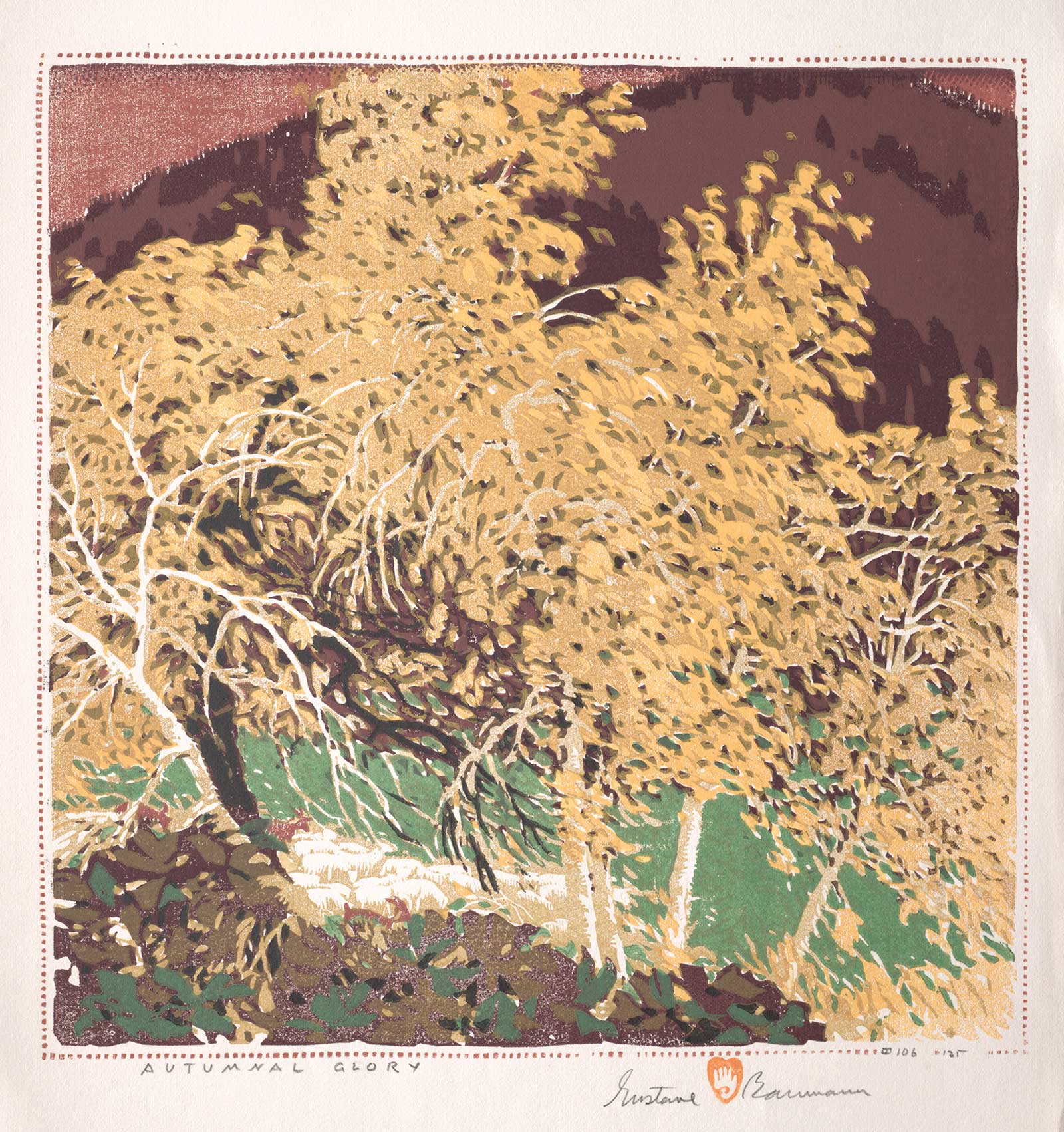 Gustave Baumann (1881-1971), Autumnal Glory, 1920, printed 1953. Color woodcut, 13.1 x 12.9 in. The Cleveland Museum of Art, Gift of Ann Baumann, 2005.407. © Ann Baumann Trust.
San Geronimo Taos depicts the feast day of Taos Pueblo. It is a complex composition with colorfully clad people in the foreground, a middle ground of people in shadow and the sunlit structure of the pueblo rising behind them.
From the arid desert of northern New Mexico he traveled to a Sequoia Forest producing a print in a cooler palette.
When he was living in Brown County, he carved the phrase, “Every morning I take off my hat to the beauty of the world” below the mantel in the home of his friend and fellow artist T.C. Steele. —
Powered by Froala Editor