Every day of the year in New Mexico the question is “red or green?” (chile). Across the country on Thanksgiving the question is “whole or jellied?” (cranberry sauce). I grew up in Plymouth County, Massachusetts, home to hundreds of cranberry bogs. I thought the little red fruit was so precious that I left an unartfully wrapped box of them for Santa Claus on Christmas Eve. He always took them, and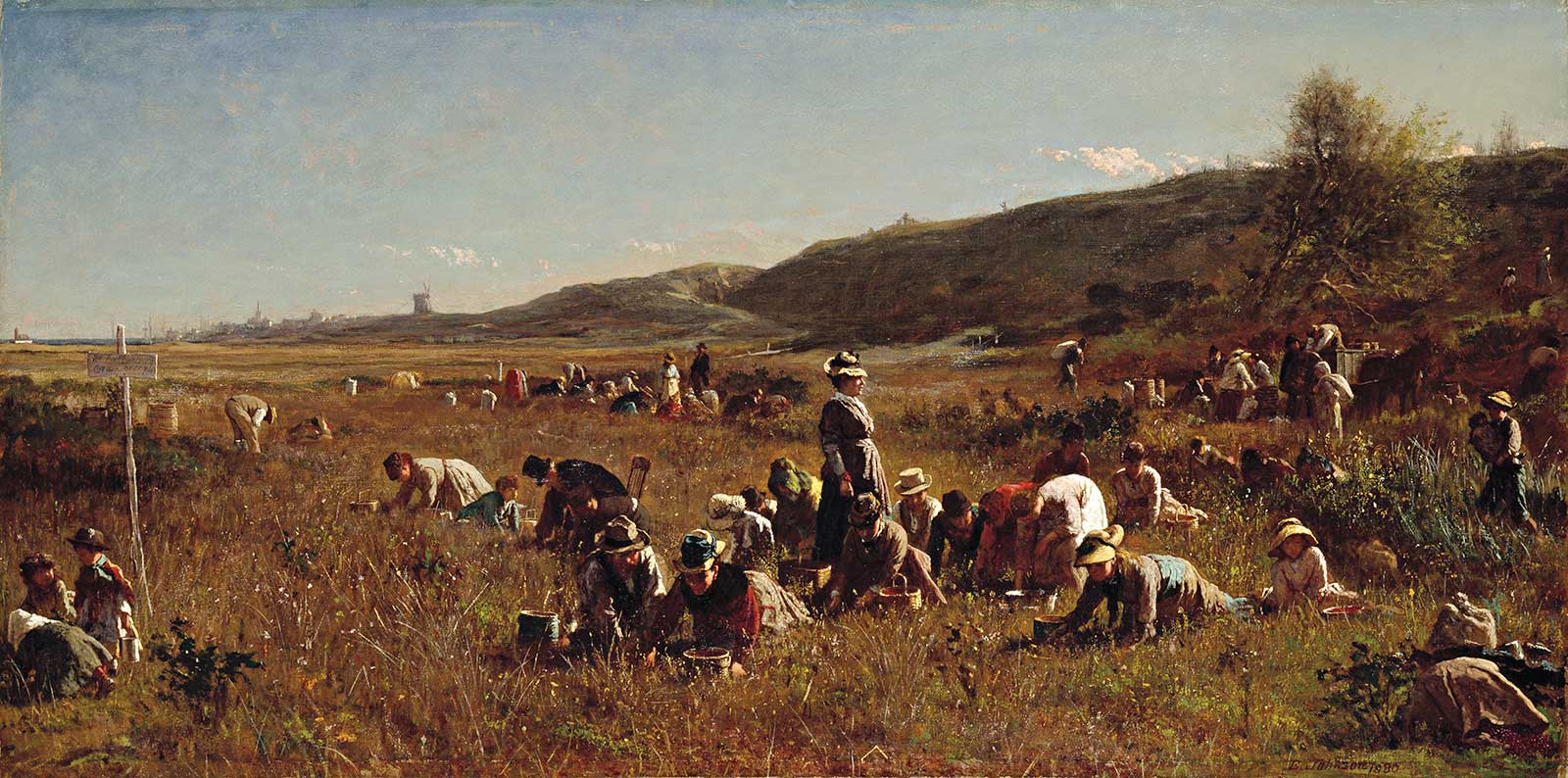 Eastman Johnson (1824-1906), The Cranberry Harvest, Island of Nantucket, 1880. Oil on canvas, 273⁄8 x 54½ in. 1972.002. Putnam Foundation, Timken Museum of Art, San Diego, CA.
I imagined Mrs. Claus making a wonderfully tart sauce or baking them in fresh muffins when he returned to the North Pole.
Cranberries are harvested from mid-September through early November either by flooding the bogs and letting the berries float to the surface of the water, or by dry harvesting them. Their reaching the harvesting stage during fall foliage season has attracted artists for many years. Wild cranberries were a staple for Native Americans. Whalers and other mariners used them to prevent scurvy. They, along with Concord grapes and blueberries, are among the only major fruits native to North America.
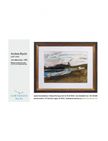
My parents were given a painting of a cranberry bog for a wedding present. The Old Bog, Duxbury, Mass, 1934, was painted by Samuel Warner (1871-1947). Warner was born in Scranton, Pennsylvania, graduated from the art, drawing and modeling department of the New England Conservatory of Music in Boston, and studied in New York and London where he was elected a Fellow of the Royal Society of Arts. He was later associated with Elbert Hubbard’s Roycroft arts and crafts community in East Aurora, New York, where he developed the graphic arts department. In about 1903 Warner moved to Plymouth County, Massachusetts, where he painted and developed art programs in the local schools. He painted a number of impressionist views of the cranberry bogs of the area.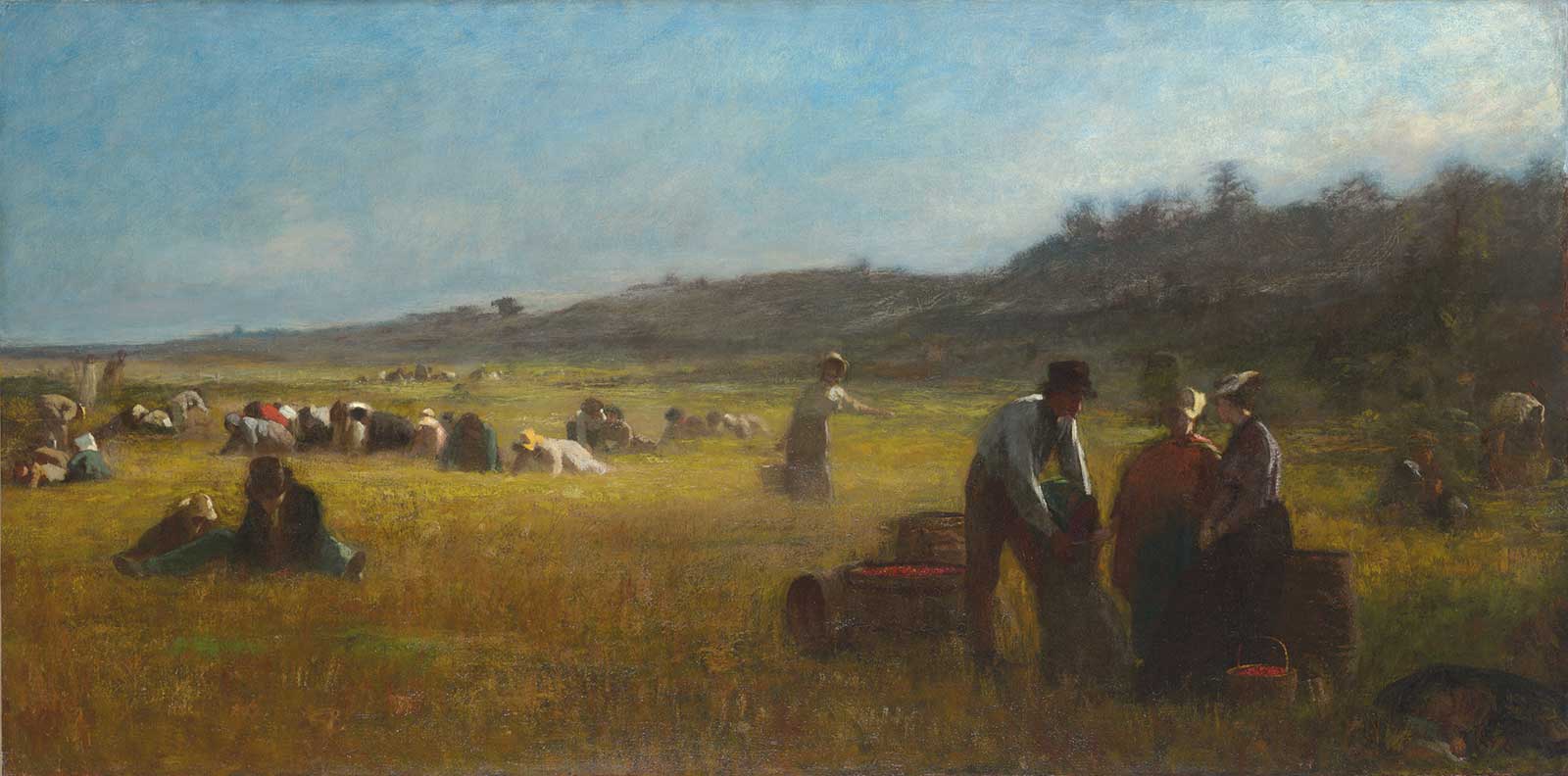 Eastman Johnson (1824-1906), Cranberry Pickers, ca. 1878-79. Oil on canvas, 27 x 541⁄8 in. Yale University Art Gallery, New Haven, CT. Bequest of Christian A. Zabriskie. 1970.56.1.
One of the best-known paintings of the 19th century is The Cranberry Harvest, Island of Nantucket, 1880, by Eastman Johnson (1824-1906). The Timken Museum of Art in San Diego, California, offers a description of the painting: “In 1870, after searching for aspects of American rural life to use as subjects for ambitious paintings, Johnson began to draw inspiration from Nantucket Island south of Cape Cod in Massachusetts. With this view of a cranberry harvest, he successfully realized his efforts to paint a celebration of New England outdoor life. The work also marks a significant achievement in the history of American art. Using an evocative, rather than descriptive, technique, Johnson lavishes attention on the landscape, from the dry grasses of the cranberry bog to the distant and accurate view of Nantucket’s spires and lighthouse. The principle focus of this scene washed by late afternoon light is the configuration of pickers, and their poses and gestures. The standing woman in the center who looks at a boy carrying an infant to her creates a narrative suggesting that the artist recorded the scene as he witnessed it.”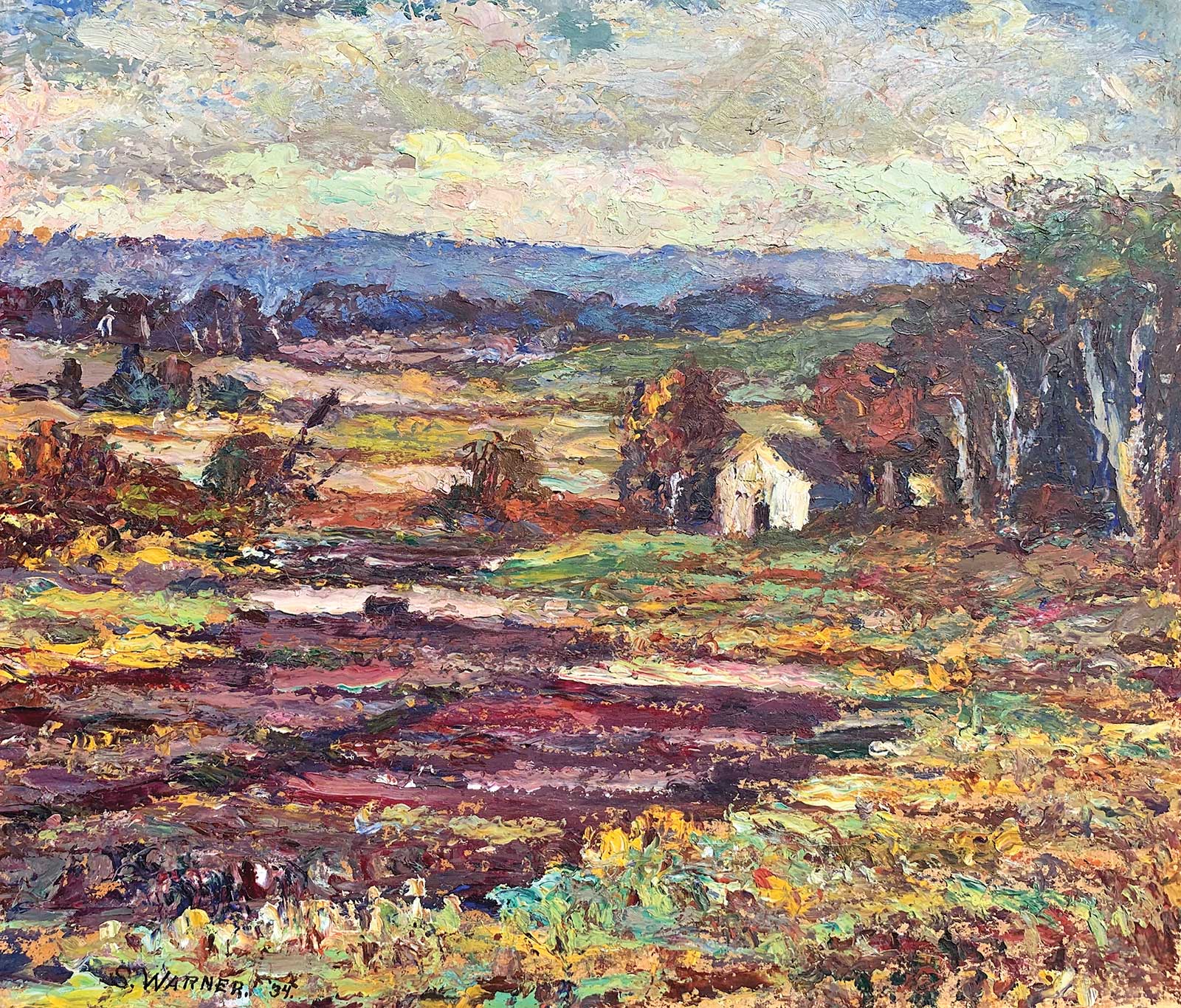 Samuel Warner (1872-1947), Old Bog, Duxbury, Mass., 1934. Oil on panel, 11½ x 13 in. Private Collection.
Johnson did more than 20 studies and other cranberry bog paintings on Nantucket. He wrote, “I was taken by my cranberry fit as soon as I arrived (some people have Rose fever yearly—I have cranberry fever) as they began picking down on the meadow a day or two after we arrived and I have done nothing else since I have been here, not a thing.”
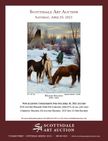
The museum acquired the painting from Vose Galleries in Boston, which describes it as “probably the most important American landscape we ever sold.” It had been rediscovered in Scotland in 1970 and shipped to the U.S. with a value of $250,000 written on the crate. The notation attracted the attention of thieves, but the crate and the painting were eventually found behind some machinery at Kennedy airport. It eventually made its way to the Boston gallery.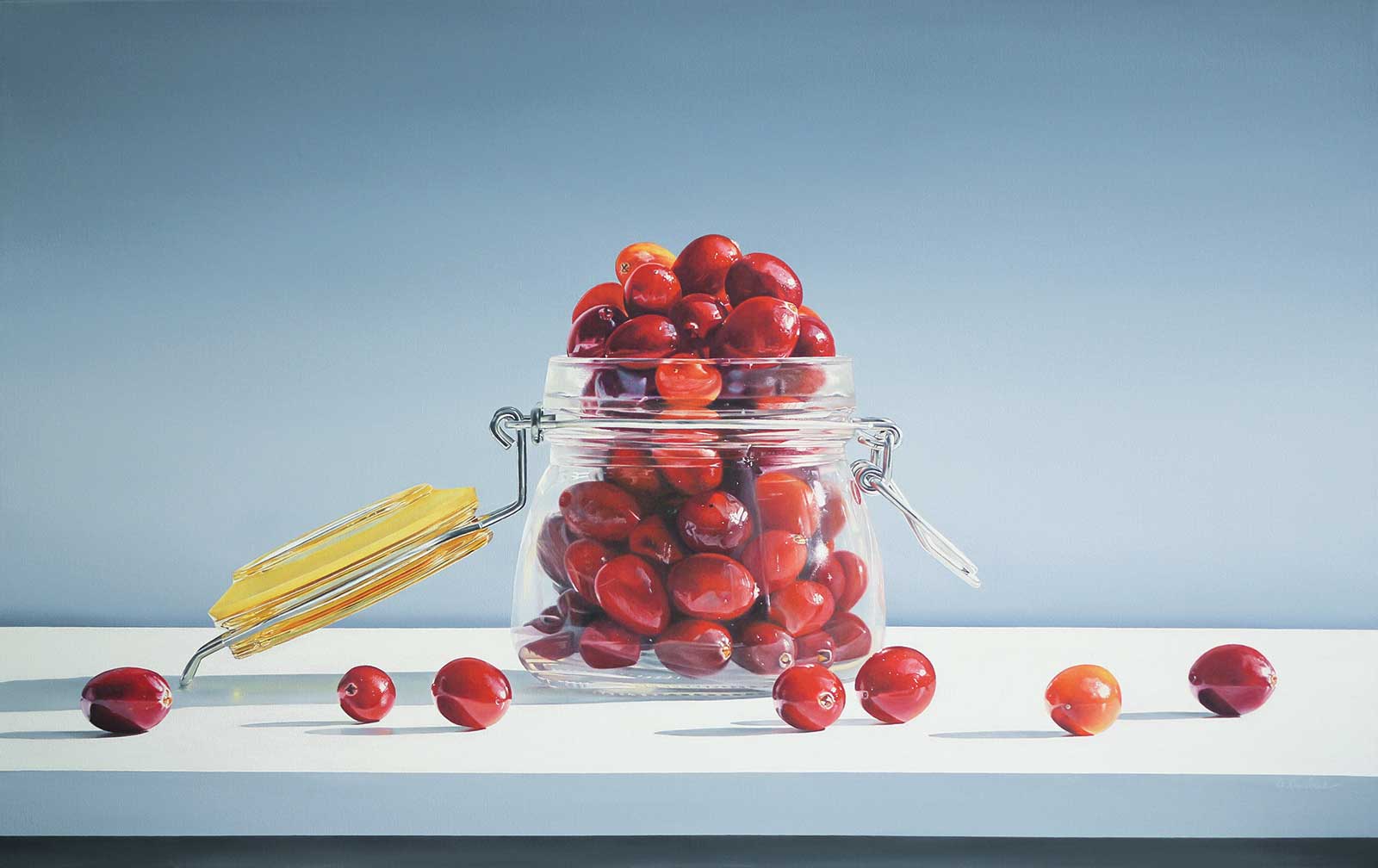 Alexandra Averbach, Cranberries. Oil on canvas, 24 x 38 in. Courtesy Gallery Henoch, New York, NY.
Robert C. Vose Jr. (1911-1998) recalled hearing of the sale to the Timken. “My wife, Ann, and I were at a delightful luncheon at a Fort Worth Country Club at the opening of a Bierstadt show when we got the happy news by phone from the gallery. Ann and I took seats with the painting in a 747 to LA (I think seven seats in all), lugged it into a motel, rented a station wagon and delivered it to the museum. I remember as we carried the box onto the plane a stewardess said, ‘You have to be kidding!’”
Yale University Art Gallery owns Cranberry Pickers, circa 1878 to 1879, a less complex painting, illustrating Johnson’s working out the relationship of figures in the field leading up to the over 40 figures in the Timken Museum painting.
Cranberry bogs continue to fascinate artists. Contemporary artist Alexandra Averbach celebrates the fruit itself in Cranberries. Born in Russia, she immigrated to the United States as a child. She says, “As I paint, the luminous petals of flowers or the round drupelets of a raspberry become a semi-hypnotizing pattern that is very calming and soothing. The minimalistic setup adds to these effects. I wish for my paintings to convey a sense of stillness, as if time is suspended within the painting, and hope the viewer experiences the same sense of tranquility in my work.” —
Powered by Froala Editor