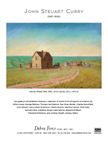
The discussions we are having today make me think of how the same issues were faced during America’s Great Depression. The reopening of the Whitney Museum and its exhibition Vida Americana: Mexican Muralists Remake American Art, 1925-1945 provides a context for art’s purpose in troubled times and made me wonder how the Mexican muralists, who were all revolutionary, helped America reimagine itself. To examine that question, I have put together an exhibition of American murals and paintings from the 1930s and 1940s for consideration.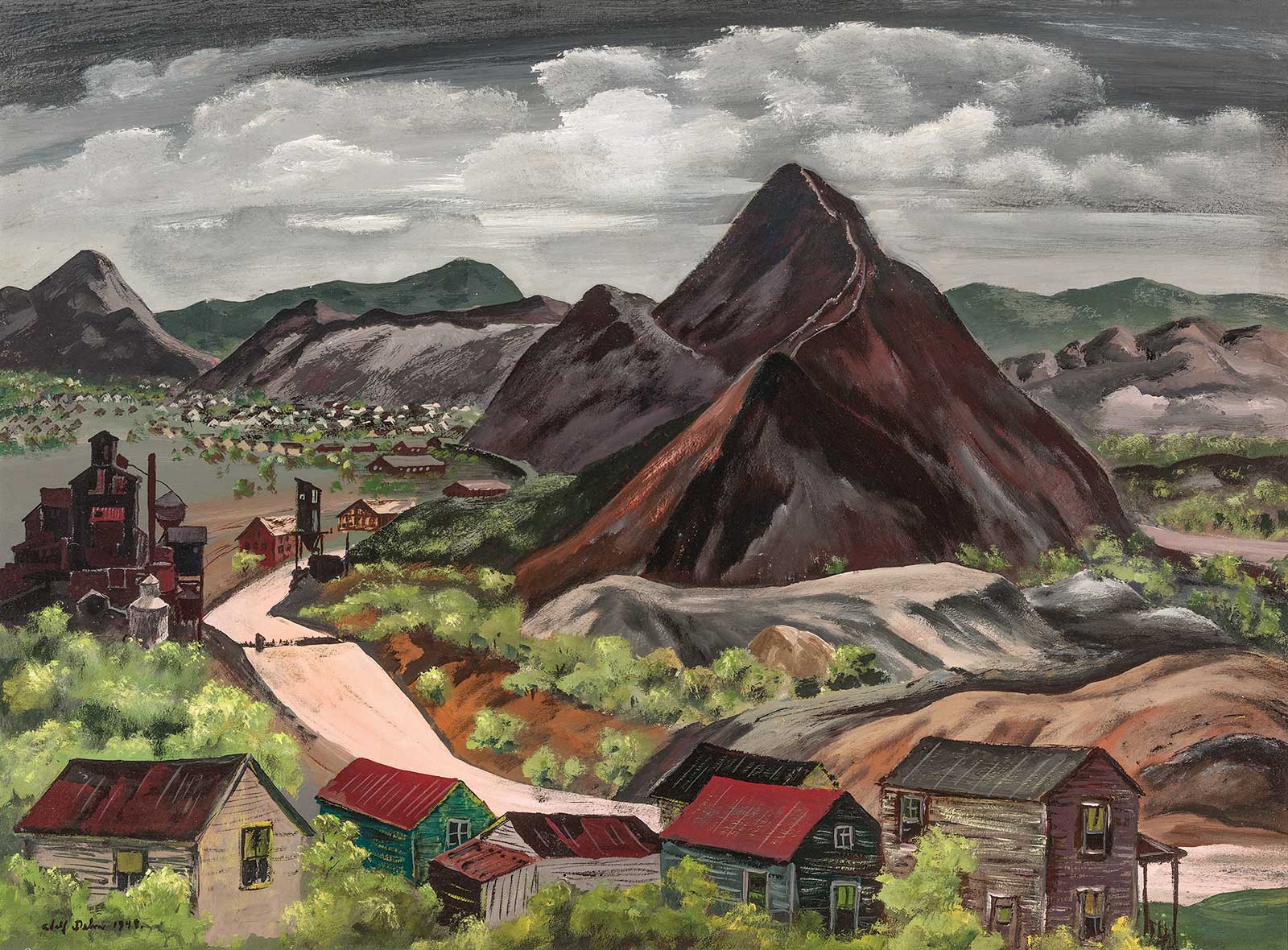 Adolf Dehn (1895-1968), Colorado Mining Town, 1948. Casein on board, 22 x 30 in.
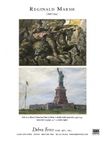
In 1933 George Biddle proposed a public works project for the arts to President Franklin D. Roosevelt in a personal letter. Biddle had seen in Mexico the impact of the government-supported public art program for both the artists and the people. Mexico’s mural program was part of rebuilding the country after 10 years of brutal class warfare. The murals depicted the life of everyday Mexicans as a means of connecting the people to their new government. President Roosevelt liked the idea of artists rallying a fractured society around a set of social ideals. The first American public art program began in 1933 to 1934. President Roosevelt expanded the arts program to include archiving American design, historic preservation and teaching community art classes as part of the Works Progress Administration. The WPA also built dams, roads, parks, electrification and other infrastructure from 1935 to 1943, employing 8.5 million as part of the New Deal.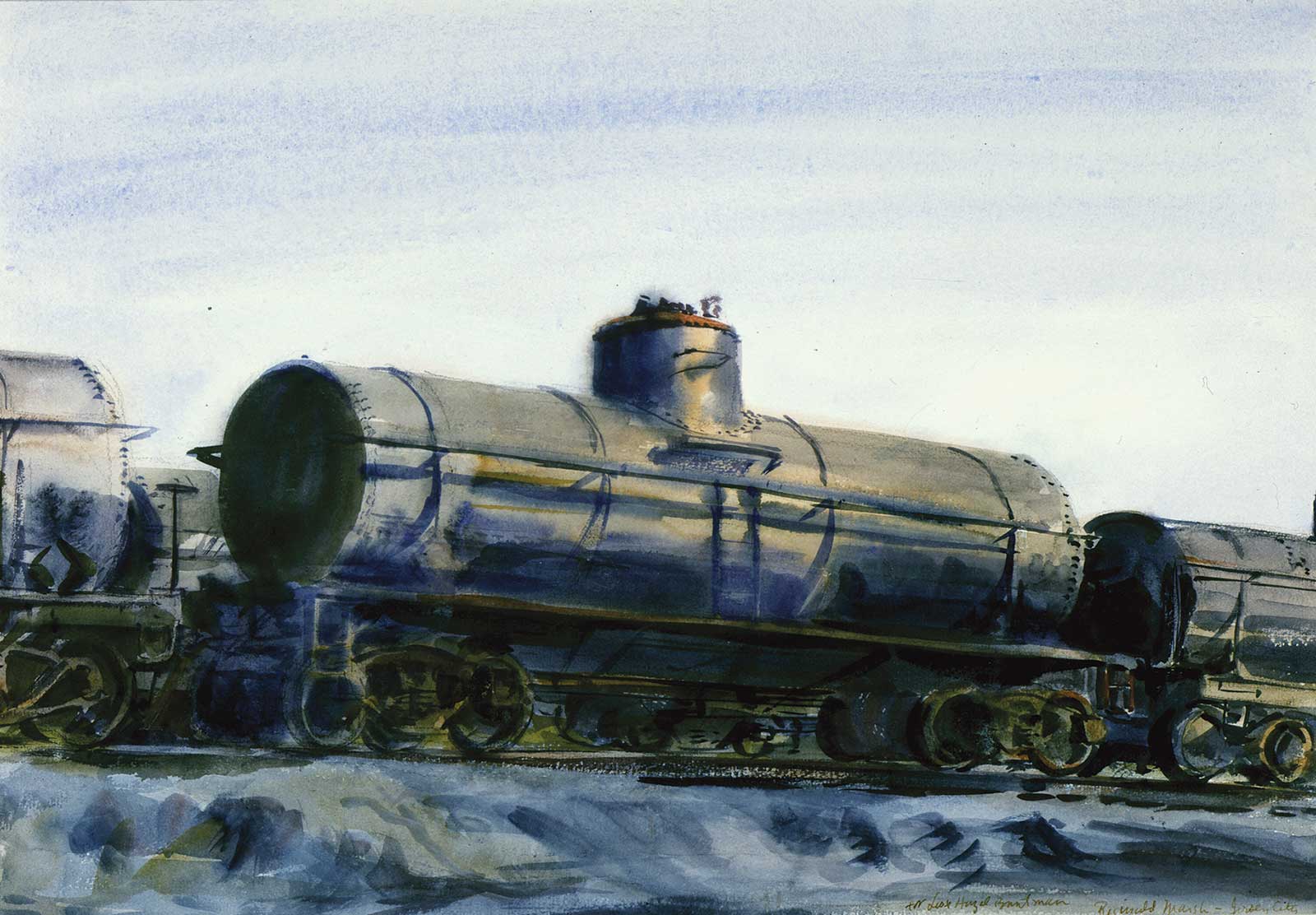 Reginald Marsh (1898-1954), Railway Tank Car, Jersey City, 1930. Watercolor on paper, 14 x 20 in.
The American public art program, like its Mexican counterpart, elevated artists to wage earners making murals, easel paintings, prints and sculptures. Mural commissions, particularly for post offices, were awarded by competition. If a mural commission was won, it elevated an artist’s stature. For every mural commission granted, a great many artists submitted an oil, watercolor, gouache or drawing of their interpretation of a specified theme or location.
The Mexican muralist style gave new vitality to representational art at a time when abstraction and non-objective art was heralded as progressive and synonymous with individual freedom. American artists struggled to decide which style—realism or modernism—would best express the American story. Government programs in both Mexico and the United States chose realism for most of its commissions as it was considered more accessible to the public. American artists adapted style elements they liked from the Mexican muralists, especially high-key color and stylized volumetric and dramatically foreshortened figures. The multi-angular perspectives and evocative juxtapositions of montage storytelling were new and interesting. The Mexican artists focused on murals because they were monumental, public and owned by the people. Easel painting was repudiated in Mexico as private intellectual art. American government programs valued both mural and easel painting. In this exhibition, I have assembled paintings produced in pursuit of an American mural commission hung thematically beside easel paintings of the Depression era. You will see that American murals and paintings do not speak of revolution; they speak of a desire for work and community.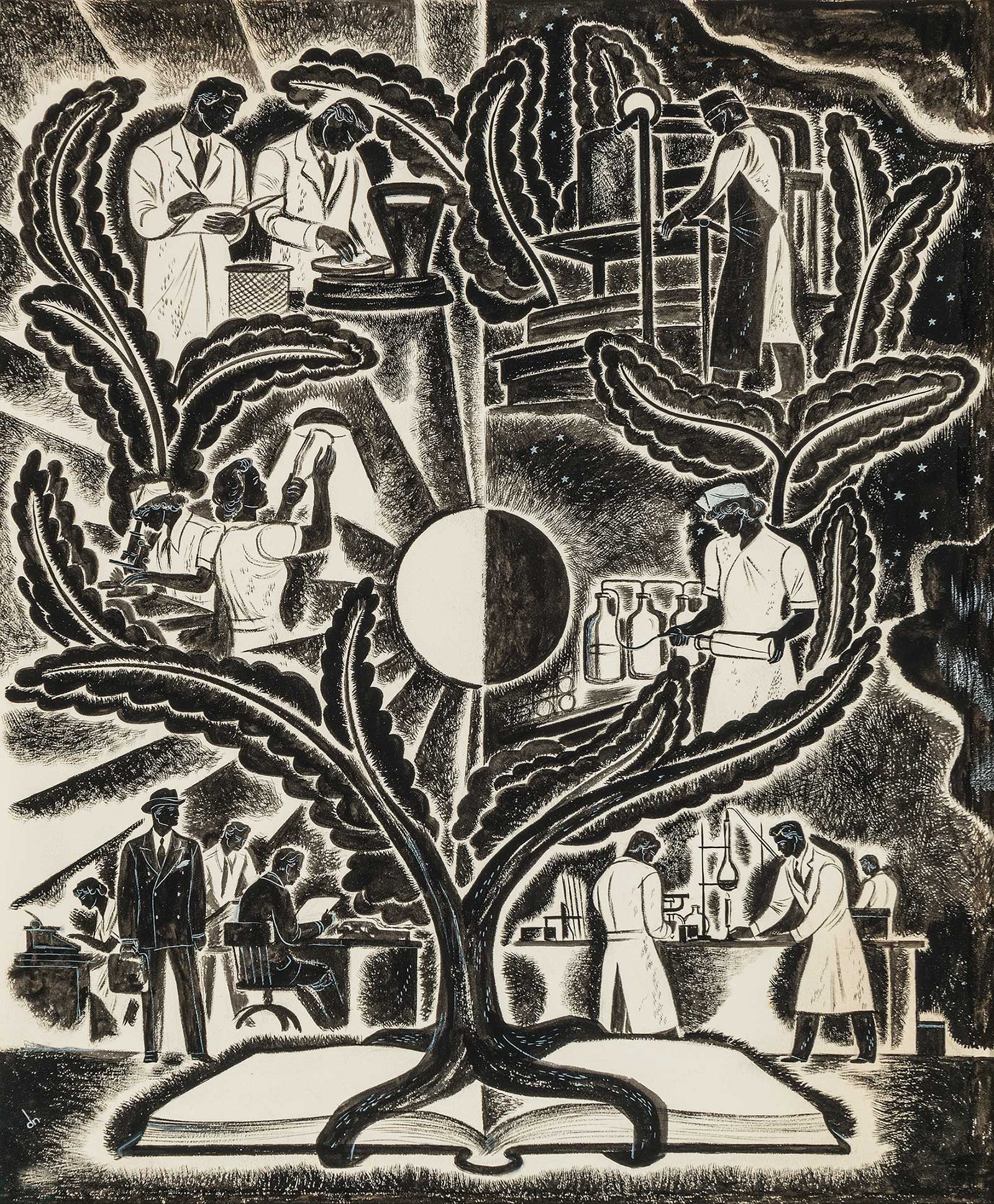 Dale Nichols (1904-1995), The Tree of Knowledge: Science, ca. 1940. Ink and china white on paper, 13 x 10¾ in.
Our exhibition includes works by social realists and regionalists. Realists who were populists saw American history as not about great leaders but rather organized workers erasing economic inequality. Artists with that point of view chose subjects about work in factories, shipping, mining and packing plants. Paintings in our exhibition that focus on industrial labor include unionized steel workers by Ben Shahn, coal miners by Joseph Lomoff, factory workers on break by Jan Matulka and fish packing by Albert Gold. Other artists who celebrated industry emphasized streamlined machinery as an expression of American power. Work subjects that focused on rural towns and farming life and their connection to community and state or local history were called regionalism. In spirit, regionalism was close to the Mexican murals in telling the story of the heroic struggle of man with his environment and his will to live. Regionalist art aimed to give people heart and pride by recalling their skills as farmers and ranchers, as well as famous moments in their local history. Regionalists in our exhibition include Joe Jones, Doris Lee, Peppino Mangravite, Austin Mecklem, Dale Nichols and Jean Swiggett. Depression-era artists whether American or Mexican did not erase race or poverty from their narratives but told an inclusive story. American art of the 1930s and 1940s expresses the complexity of a time when contemporary art was politically, socially, economically and culturally concerned.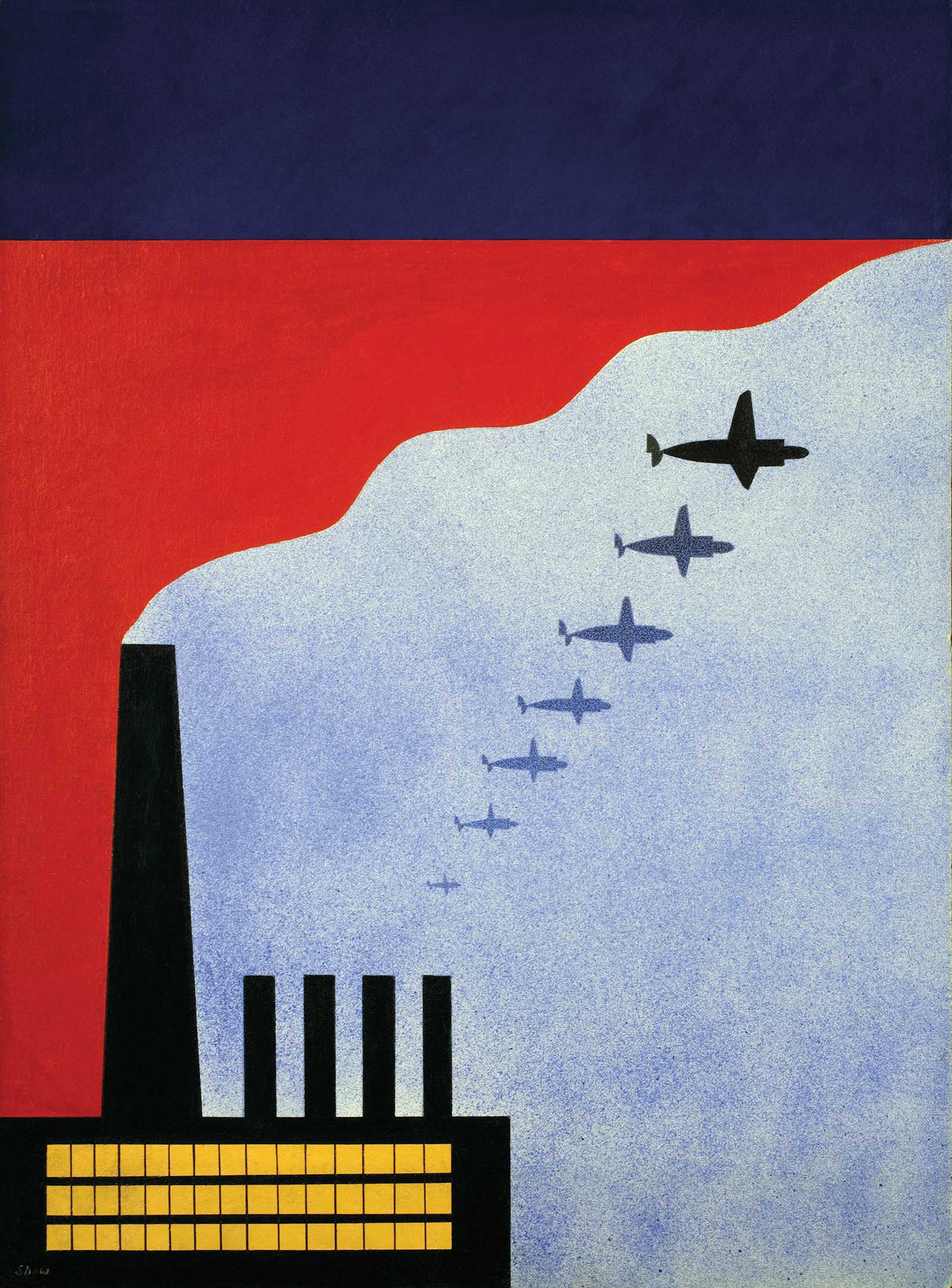 Charles Green Shaw (1892-1974), Industry for Victory, 1944. Oil on canvasboard, 22 x 16¼ in.
Regardless of their subject and style, American artists felt pressed to negotiate a way between the national identity claimed by the realist style and modernism’s connection to Europe. The modernists had to adapt to the dominance of realism caused by the Mexican mural movement. To unite themes of work with modernism, artists used the structural design of factory machinery to depict industry as ordered and pristine. Streamlining of shapes in a painting suggested American efficiency and were perceived as patriotic. This blending of realism and modernism can be seen most clearly in works of the 1940s as America entered World War II and there was great pride in manufacturing. Our exhibition includes works by Park Avenue cubist Charles Green Shaw which combine nationalist realism and modernist abstraction as seen in Join and Industry for Victory. As America geared up for the war, industrial inventions were praised, as expressed in The Tree of Knowledge: Science by Dale Nichols. —
Powered by Froala Editor