The point of Fresh Fields is to expose the politics in the picturesque, to peel back the beauty—the daubs and strokes of oil paint, the emphasis on light, the sheer, gossamer airiness of American impressionism in order to examine the layers of history beneath those gorgeous surfaces. Curator Amy Kurtz Lansing has enlisted ecologists, local historians, specialists in the history of slavery and race, and Native Americans from the region to shed new light on works we may have taken for granted, demanding a revision, a “re-seeing,” a “seeing again.”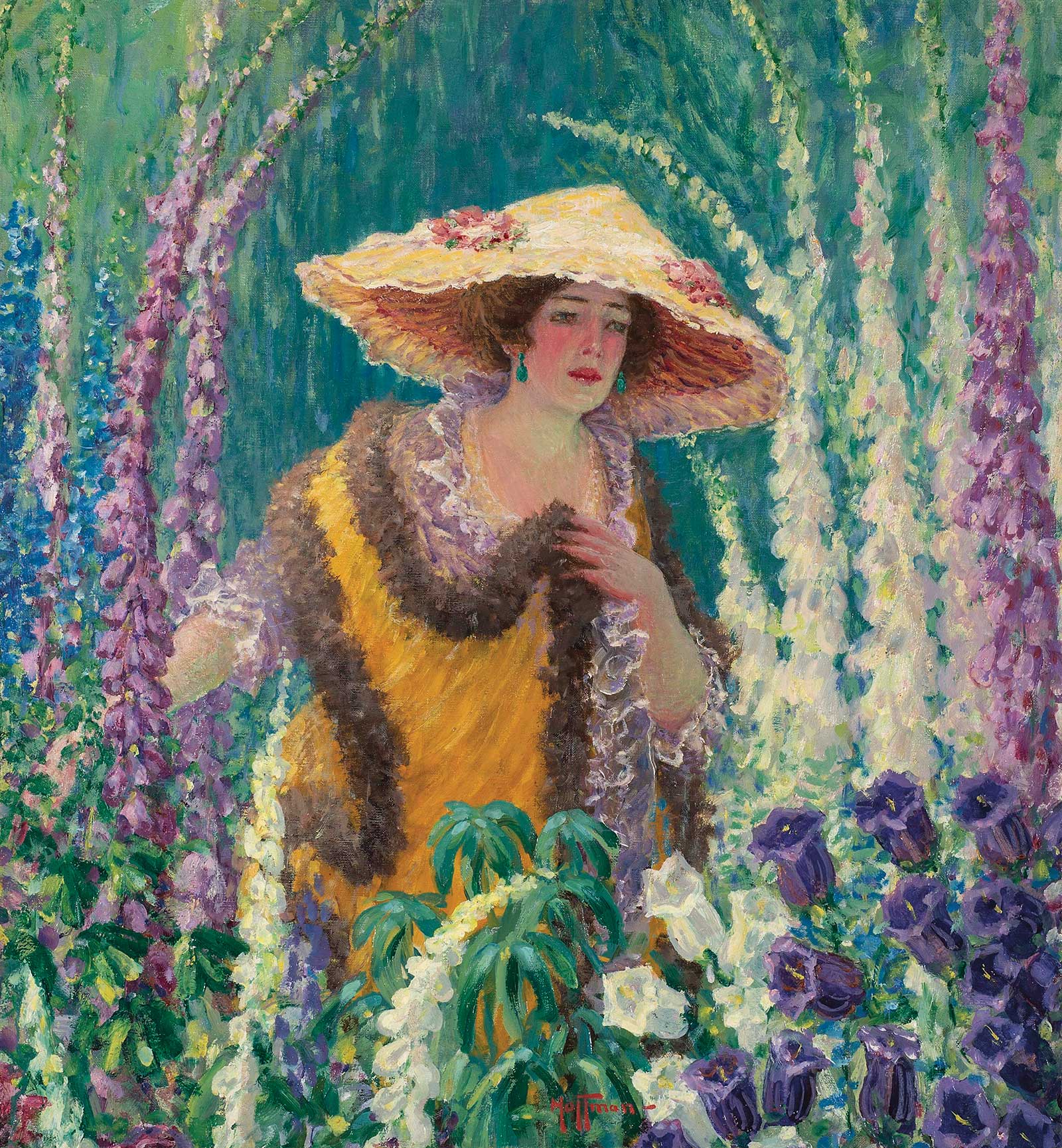 Harry Hoffman (1874-1966), An Old-Fashioned Garden, ca. 1920. Oil on canvas, 26 1⁄16 x 24 1 ⁄8 in. Florence Griswold Museum, Gift of David and Suzanne Hoffman, and the Hoffman Family, 2017.10.
George Brainerd Burr’s oil on panel sketch, President Wilson’s Daughters, almost certainly done on the spot, epitomizes the exhibition’s ambitious aim in miniature. At first glance, the daughters, clad in long white dresses seem liberated from the strictures of their lives as Woodrow Wilson’s daughters. Two chat amiably, another looks out over the water, thinking her own thoughts, while the central figure, bathed in the glow of a roaring bonfire, reaches up to loosen her hair. The trees enfold them like a bower; the bay acts as backdrop. Young women find their inner nymph. The reading is feminist.
Then you read the accompanying text and learn that Burr met Ellen Axson Wilson (a painter, and the President’s future wife) in 1910 at the artist’s colony that centered around what was then the Florence Griswold House. You learn that he met “the three Wilson daughters, Margaret, Jessie, and Eleanor…Most certainly the eldest daughter, Margaret, is standing at center, bathed in the glow of the fire, while surrounded by the wild darkness of the New England landscape.” And at last, the writer of the text, Matthew Warshauer, professor of history, reminds us that “Mrs. Wilson, who was from the South and retained segregationist views, returned there to give birth to the two eldest daughters, as she didn’t want them to be ‘Yankees.’” We remember that for all his leadership during World War I and his dream of a League of Nations, President Wilson was himself a committed segregationist whose policies openly discriminated against Black citizens, opposed immigration from Southern and Eastern Europe, and curtailed civil liberties during World War I to silence anti-war opposition from the left.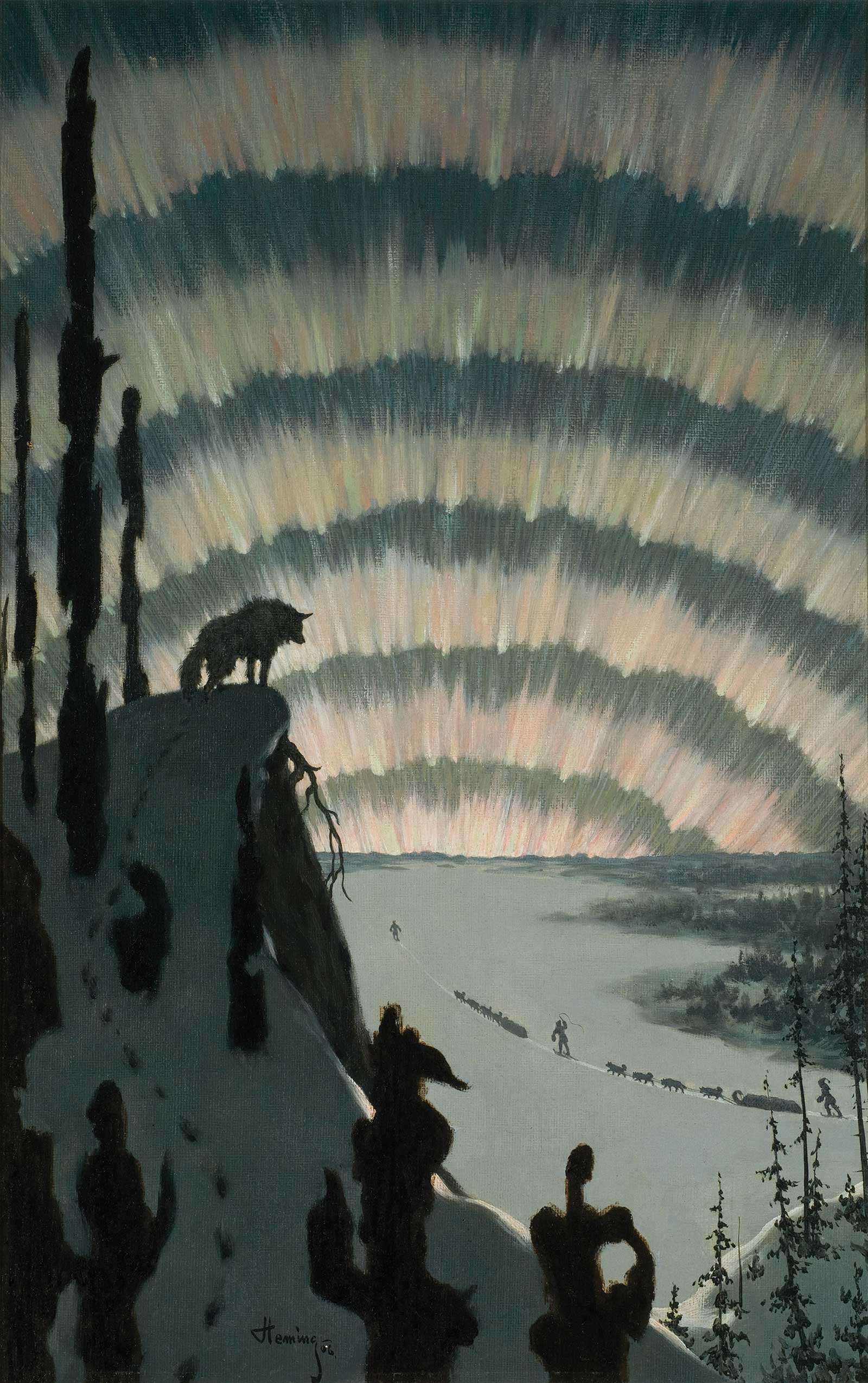 Arthur Heming (1870-1940), Aurora Borealis, 1906. Oil on canvas board, 20 x 12¾ in. Florence Griswold Museum, Gift of Helen D. Perkins, 1970.1.
What are we to make of Wilson’s three daughters, reveling in their freedom under cover of darkness? What did they think? Did they rebel against the ingrained attitudes of their parents, or did they play their role? With a deeper understanding of history, our reading of this little work becomes much more complex, even contradictory, as it becomes entangled with our own beliefs and the turmoil of our own times. As difficult as it is, this feels like a necessary correction to the idea of American impressionism as a simple exercise in beauty and an engagement with nostalgia.
From an ecological standpoint, the land in the landscapes that predominate in the museum is not some static, nostalgic geographical feature. Yes, time and modernity have transformed the depicted places, but in many cases, the land, once cleared for farming, has returned to forest. Yet it is a different forest, with different trees and foliage—invasive and introduced species, like the Norway maple—and in a land altered by climate change. The boulder in William Chadwick’s Bathers at Griswold Beach, for example, sits well above the high-water mark, but as Carolyn Wakeman observes, neither the beach, nor even the boulder, are permanent features. “Nehantic graves above the beach,” Wakeman writes, “were said to be visible until a fierce gale in September 1815 washed away the tall bank, removing all traces of the native burying ground,” and “today as rising sea levels accelerate coastal erosion, the boulder sits a hundred feet offshore.”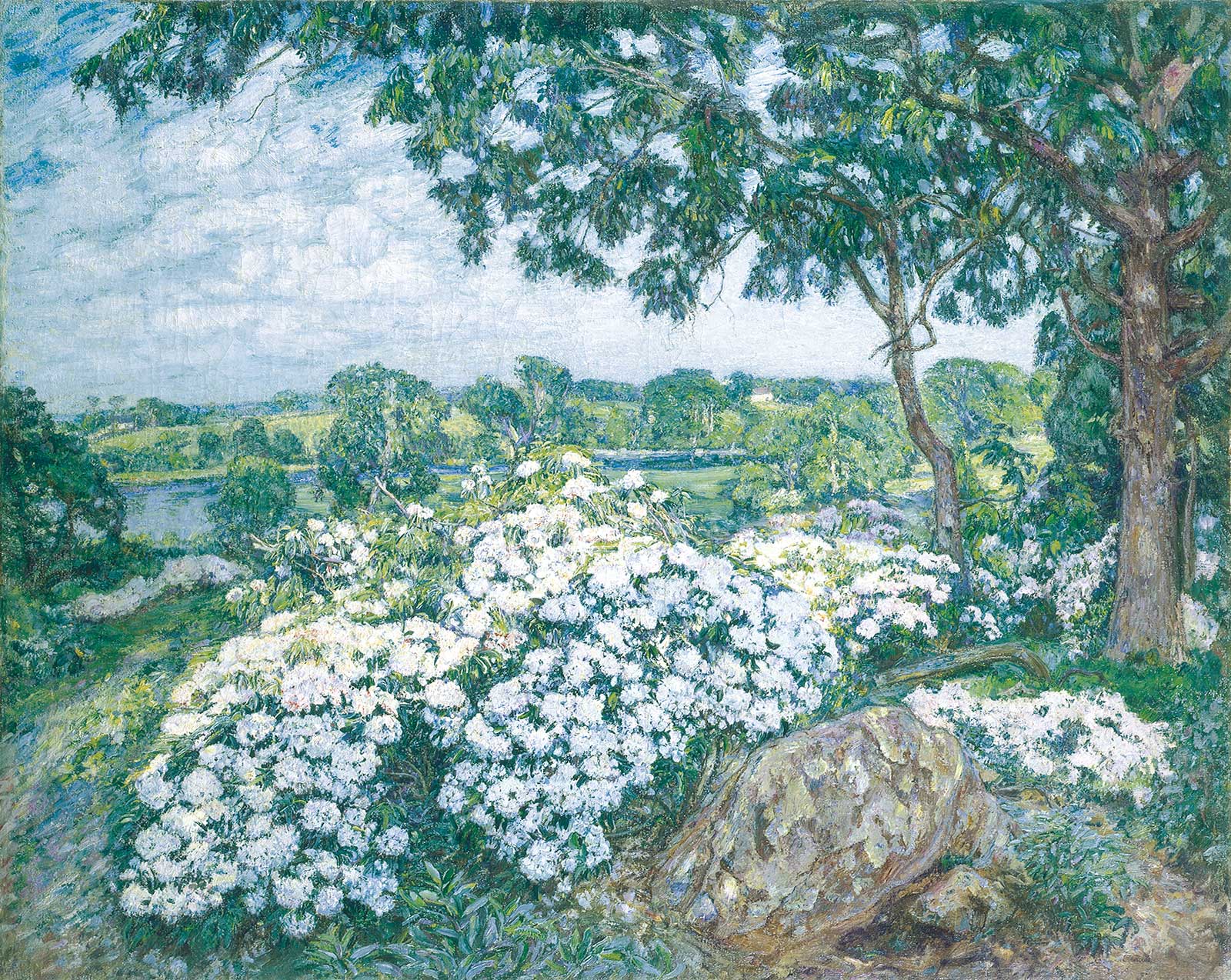 Edward F. Rook (1870-1960), Laurel, ca. 1905-10. Oil on canvas, 40¼ x 50¼ in. Florence Griswold Museum, Gift of The Hartford Steam Boiler Inspection Insurance Company, 2001.1.117.
Ecologist Judy Preston discusses Wilson Henry Irvine’s paintings, Saybrook Light and The Broken Wall as depictions of moments in a fluctuating cycle of “cleared-to-covered hillsides,” stating, “The chances are that the open hilltop pictured is now largely forested, but there remain clues to its past. If the owner abandoned this hilltop the day after this painting was completed, a gradual and time-honored process of plant (and animal) succession would have begun, leaving behind clues,” like the “stone walls” that “today seem to wander through the woods, a relic of the back-breaking effort it once took to clear and define fields.”
Human-made boundaries were not characteristic of the area’s original inhabitants, Indigenous peoples such as the Nehantic, who used natural landmarks to demarcate their territories.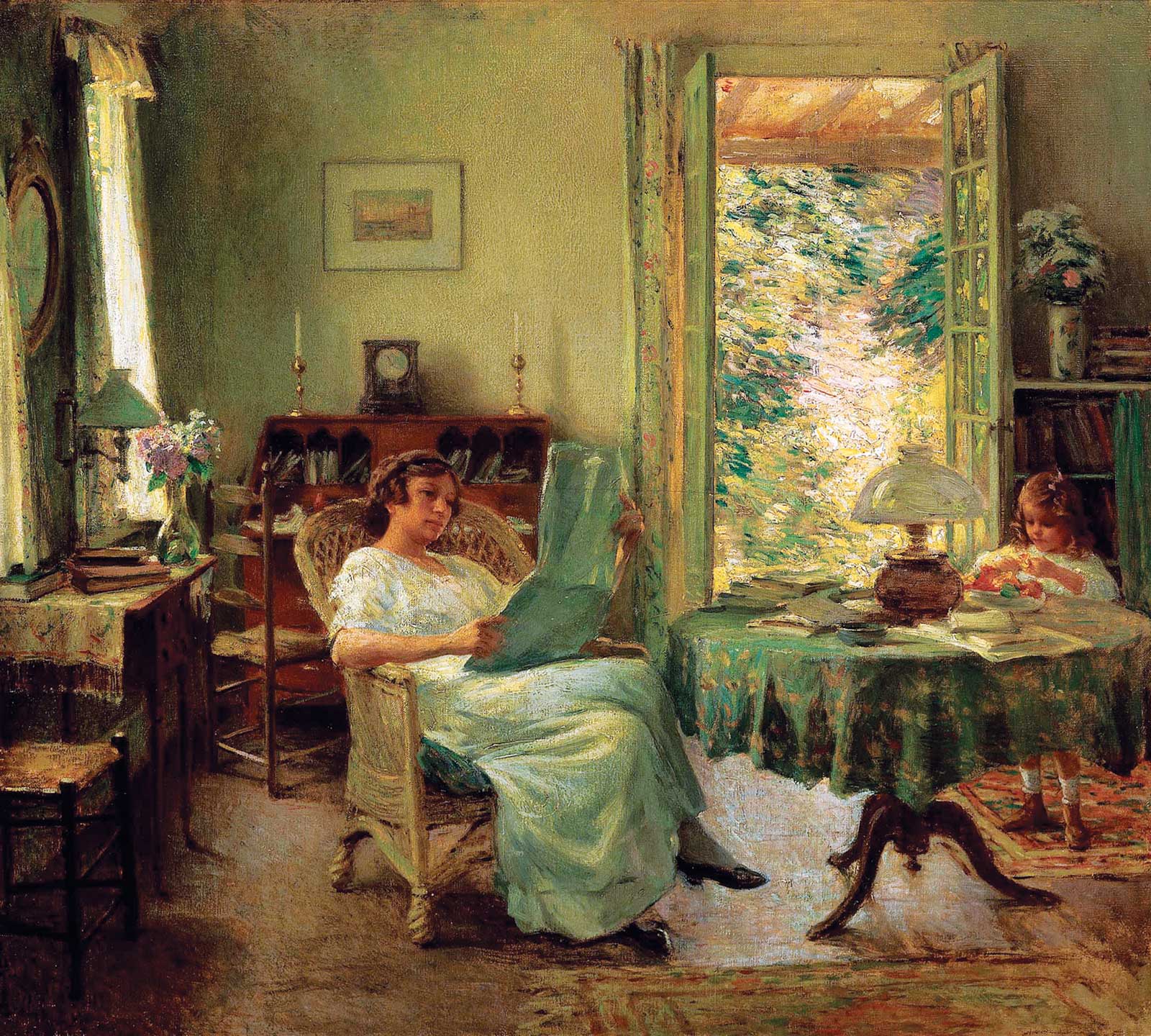 Willard Metcalf (1858-1925), Summer at Hadlyme, 1914. Oil on canvas, 25¾ x 28¾ in. Florence Griswold Museum, Gift of Mrs. Henriette Metcalf, 1980.8.
Dams are another sort of boundary, a wall in water, and the many dams erected in Connecticut enabled the area’s mills and factories and helped create local economies. But anadromous fish, shad and salmon, could no longer swim up their home rivers to spawn, decimating populations and fisheries that had sustained generations of Native Americans. A sawmill erected upstream from Joshua’s Seat, the subject of a watercolor by Charles De Wolf Brownell, encroached on fishing and hunting rights guaranteed to the Mohegan people by treaty. The recent removal of dams and the reintroduction and conservation of endangered species has renewed these waters, turning the wheel of the landscape yet again and adding a new layer to the region’s history.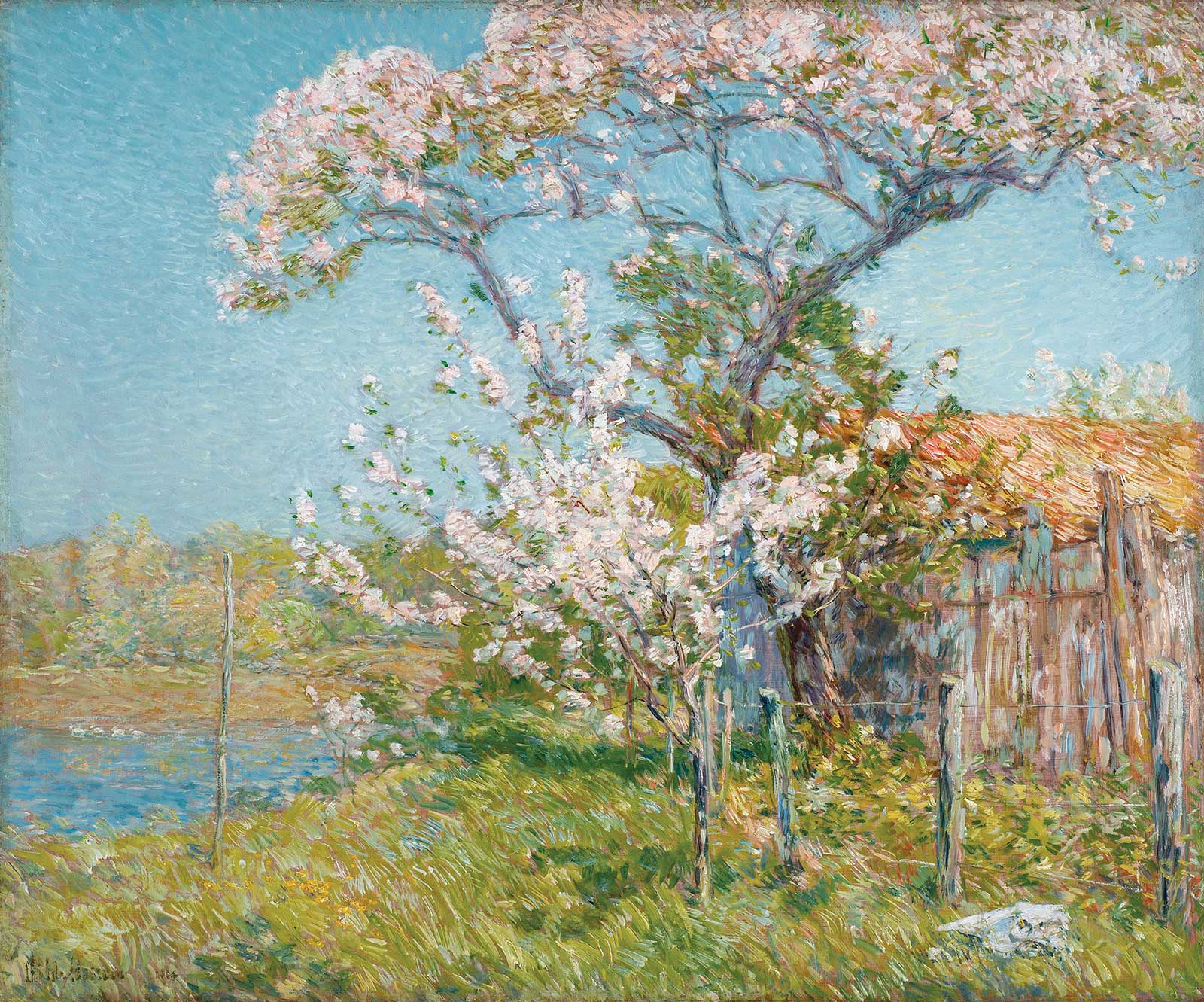 Childe Hassam (1859-1935), Apple Trees in Bloom, Old Lyme, 1904. Oil on wood, 25 x 30 in. Florence Griswold Museum, Gift of the Vincent Dowling Family Foundation in Honor of Director Emeritus Jeffrey Anderson, 2017.16.
“Mason” in Mason’s Island, 1905, a painting by Henry Ward Ranger is Captain John Mason, who was given the island as a reward for slaughtering 400 Pequot men, women and children in 1637 during the Pequot War. The remaining Pequots were dispersed, forced into bondage, or relegated to a reservation. The island itself was a named place to the Pequots, a landmark in their world. After the war, settler colonists cleared it and let their livestock graze on it, but Ranger favored its picturesque qualities because it had been “‘allowed to revert back into the arms of Mother Nature.’”
Women who painted as part of the community of artists surrounding the Florence Griswold site are also highlighted in the exhibition. Matilda Browne’s Peonies, at first, seems to be a joyous ribbon of reds, pinks and white draped across a shade-dappled lawn. The woman who tends the flowers is herself a flower, personified as she rises from the bed. In truth, the sitter is Katharine Ludington, an artist who would become an advocate for women’s suffrage (a view Browne did not share). Closer inspection of the painting indicates that many of these peonies are past their prime. Has Browne merely “acknowledged imperfection” in the natural world? Is she paying tribute to the cycle of life? Or is some subtler association at play here?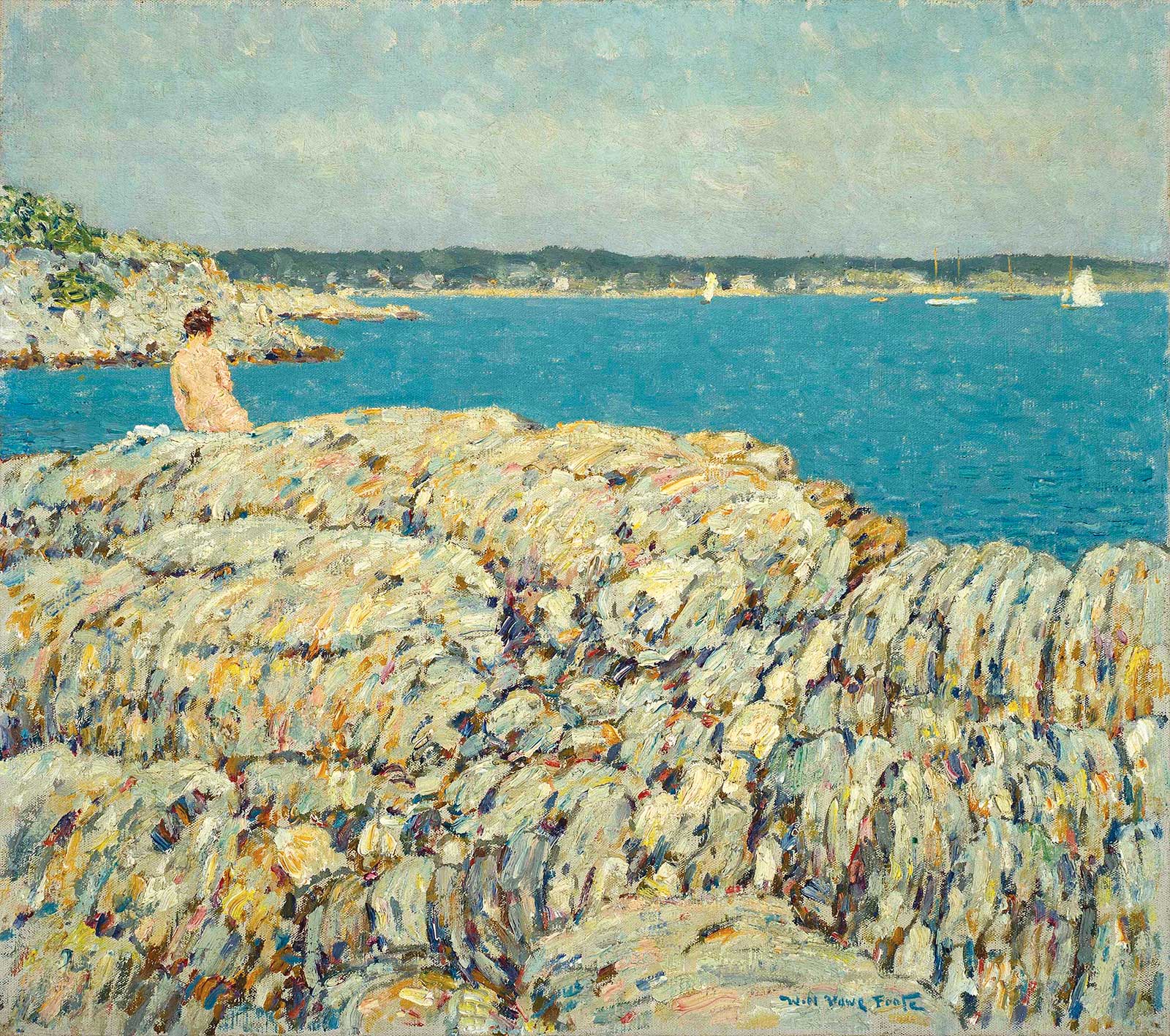 Will Howe Foote (1874-1965), Nude Overlooking White’s Point from Millstone (The Bather), ca. 1920. Oil on canvas, 16 x 18 in. Florence Griswold Museum, Bequest of Arthur J. Phelan, Jr., 2017.1.5.
It’s quite clear that the Florence Griswold House and grounds—indeed, the whole area—were a place where artists saw, sought, and experienced transformations, not only in their art, but in themselves. Even as they went back to nature and to the sea, they went forward in their own work and views of the world. Pro-suffrage or anti-suffrage (to take a single example) the place seemed to compel the artists who worked there to express themselves and make their choices known. It is almost as if the act of making art, of selecting a subject and point of view, of planting the easel, created a friction with others who were doing the same things, a friction that would, on occasion, release new energies. Harry Hoffman’s An Old-Fashioned Garden, painted after World War I, is anything but old-fashioned. Depicting his wife, Beatrice, the painting humorously transforms the “beautiful woman in a garden” trope into a tropical undersea fantasy. Hoffman, as the text indicates, “developed a fascination with the undersea, and studied coral, tropical fish, and other ocean flora and fauna from life,” and “painted a remarkable series of canvases that brought the unfamiliar forms, new sense of scale, and wild colors of tropical waters before his viewers’ eyes.” Beatrice emerges as a kelp-draped jellyfish in a forest of fronds, subverting the trope and the entire genre. Perhaps the horrors of the Great War had done it, had sent Hoffman back through the white dresses in the gardens, back through the farmers’ and colonists’ cleared forests, back through the Native American settlements to a time when there was no landscape because there was no land, when all was ocean. The juxtaposition in this beautiful painting might be humorous, but the effect is unsettling and jarring. —
Through November 1
Fresh Fields: American Impressionist Landscapes from the Florence Griswold Museum
Florence Griswold Museum
96 Lyme Street
Old Lyme, CT 06371
(860) 434-5542
www.florencegriswoldmuseum.org
Powered by Froala Editor