Today, as I isolate myself with my family, observing social distancing while the world’s economies topple like flaming dominoes, the effect of small things, even things we cannot see on, well, everything, and the inextricable interconnectedness of all things great and small, hits home. It’s an idea that really begins with Alexander von Humboldt, who is the focus of a new and crucial exhibition, Alexander von Humboldt and the United States: Art, Nature, and Culture, at the Smithsonian American Art Museum. As “going viral” recovers its original, deadly serious meaning in our time, Humboldt’s brief six-week visit to the young United States in 1804 went viral in the current sense of the term. His visit and ideas might be said to be the vector that transformed the scientific, political and artistic community in America. Its effects, felt and noted directly for decades, have never ceased to resonate. They vibrate with new energies now.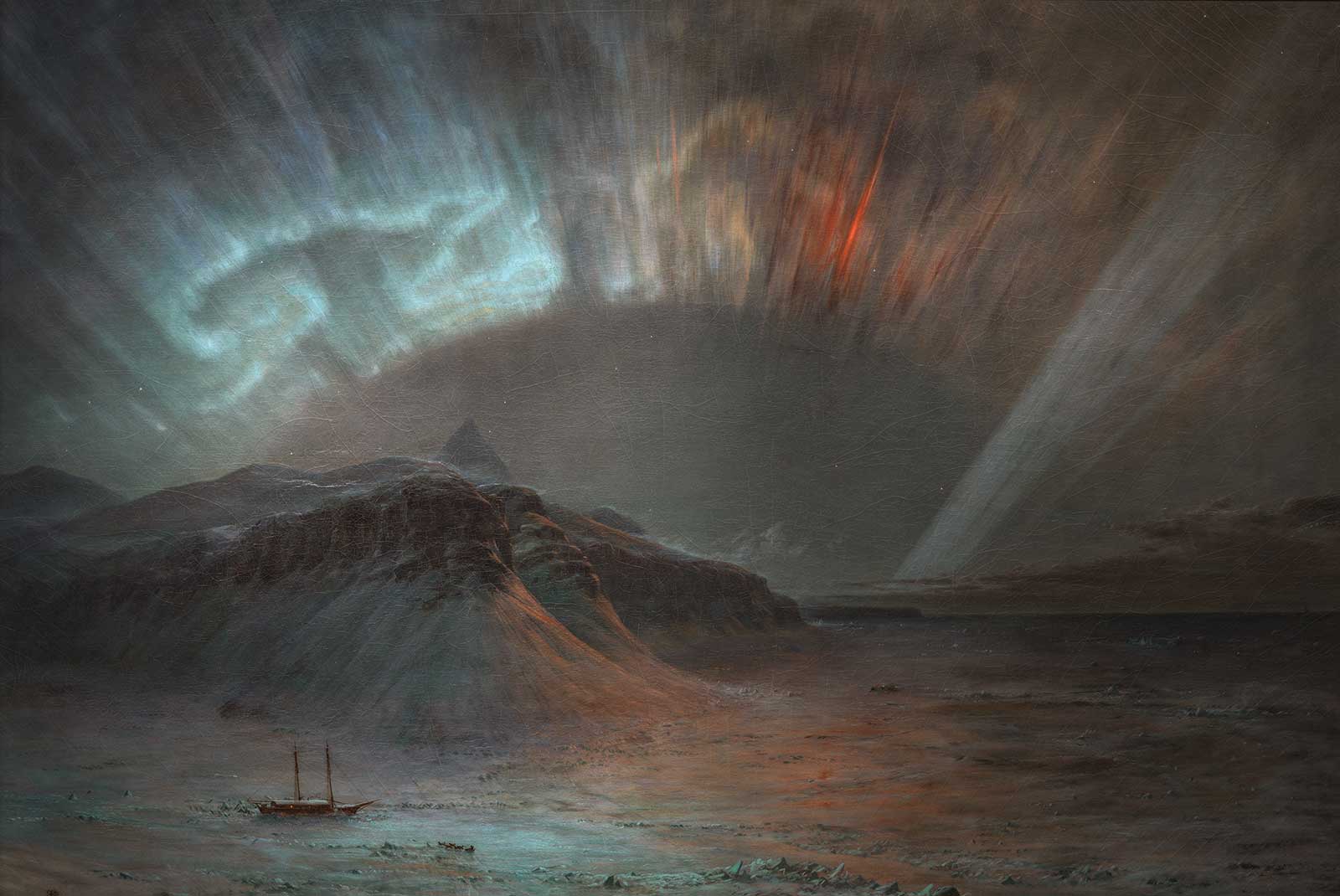 Frederic Edwin Church (1826-1900), Aurora Borealis (detail), 1865. Oil on canvas, 56 x 83½ in. Smithsonian American Art Museum, gift of Eleanor Blodgett, 1911.4.1. Photo by Gene Young.
Senior curator Eleanor Jones Harvey, who organized the exhibition and wrote the excellent accompanying book, begins as Humboldt, on his way back to Europe after an extraordinary Latin American expedition, diverted to Philadelphia. There, he met with leading men of science, including naturalist-artist Charles Willson Peale and journeyed to Washington to meet with President Thomas Jefferson, who had just concluded the Louisiana Purchase, more than doubling the size of the United States with the stroke of a pen. Jefferson was astonished to find that Humboldt, whose trip had been sponsored by Spain, had made the most accurate map of the swath of New Spain that had been sold to Napoleon—the part that comprised the Louisiana Purchase. Humboldt’s map and descriptions of the geography of the area would form the basis for negotiations between the United States and Spain and would spur expeditions for decades.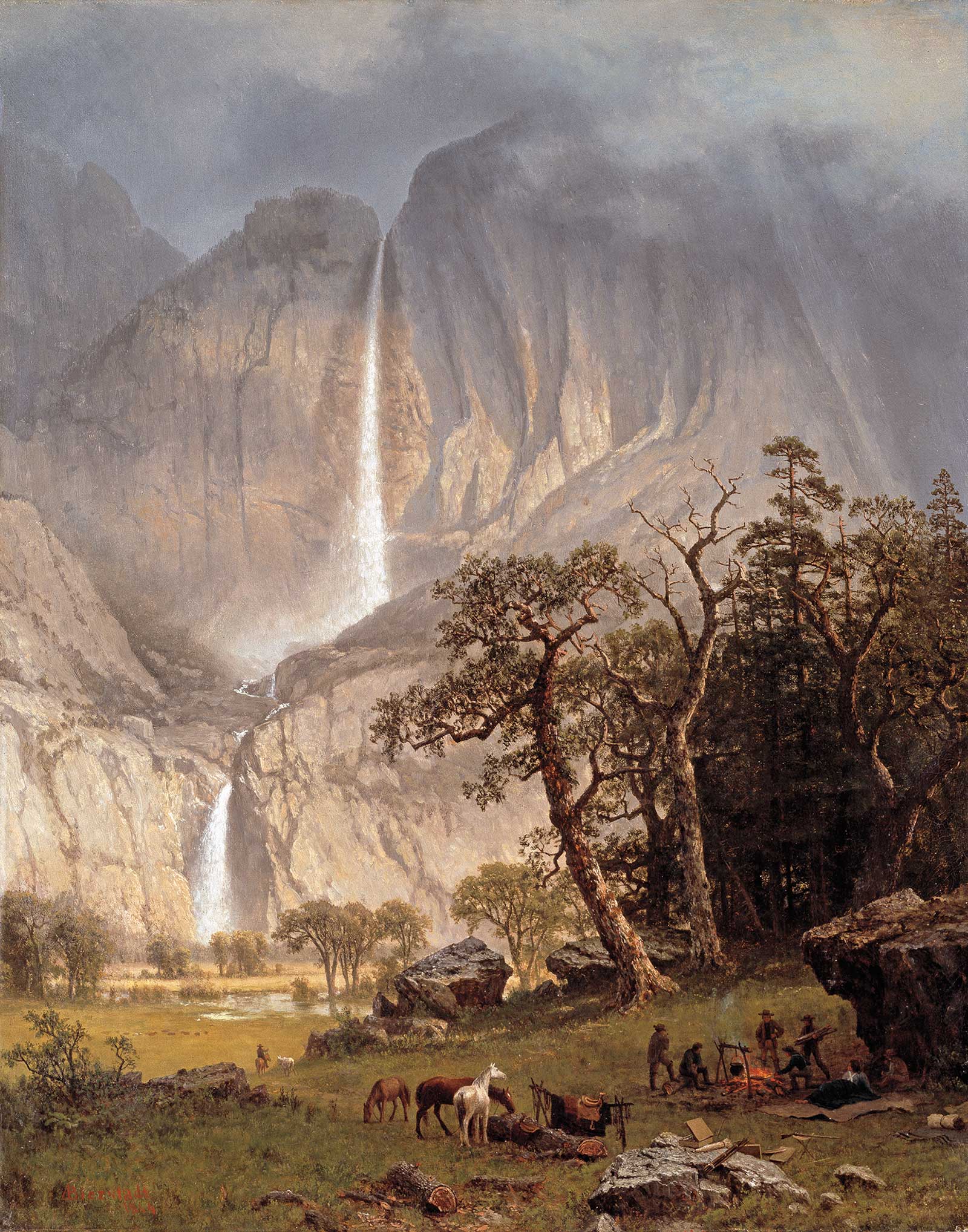 Albert Bierstadt (1830-1902), Cho-Looke, The Yosemite Fall, 1864. Oil on canvas, 34¼ x 271⁄8 in. Timken Museum of Art, Putnam Foundation.
Humboldt looms large in the history of science. He was the first to note climate change and to understand its origins in human activity. He described thousands of plants, animals and topographical features and practically founded the sciences of meteorology and biogeography. He delved into every branch of science and culture, advocated for the abolition of slavery and saw all races as equal under the umbrella of his theory of the “unity of nature.” Among the many thinkers influenced by his ideas were Charles Darwin, John Ruskin, Ralph Waldo Emerson, Walt Whitman and many others. Transcendentalism can trace its lineage to Humboldt and his multivolume attempt to embrace the entire universe, Cosmos. James Smithson’s own devotion to Humboldt’s ideas leads directly to the mission of the Smithsonian itself.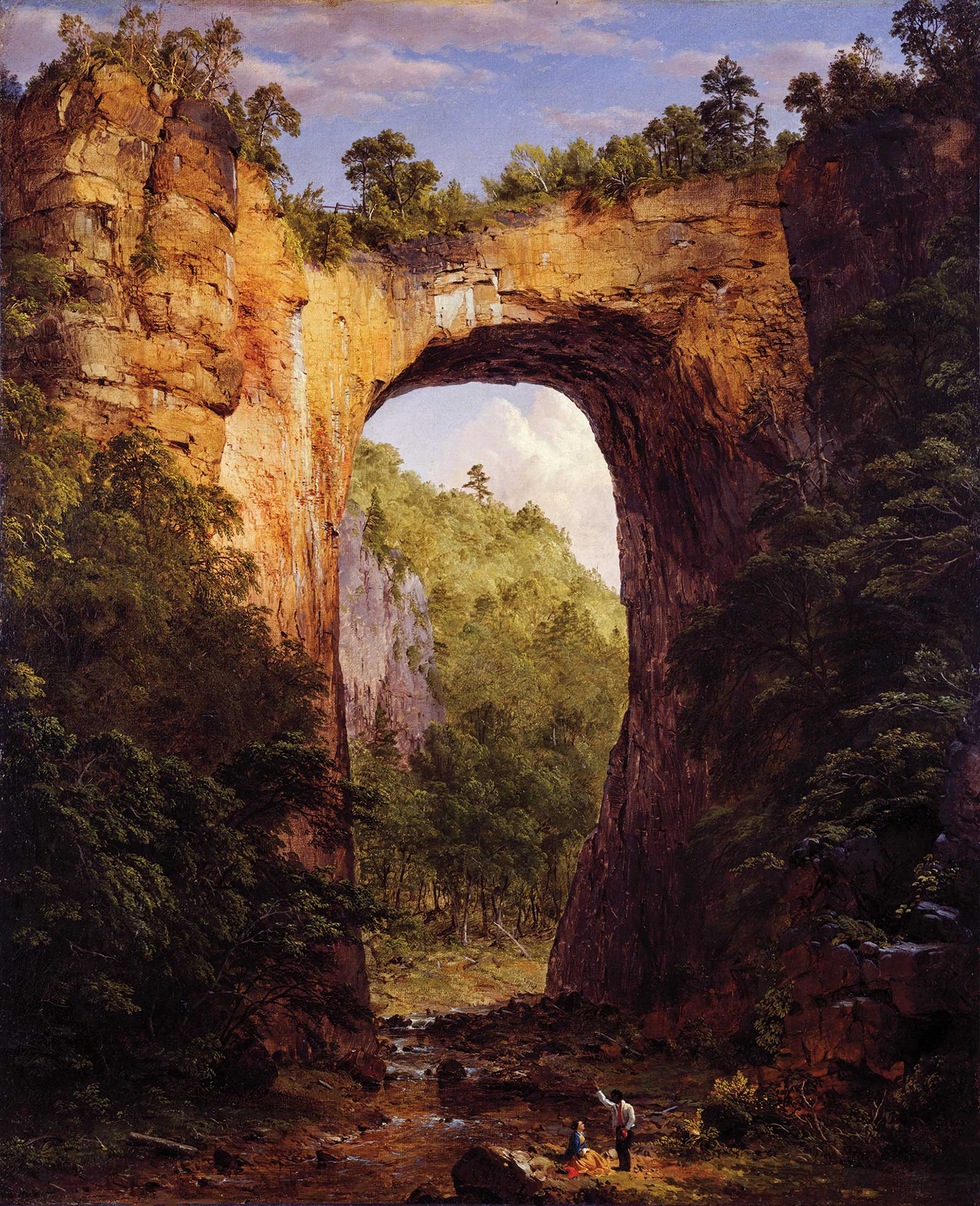 Frederic Edwin Church (1826-1900), The Natural Bridge, Virginia, 1852. Oil on canvas, 28 x 23 in. The Fralin Museum of Art at the University of Virginia, gift of Thomas Fortune Ryan.
In art, Humboldt’s meeting with Prince Maximilian zu Wied in Paris inspired the prince’s extensive travels through the American West in 1832 to 1834. Accompanying Prince Max, artist Karl Bodmer would provide hundreds of beautiful, detailed watercolors of Native Americans, their daily lives, rituals and ceremonies, and the lands they lived in. Humboldt also met George Catlin when the artist was exhibiting his Indian paintings throughout Europe; more importantly, he had a chance to meet Native Americans, a group of Iowa Catlin brought with him. But Humboldt’s influence on American artists extended beyond those he met. The Hudson River School, and Frederic Church in particular, might be said to have sprung from Humboldt’s popular writings on the intricate splendor of the natural world and the place of humankind in it. At a time when we are beginning to reappraise artists like Church and Thomas Cole in light of their proto-ecological ideas, excavating the origins of those ideas in Humboldt’s enthusiastic science seems especially appropriate.
Above all, what Humboldt bequeathed to American art is the notion that we need not look to the Old World, and to old empires, for our inspiration. The “spectacle of a free people,” that Humboldt came to see—though slavery and the treatment of Indigenous peoples greatly disappointed him—derived in large measure from the landscape. The nation’s abundant natural beauties, the vast, unspoiled, unimproved, unplundered wilderness, as he saw it, should be our touchstone. America’s natural wonders are our monuments: Yosemite is our Parthenon, Acadia is our Coliseum, the Grand Canyon is our Great Wall.
Humboldt was also acutely interested in the new science of paleontology and the history of the earth, its formation and development and the relationship between climate and species. He surmised, for example, that the continents had in the distant past been united, and in doing so, anticipated plate tectonics. By extension, he was also interested in the distribution of plants and animals and in extinction.
A key painting in the exhibition, Charles Willson Peale’s Exhumation of the Mastodon, painted after Humboldt departed, offers some insight into the fervor for natural history in the young republic. The sheer number of laborers, scientists and onlookers in the painting conveys the sense of excitement, while the enormous “waterwheel and pulley system on the far bank echoes that of the skeleton being lifted out of the primordial ooze. The painting’s action alludes to a metaphoric Great Chain of Being, as the buckets rise in sequence on the right bank, and the workmen form a human chain while emerging from the pit or tending the waterwheel.” As Harvey writes, Peale, standing at the edge of the pit, seems to conjure the bones like a magician, willing them to emerge from the ooze. This notion of the discoverer as creator, of men of superior will being destined to dominate the earth—whether they are wresting knowledge or wealth from it—will become a hallmark of American philosophy and policy.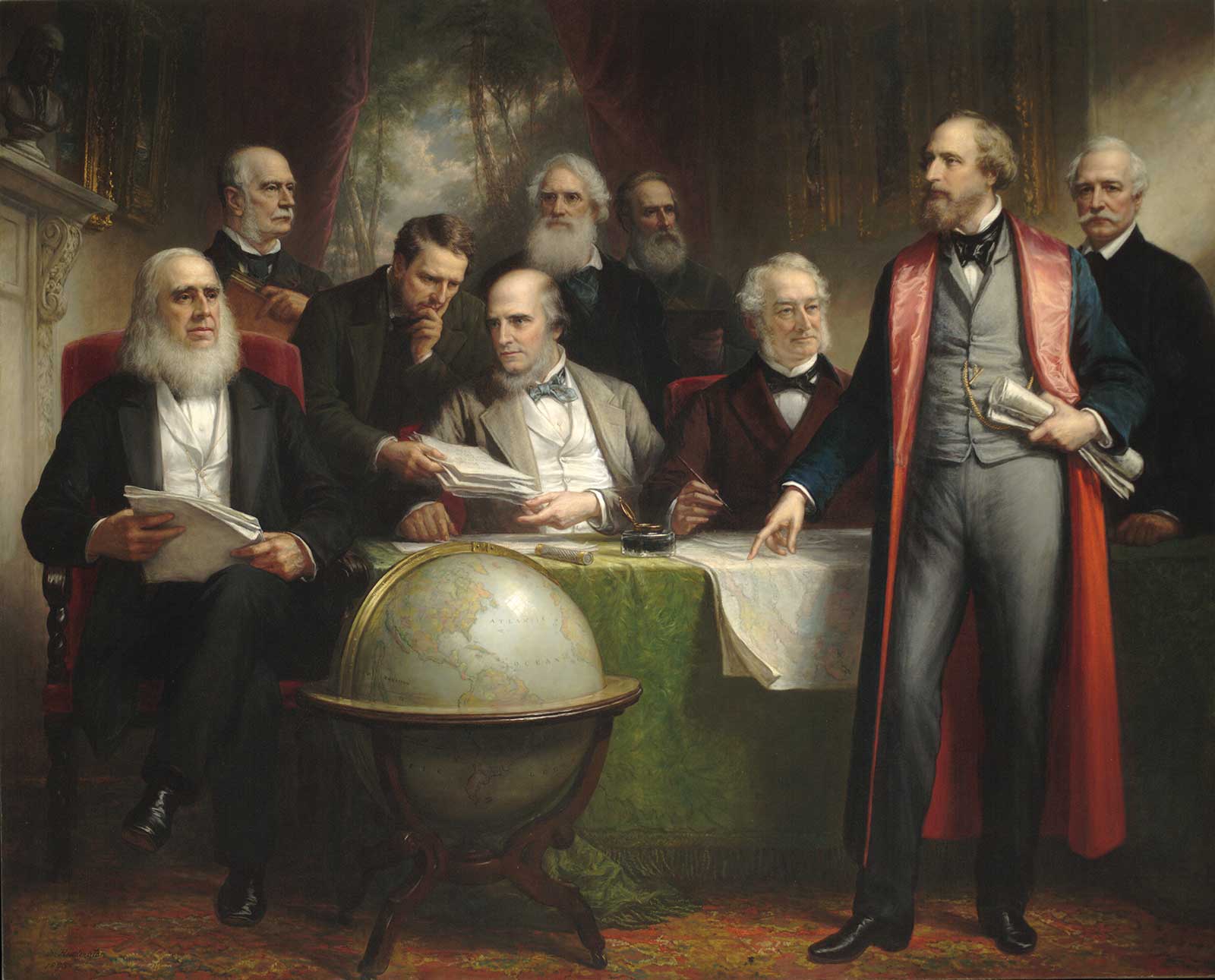 Daniel Huntington (1816-1906), The Atlantic Cable Projectors, 1895. Oil on canvas, 87 x 108¼ in. New York State Museum, Albany, NY. Courtesy New York State Museum, Albany, NY.
As we note this, we should recall the battle royale between Thomas Jefferson and the French naturalist Buffon when Jefferson was residing in Paris in the 1780s. Buffon argued that America was swampy and young, and that our flora, fauna and people, were stunted, both physically and intellectually, as a result. Jefferson was so incensed he had a mangy stuffed moose with deer antlers shipped to France, and, in the offing, set in motion the seeds of American natural science, whose primary goal, at first, seems to have been to find and measure bigger bears, deer, fish, birds, etc., than could be found in tired old Europe.
Second fact: one of Jefferson’s not-so-secret reasons for sending Lewis and Clark west was so that they could bring back a live mastodon—think woolly mammoth—and show those Europeans once and for all.
Considering this, Peale’s painting smacks of paleontology as patriotism—my fossilized femur is bigger than your fossilized femur. Seen in this way, the “Great Pictures,” landscapes of the Americas—of Niagara Falls and Cotopaxi, of Yosemite and the Sierra Nevada—painted by Church, Bierstadt and others, having been seen and dismissed as emblems of manifest destiny, might, in fact exhibit a kind of pride and awe in the variety and diversity of nature and contain pleas for their preservation. After all, the people in these paintings, where there are people at all, are small, painted to scale, part of the landscape rather than dominating it. These artworks are complex, perhaps even contradictory puzzles we may never fully work out, speaking in languages we have forgotten, or languages we have yet to learn.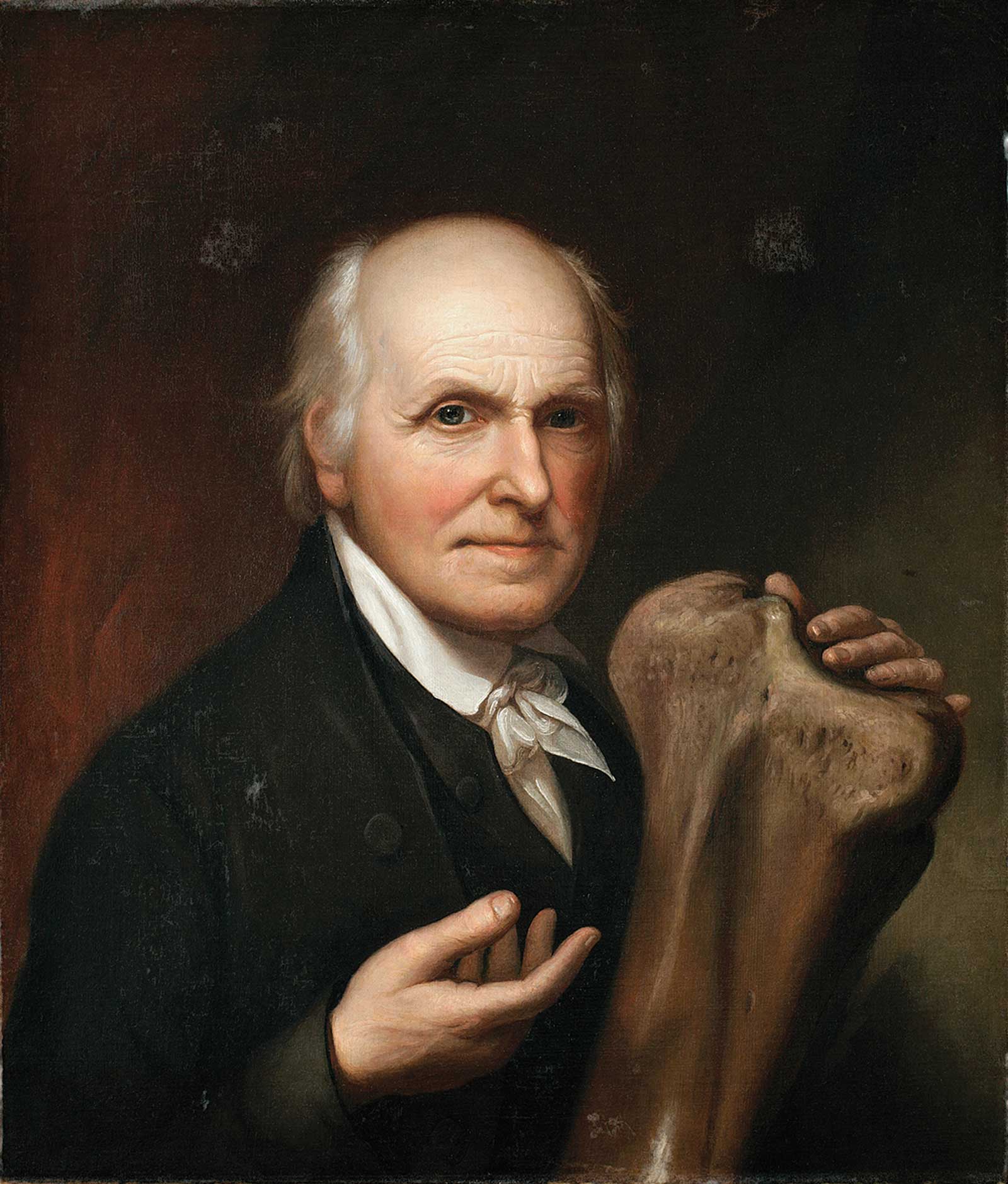 Charles Willson Peale (1741-1827), Self-Portrait with Mastodon Bone, 1824. Oil on canvas, 26¼ x 22 in. New-York Historical Society, Purchase, James B. Wilbur Fund. Photography © New-York Historical Society, negative #8736c.
When my son was very young, I used to watch him sit—he had just learned to sit—looking out a set of French doors onto a deck that overlooked our backyard. By the side of a tiny trickle of a creek at the back of the yard, an old weeping willow stood. Snow dusted the hard ground, but the tree was festooned with golden green leaves, hanging in vines like the hair of a goddess. The sun shone. A breeze blew. Shadows of the leaves and branches made patterns on the panes of glass in the doors. Light and shadow played over my son’s face, over the little sweater he wore, over his jeans with the rolled-up cuffs.
He made noises, many different kinds of sounds, of varying volumes and durations, speaking to the play of light and shadow. For long periods he was silent, listening with his ears, his eyes, his whole body, apprehending those patterns as if they constituted a language. As if he, and the tree and the sun, the light and the shadows, were engaged in deep conversation. Perhaps they were.
And perhaps, just perhaps, in order to acquire human language, we have to make room for it, we have to forget the first languages, the languages of trees, birds, animals, plants, all things great and small. And if we want to get back to Eden, to restore our relationship with capital N Nature, we have to relearn the languages we knew as children, languages we have since forgotten, and rediscover Humboldt’s “unity of nature.”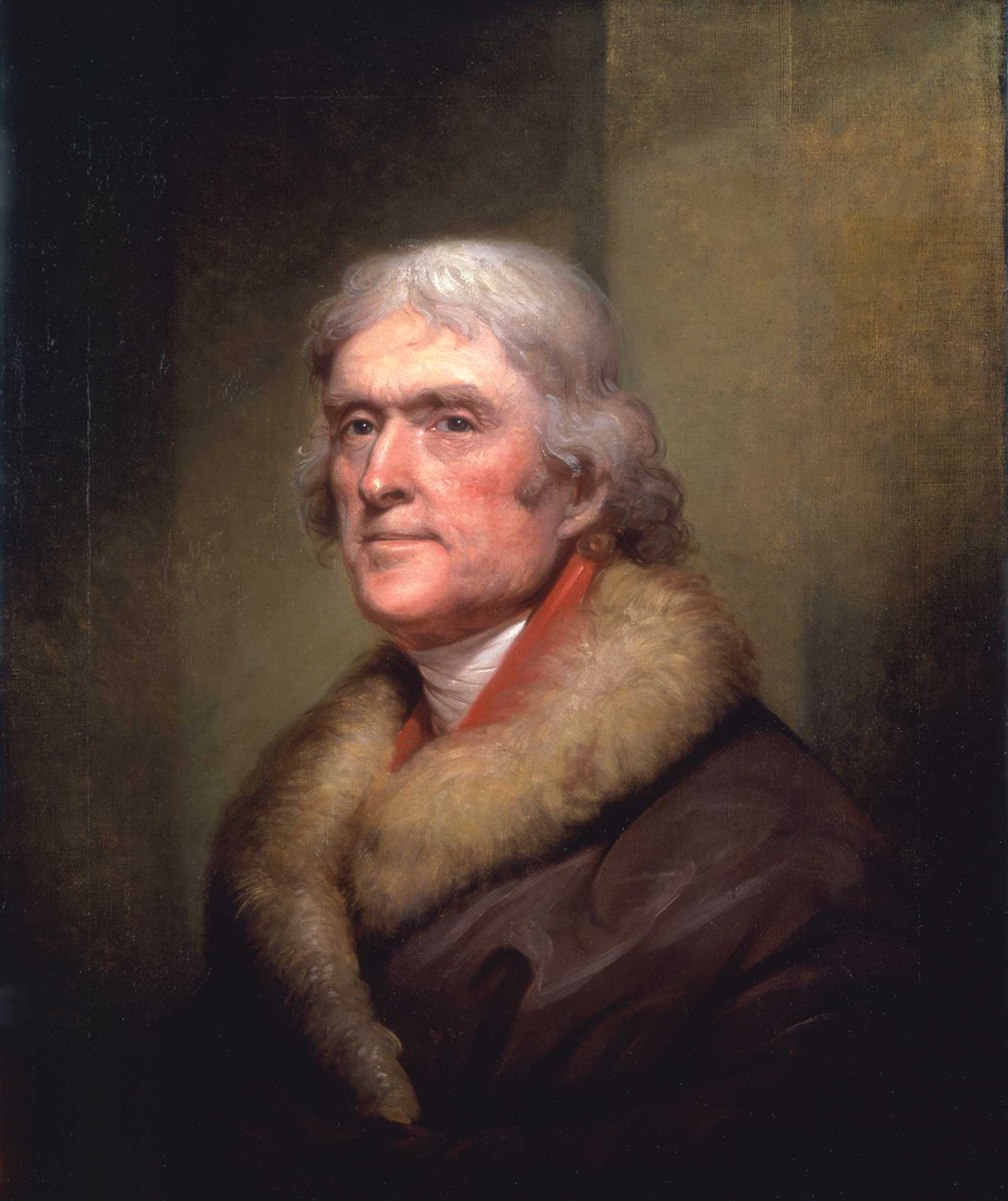 Rembrandt Peale (1778-1860), Thomas Jefferson, 1805. Oil on linen, 28 x 23½ in. New-York Historical Society, gift of Thomas Jefferson Bryan. Photography © New-York Historical Society.
When my son was 10, he and I had a special invitation from the New York Paleontology Society to visit the American Museum of Natural History after hours and see behind the scenes. In one of the seven basement floors, a wall of mammoth skulls hung, unearthed by the construction of New York’s subways, streets, skyscrapers, bridges and tunnels. We were told that there are so many that no institution wants them.
Extinct and unwanted.
Does the earth need us?
In H.G. Wells’s War of the Worlds, the invading, ruthlessly colonizing Martians succumb, not to weapons, but to “the humblest things that God, in his wisdom, has put upon this earth.” Germs. Bacteria. Viruses. Is it within us, not to be Martians, but to be one with our planet, to find nature in our nature, to find our nature in nature? We have to learn to speak again, in innocence, openness and wonder to the natural world. But first we have to learn to listen. —
Opens in 2020
Alexander von Humboldt and the United States: Art, Nature, and Culture
Smithsonian American Art Museum
8th and F Streets, Northwest, Washington, DC 20004
(202) 633-7970, www.americanart.si.edu
Powered by Froala Editor