Maurice Katz is a born collector, starting out with classic comic books and baseball cards and graduating to assembling a prime collection of early American modernism with his wife, Margery. “We started 45 years ago,” Maurice explains, “and we haven’t stopped.”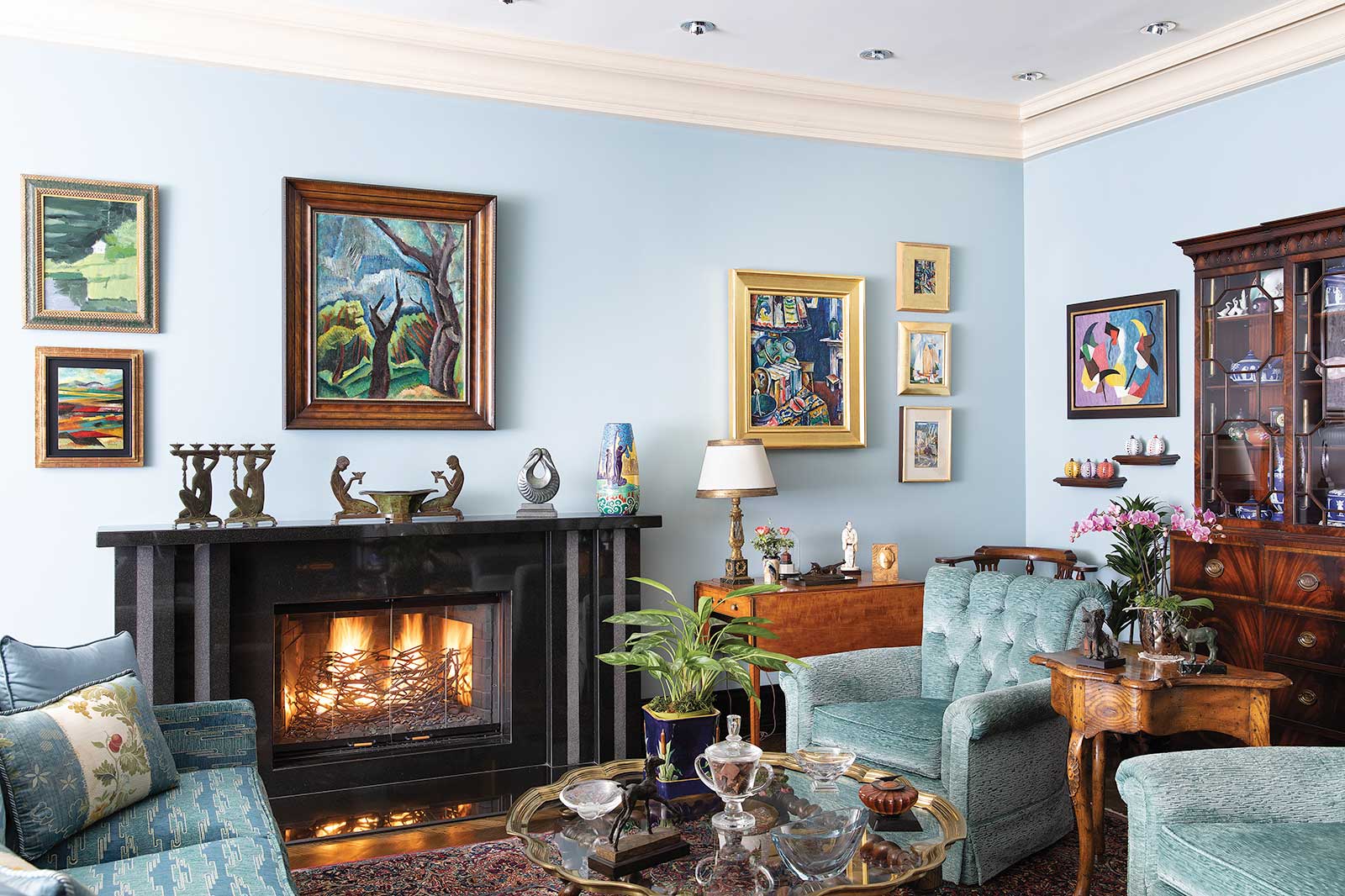 To the left of the fireplace in the living room are, from top, White House I, 2012, oil on board, by Alex Katz, and New Mexico Landscape, 1940 oil on board, by Andrew Dasburg (1887-1979). Above the mantel is Connecticut Landscape, 1911, oil on canvas, by Max Weber (1881-1961). On the right are is Interior, 1918-19, oil on canvas, by Preston Dickinson. Next are, from top, Dickinson’s Interior, 1922, oil on paper; Sailboats with Red Piling, 1925, oil on board, by Herman Trunk; and Blue House in the Woods, 1956, oil on parchment, by Werner Drewes (1899-1985). On the adjoining wall is Carnival, 1937, oil on canvas, by George L.K. Morris (1905-1975). Beneath it are five Pumpkins, porcelain, by Yayoi Kusama. On the mantel, from left, is Table Garniture, 1920-21, bronze, commissioned by Gorham, by Emory P. Seidel (1881-1954). Steve Kestrel’s Circle of Cranes, 1988, bronze, is to the right, next to a 1920 Longwy Art Deco French majolica vase. On the table are, from left, Young Samurai, 1950, ivory carving with hand painted watercolor decoration, by Ryushe and Cyclidic Head, 1915 (cast 1974), bronze, by Max Weber (1881-1961). The bronze sculpture on the coffee table is Proud Pony, 1930, bronze, by Renée Sintenis (1888-1965).
Both took classes with renowned art historians in college, which helped refine their innate attraction to fine art. Maurice studied with the art historian Meyer Schapiro at Columbia College. “He made you delve into what art was all about as well as its role in civilization.” Margery studied with Alfred Frankenstein, the San Francisco Chronicle art critic, at Mills College. “It was my first opportunity to see fabulous American art,” she says.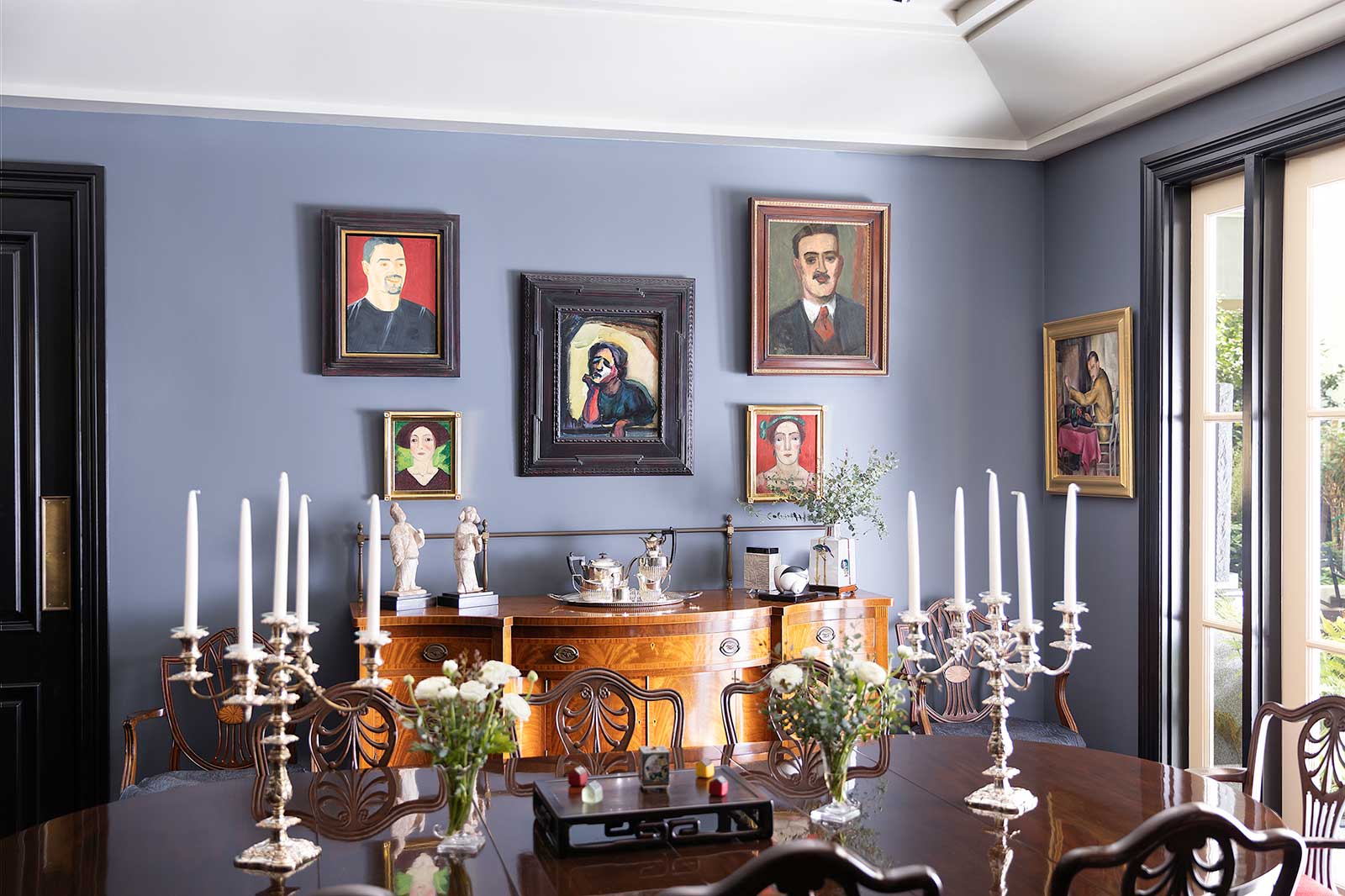 Above the sideboard in the dining room are (top to bottom, left to right) Juan, 2003, oil on board, by Alex Katz; Woman’s Head, 1908, oil on canvas, by Abraham Walkowitz (1878-1965); Self-Portrait, 1921, gouache, by Barbara Morgan (1900-1992); Red Tie, 1929, oil on canvas, a self-portrait by Milton Avery (1885-1965); and Woman’s Head, 1908, oil on canvas, by Walkowitz. Next to the window is Artist at Easel, 1929, oil on canvas, by Konrad Cramer (1888-1963). On the sideboard are, from left, male and female Chinese ceramic figures, Tang Period, 618-907 CE; a Mappin & Webb English coffee service, 1903; Vase, 1999, porcelain, by Jun Takegoshi; and Covered Vessel, 2011, ceramic and glass, by Kondo Takahiro. On the stand on the dining table are four Glass Houses, 1985, by Katsuya Ogitha.
“After we were married, we were in a gallery on La Cienega when I spotted an etching by John Sloan,” Margery relates. “It was called Stealing the Wash.” It was the beginning of their collection of more than 75 works on paper by Sloan. They had begun collecting European art before they assembled their Sloan etchings. “We later realized the Southern California sun could be devastating to the works on paper, sold them and turned our attention to the artists of the Stieglitz Circle,” Maurice adds.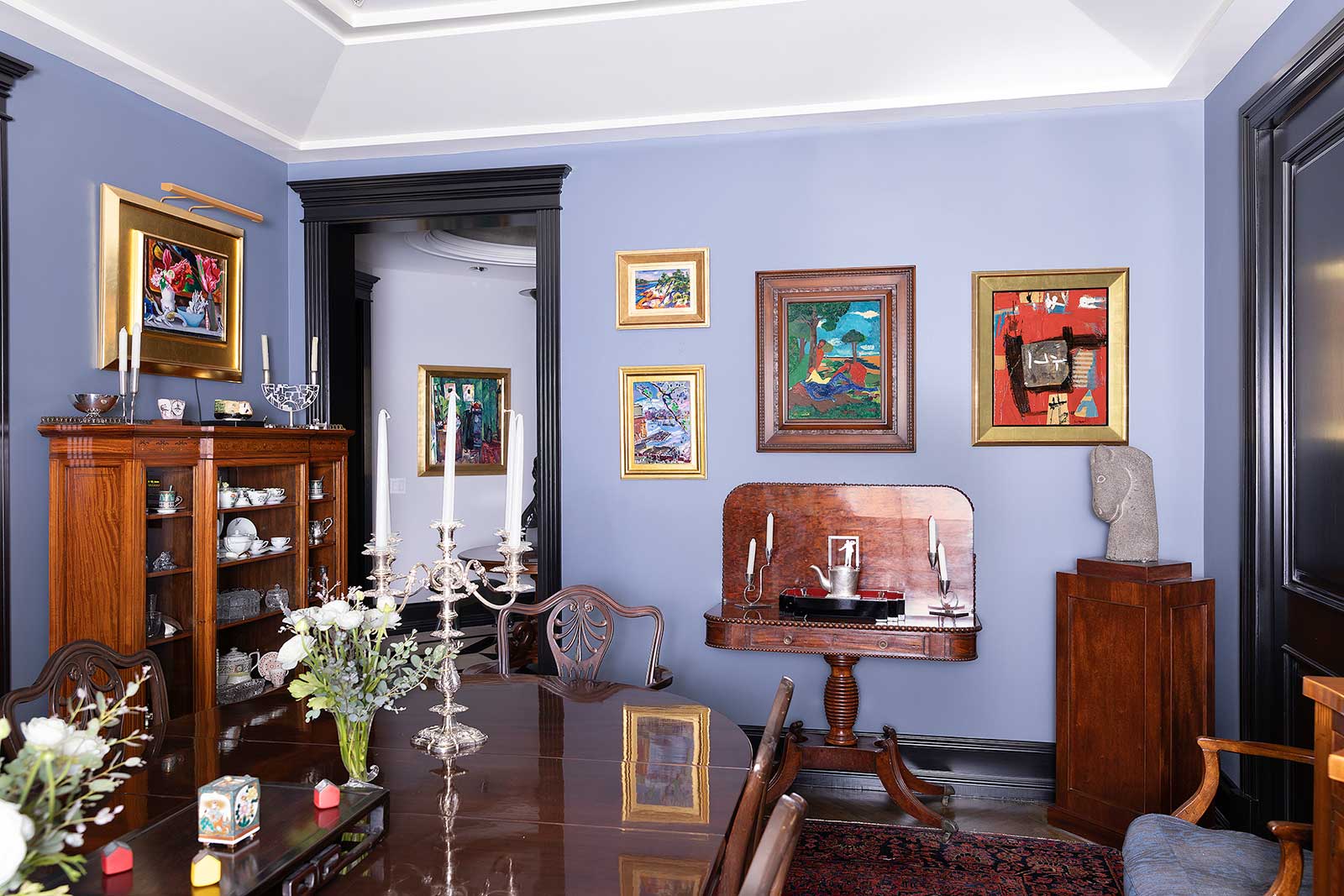 On the left in the dining room is Untitled, 1930, oil on canvas, by Joseph Stella. Next to it is a sterling silver Wien Werkstatt candlestick by Hagenauer. Through the doorway is Interior-Capri, 1924, oil on canvas, by Vaclav Vytlacil (1892-1984). To the right of the door are, top to bottom, left to right, Souvenir from Maine, 1913, oil on board, by Andrew Dasburg (1887-1979); Weehawken Sequence, 1904-1910, oil on canvas, by John Marin (1870-1953); Nymph Surprised by Satyrs, 1965, oil on canvas, by Bob Thompson (1937-1966); and The Return, 1954, oil and collage on canvas, by Emerson Woelffer (1914-2003). On the pedestal is Colt—Head of a Young Horse, 1931, bluestone, by John Flannagan (1865-1952). On the American Regency game table, 1830, is a sterling silver teapot, Sixteen Years, 1997, by Christina Smith.
“The early 20th century was one of the greatest eras of American artistic expression,” he continues. “Many of our artists studied or traveled in Europe where they saw the work of the Fauvists, expressionists, cubists and others. They came back and combined the movements into an American idiom.”
Noting that “there isn’t a white wall in the house,” Margery adds that they both respond to color in the art they collect, and they like when an artist paints with a heavy impasto. “I like to see the brushstrokes,” Maurice says, “representing the effort the artist put into the work. We have a number of studies by Alex Katz. We’ve met him many times and visited his studios in New York and Lincolnville, Maine. He starts with a drawing and, later, oil studies before beginning his highly finished large paintings. We like the painterly quality of the small studies.”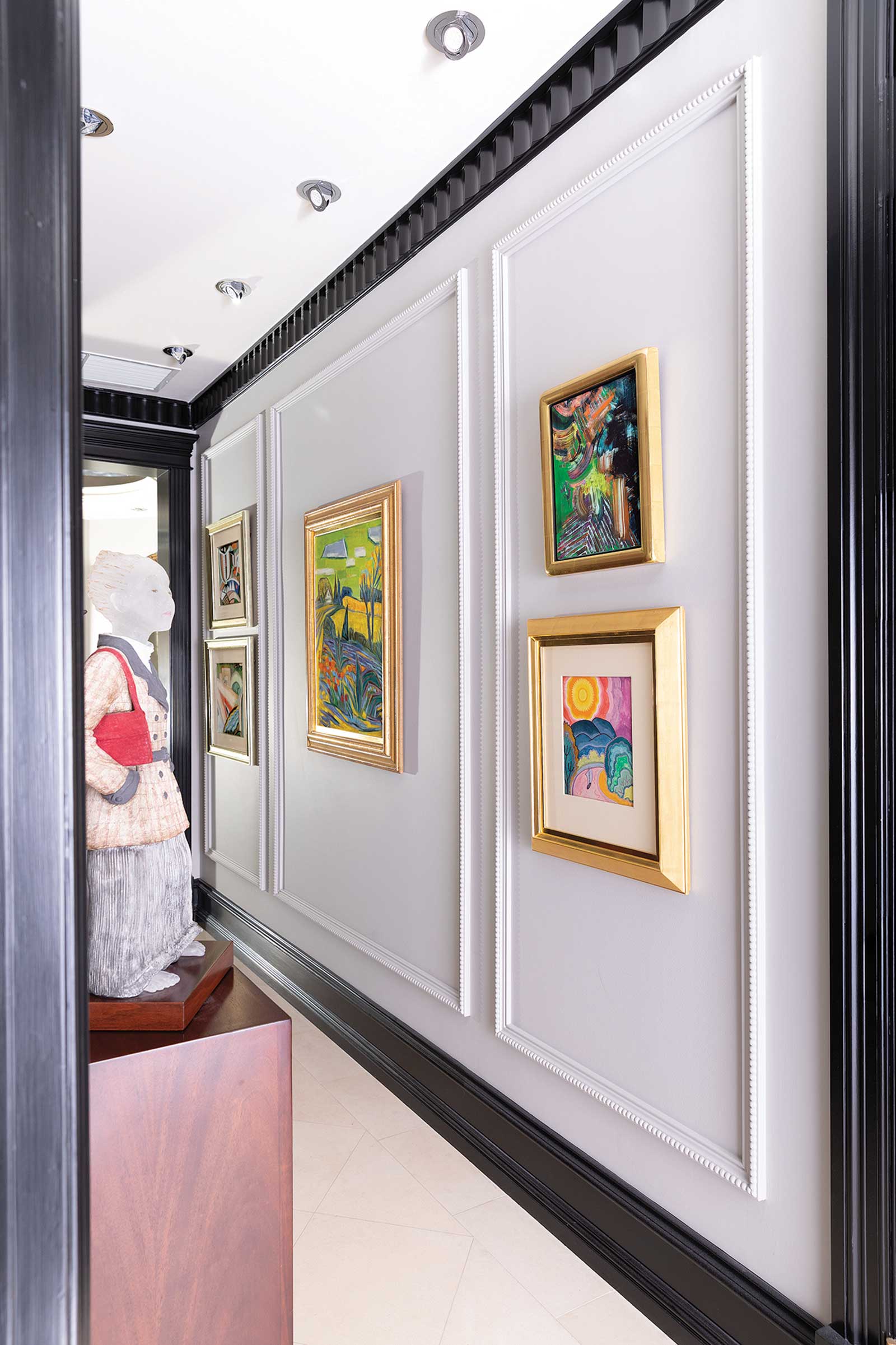 On the left in the hallway to the master bedroom, is Alligator Bag, 2010, ceramic and glass, by Vivian Wang. The large painting is Indian Summer, Missouri, 1960, oil on canvas, by Werner Drewes (1899-1985). On the right, from the top, are Study #4, 2014, oil on canvas, by Tam Van Tran, and Boat on River, 1911, gouache, by Konrad Cramer (1888-1963).
The couple has focused on American painting and sculpture up to the late ’20s including works by John Marin, Marsden Hartley, Max Weber, Arthur Dove, Joseph Stella, Oscar Bluemner and Leon Kroll. Over the years, they also acquired works of later 20th-century art including Japanese ceramics as well as glass by artists such as Richard Marquis and Vivian Wang. In addition, they have extensive collections of French Quimper faience and English Wedgwood stoneware. Commenting on the Quimper ware, Margery notes, “It’s not fine art, but it’s charming. We use it every day and some of it is for display.”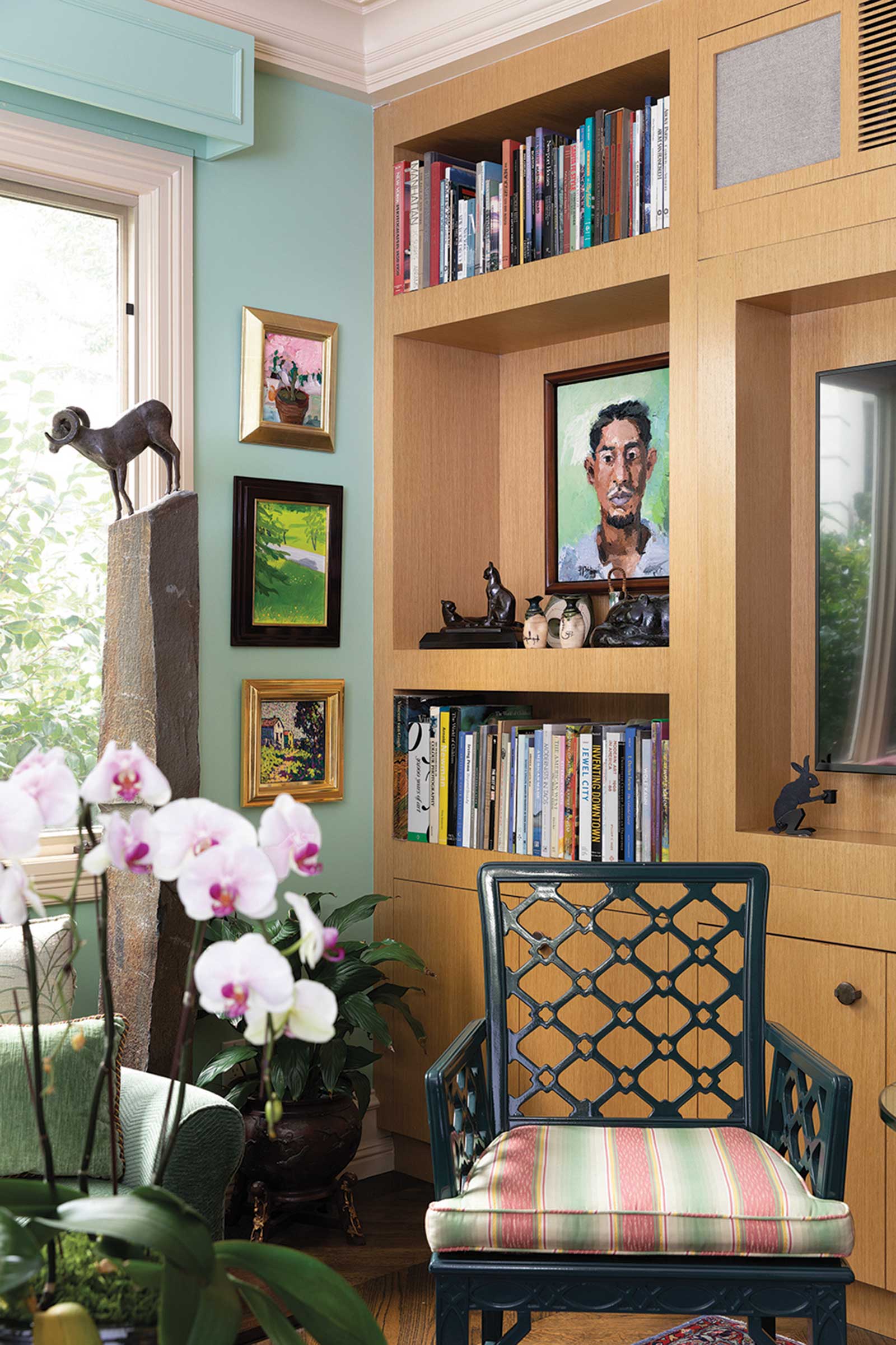 In front of the window in the den is Gwynn Murrill’s Bighorn Sheep Maquette, 2008, bronze on a basalt base. On the wall are, from top, Azalea, 1964, oil on board, by Paul Wonner; Road #1, 2003, oil on board, by Alex Katz; and Landscape, 1910-15, oil on canvas, by Hugh Breckenridge. In the bookcase is Efrain, 2009, oil on canvas, by John Sonsini. Beneath it are sculptures by Wilhelm Hunt Diederich (1884-1953): Two Resting Cats, 1918, bronze, and Rabbit candlestick, 1935, black steel and cut sheet metal. On the right of the shelf is Cat with Green Eyes, 1930, bronze, by William Zorach (1889-1966).
They first saw a piece by Marquis at the home of their friends and noted collectors, Richard and Carolyn Barry. “I loved it,” Maurice notes. “We looked for a piece for four years until we met a dealer in Palm Springs who represented the artist. He contacted Marquis who had a piece he was going to keep for himself but was willing to sell to us.”
Their friends Sonny and Gloria Kamm have an extensive collection of teapots. The Kamms had challenged Christina Smith, a California silversmith and jeweler, to create a sterling silver teapot that is now part of their collection. The Katzes have also acquired a piece from Smith that complements the period silver in their collection.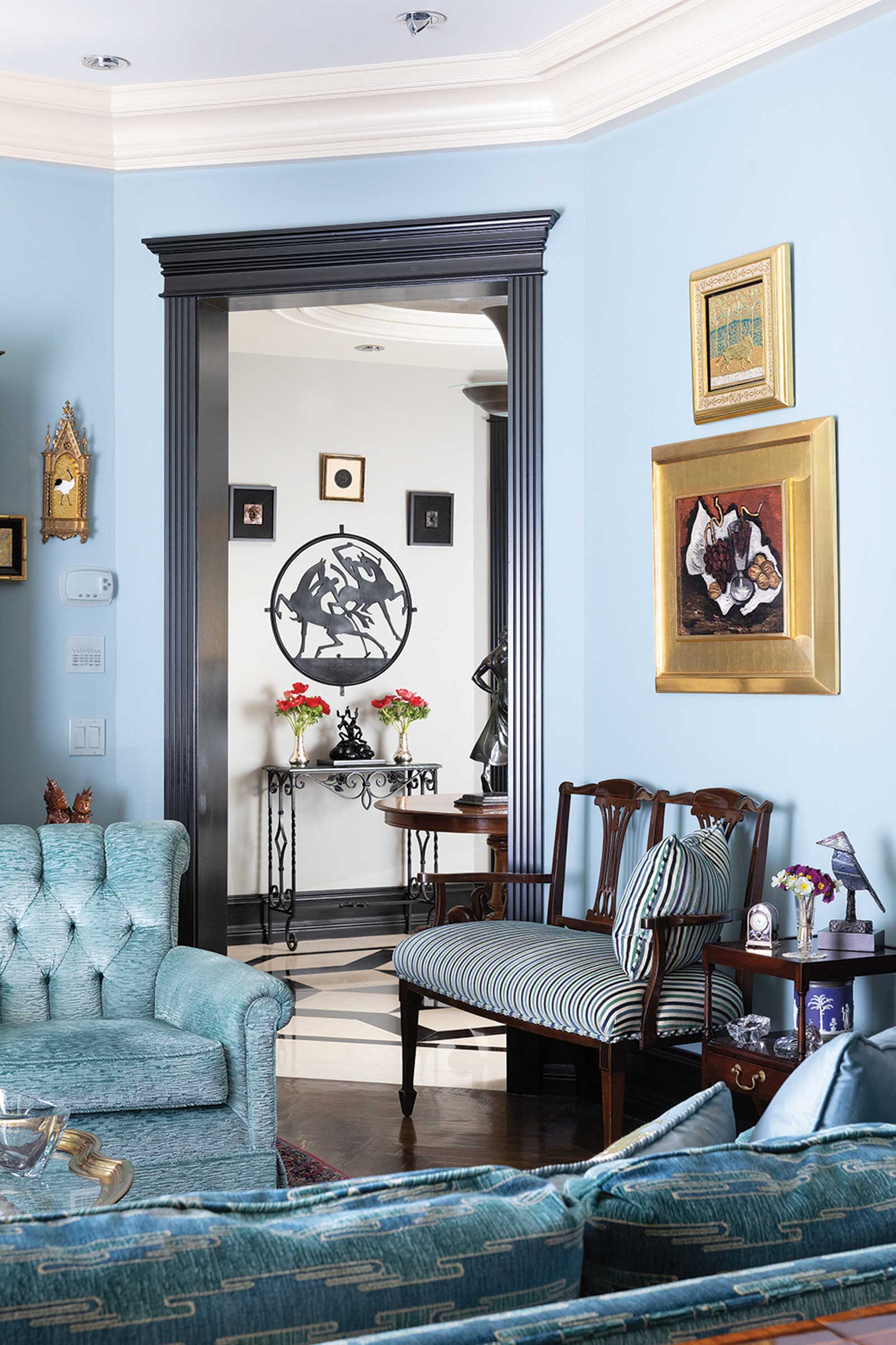 To the left in the living room is Endangered Species-Red Crowned Crane, 2003, by Kay Jackson, in a 19th-century Gothic revival frame. To the right of the doorway are Jackson’s Endangered Species-Lion and Still Life, 1926-27, by Marsden Hartley (1877-1943). On the table is Colored Bird, 1960 (cast in 1979), polychromed bronze, by Max Weber (1881-1961). Through the doorway is a tondo, Polo Players, circa 1930, by Wilhelm Hunt Diederich (1884-1953). Above it is a Wedgwood basalt plaque, 1850, and on either side are bronzes in black frames, Collette and Helga, 2002, by Robert Marx. The bronze beneath the Diederich is Two Hares on a Mole Hill, 2001, by Barry Flanagan (1941-2009).
“Larry Fleischman at Kennedy Galleries showed us paintings from John Marin’s Weehawken Sequence,” Maurice says. “He told us we should buy 10 of them. They were only $2,000 or $3,000 at the time. We should have listened to him!”
Sometimes pieces came into the collection in more colorful ways. “We saw a painting in Joyce Treiman’s studio and fell in love with it,” Maurice relates. “She had put it in a beautiful, elaborate frame. She came to dinner one night and handed us a paper bag containing the painting but no frame. She said, ‘You’re not getting the damn frame. I paid a dollar for it at a swap meet and you’re not getting it.’ We asked her about the frame for five years until she came to dinner another time, threw a paper bag on the table and said, ‘Here’s the damn frame.’ We showed it to a well-known framer who told us ‘You have a great example of an 18th-century Spanish Baroque frame!’”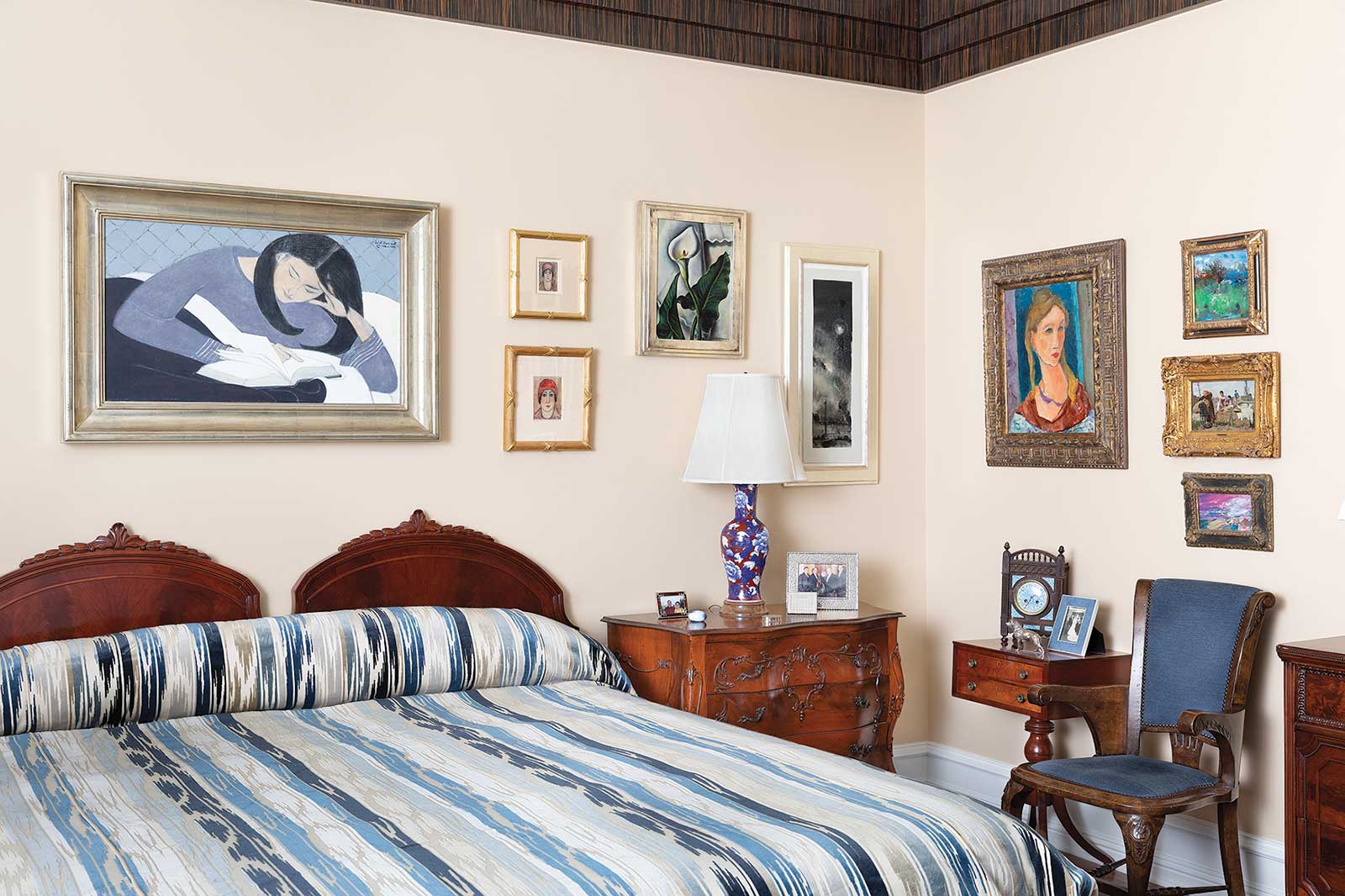 Above the bed in the master bedroom is Ona When Young, 1970-80, oil on canvas, by Will Barnet (1911-2012). Next to it are two watercolor and pencil drawings of Women’s Heads, 1902 and 1905, by Abraham Walkowitz (1878-1965). Above the lamp is Calla Lily-Still Life, 1930, oil on board, by Umberto Romano (1905-1982). In the corner is 50th Anniversary of the Golden Gate Bridge, 1986-89, monoprint and etching, pastel and gold leaf, by Joseph Goldyne. Above the cherry and white birch American sewing stand, 1810-20, is Girl’s Head, 1950, oil on board, by Gerrit Hondius (1891-1970). On the right are, from top, Landscape for Leaden Echo, 1989, oil on plywood, by Joyce Treiman (1922-1991); Italian Genre Scene, 1870, oil on board, by Pio Joris (1843-1922); and Treiman’s Sky Pink, 1984, oil on board, in an 18th-century Spanish Baroque frame.
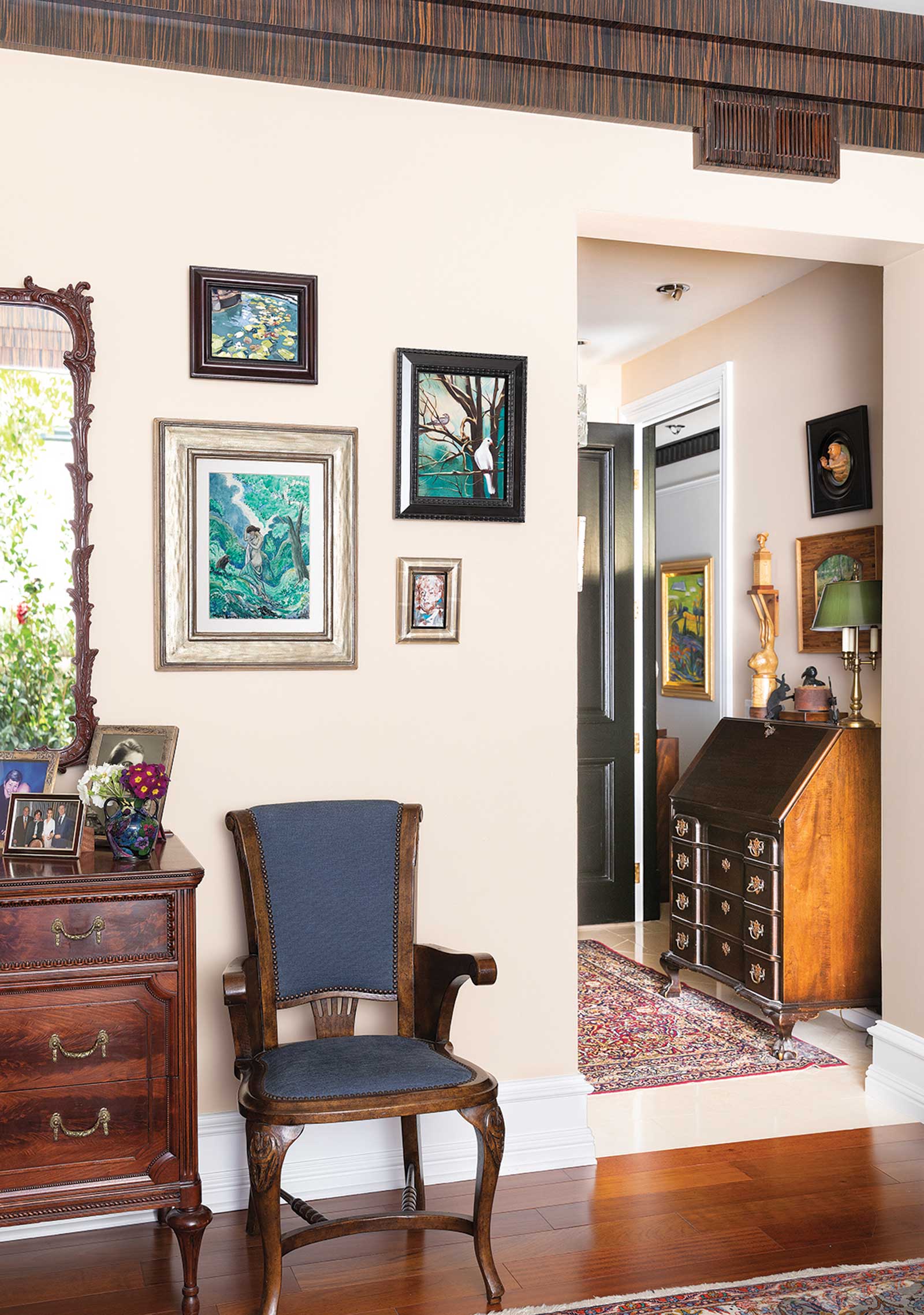 In the master bedroom, top to bottom, left to right, are Plein Air, 2007, oil on panel, by Rebecca Campbell; Nude, 1913, watercolor on paper, by Edward Middleton Manigault (1887-1922); Campbell’s Winter’s Hope, 2006, oil on board; and Portrait of a Man, 1989, oil on canvas, by Joyce Treiman (1922-1991). On the desk are various wood and bronze sculptures by John Frame. Through the far doorway is Indian Summer Missouri, 1960, oil on canvas, by Werner Drewes (1899-1985). Above the desk is Self-Portrait, 1998, a framed wood sculpture by John Frame. Beneath it is Tenax Vitae, 1997, oil on wood panel, a double portrait of John Frame by Jon Swihart.
They purchased Leon Kroll’s Still Life in Window-Ogunquit at ACA Galleries. “I think it’s the best painting he ever did. It remains one of our favorite works,” Maurice remarks. “We went back and forth making offers to his widow who kept changing her mind on the price.” Another favorite painting, Nymph Surprised by Satyrs, by Bob Thompson, hangs in their dining room. Thompson produced over 1,000 paintings before his death at the age of 28. “He was one of the greatest American colorists,” Maurice explains. “He was inspired by artists from the past, as here by Poussin. It’s such a harmonic painting.”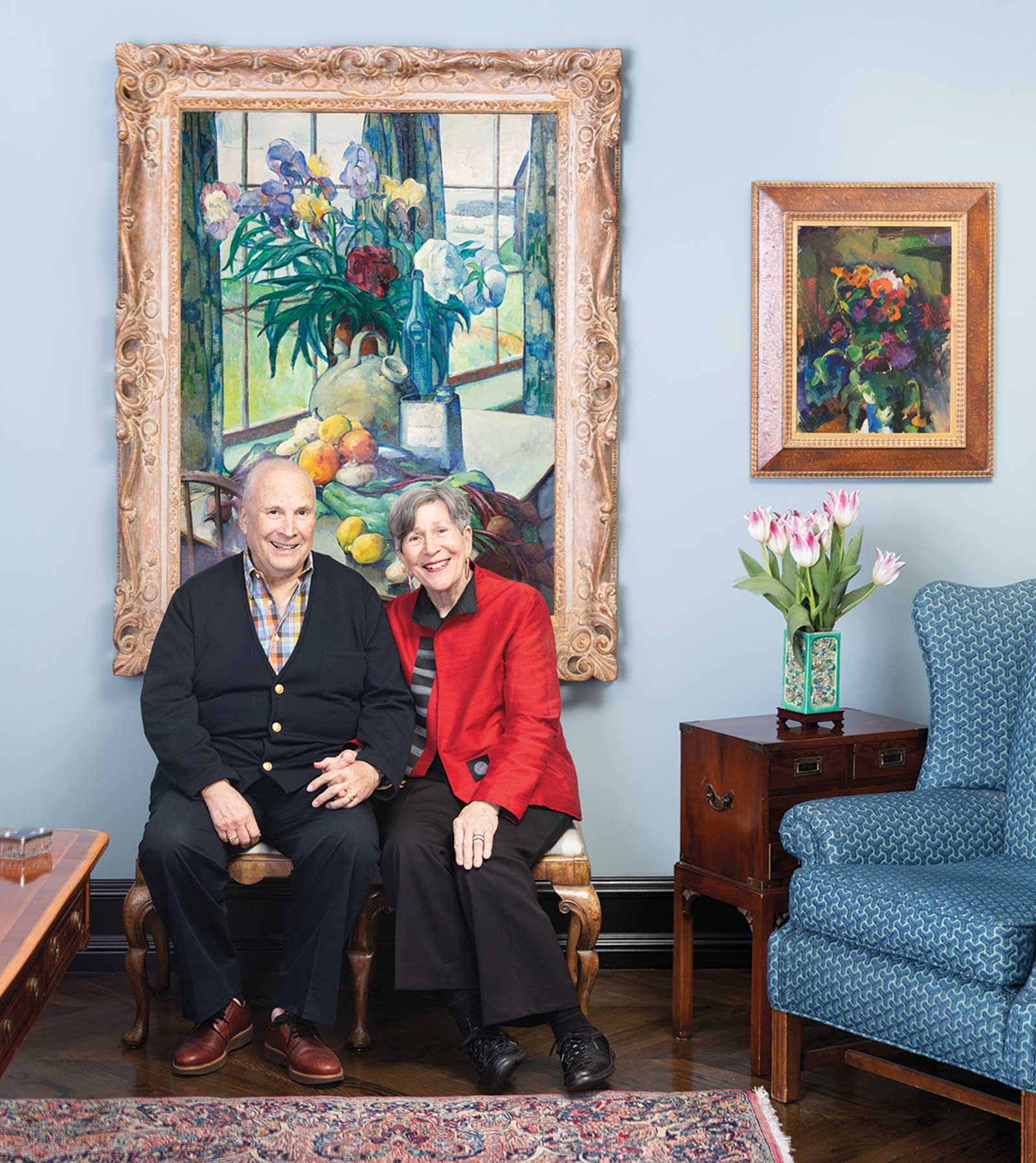 The collectors sit in front of Still Life in Window-Ogunquit, 1915, oil on canvas, by Leon Kroll (1884-1974). To the right is Still life with Flowers, 1913-16, oil on canvas, by Morgan Russell (1886-1953).
They credit not only their friends for introducing them to artists but a number of noted dealers and scholars. Maurice explains, “John Driscoll, Carole Pesner at Kraushaar Galleries, Debra Force, Linda Hyman, Richard York and Jay Cantor introduced us to artists with whom we had not previously been acquainted. John Driscoll showed us to the work of Edwin Dickinson of whom we hadn’t heard. We later gave our Dickinson to the Huntington Museum in San Marino, California, where it is on continual exhibition. These dealers fostered our education.” —
Powered by Froala Editor