In 1977 Calvin Tomkins wrote one of his “profiles” in The New Yorker on Romare Bearden (1911-1988). It was titled “Something Over Something Else” referring to a quote from Bearden. Commenting on his paintings of interiors he noted Dutch painters who had influenced him.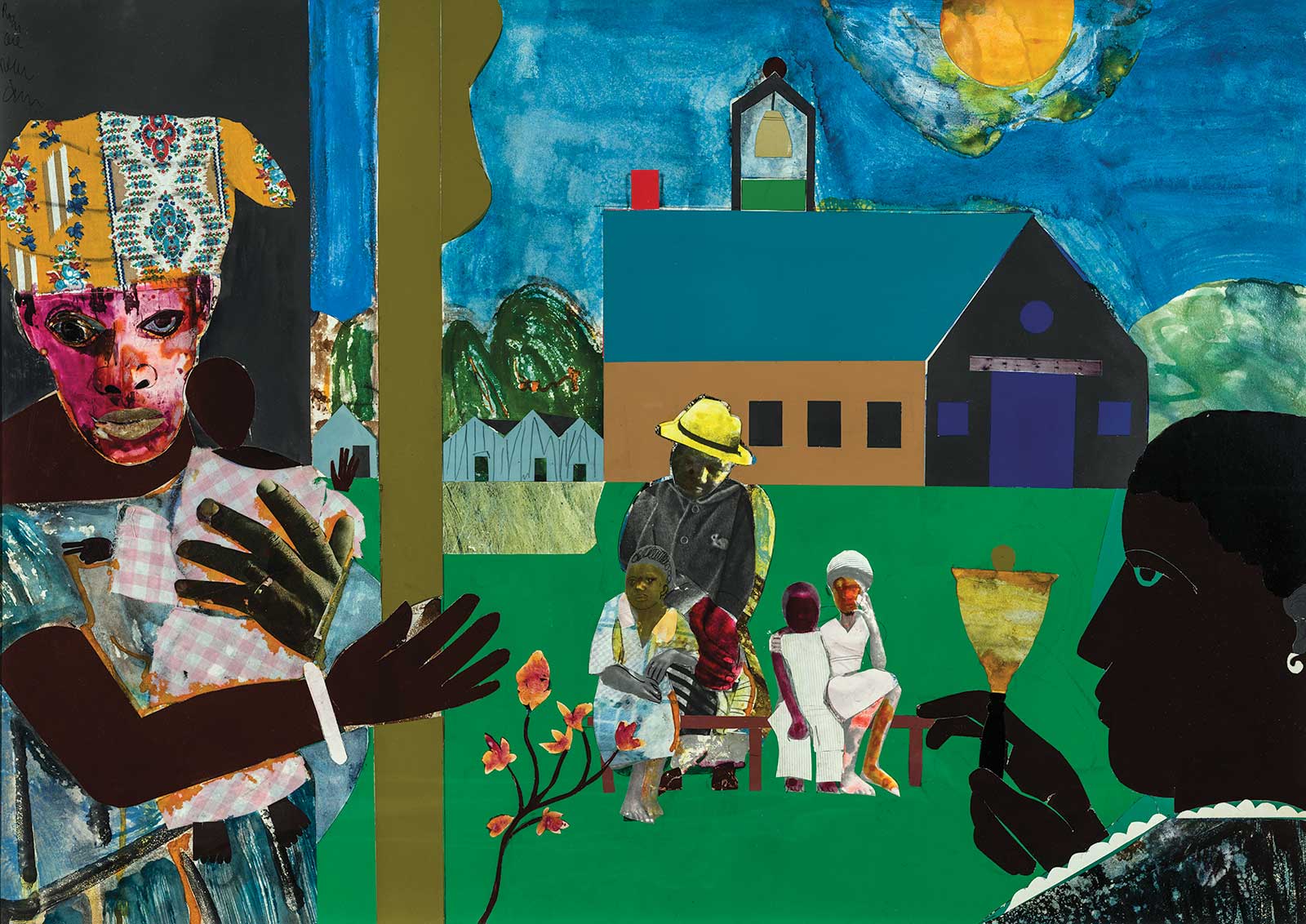 Romare Bearden (1911-1988), Profile/Part I, The Twenties: Mecklenberg County, School Bell Time, 1978. Collage on board. Kingsborough Community College, The City University of New York. © Romare Bearden Foundation/VAGA at Artists Rights Society (ARS), New York. Photo by Paul Takeuchi.
“I found that, especially with Vermeer and Steen, a lot of the work was controlled, like Mondrian’s, by the use of rectangles over rectangles. I really think the art of painting is the art of putting something over something else, and in a way these new pictures of mine, while they used representational images, were more abstract than the work I’d been doing before.”
At another time, Bearden said, “You put something down. Then you put something else with it, and then you see how that works, and maybe you try something else and so on, and the picture grows in that way.”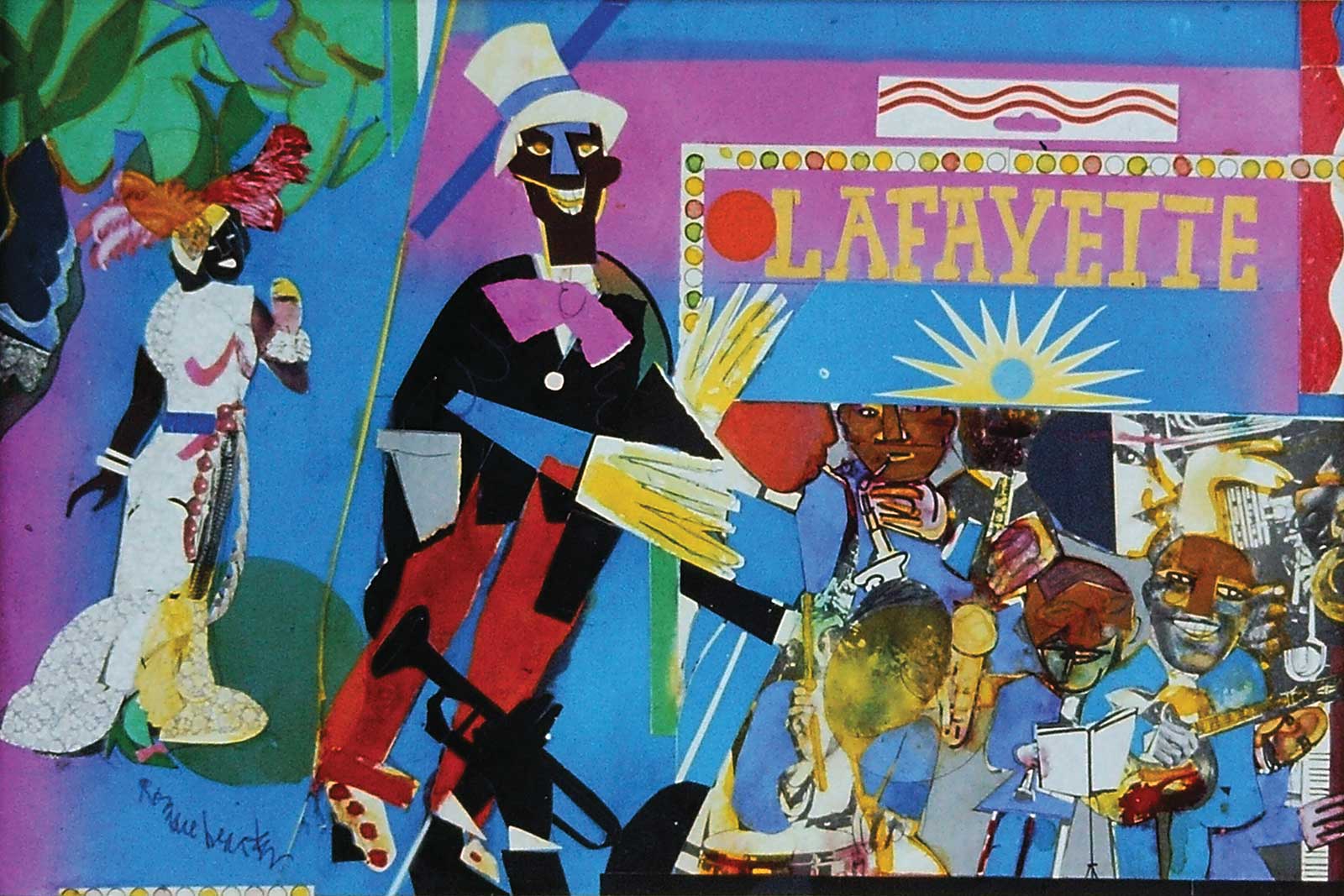 Romare Bearden (1911-1988), Profile/Part II, The Thirties: Johnny Hudgins Comes On, 1981. Collage on board. Courtesy of Rick and Monica Segal. © Romare Bearden Foundation/VAGA at Artists Rights Society (ARS), New York.
He was so moved by Tomkins’ article and its impact that he began a series of autobiographical collages that were shown in 1978 and 1981. Forty years later, his Profile Series has been reunited for an exhibition at the Cincinnati Art Museum, February 28 through May 24.
Julie Aronson, the museum’s curator of American paintings, sculpture and drawings, comments, “To see this stunning historic series brought together is an opportunity not to be missed. Bearden’s work defies easy categorization—he moved gracefully between abstraction and figuration with exceptional creativity and drew upon so many different traditions. Walking through this exhibition, with its combination of poetic images and words, is like having the artist whispering in your ear. It is an extraordinarily moving experience.”
The exhibition was organized by The High Museum of Art in Atlanta.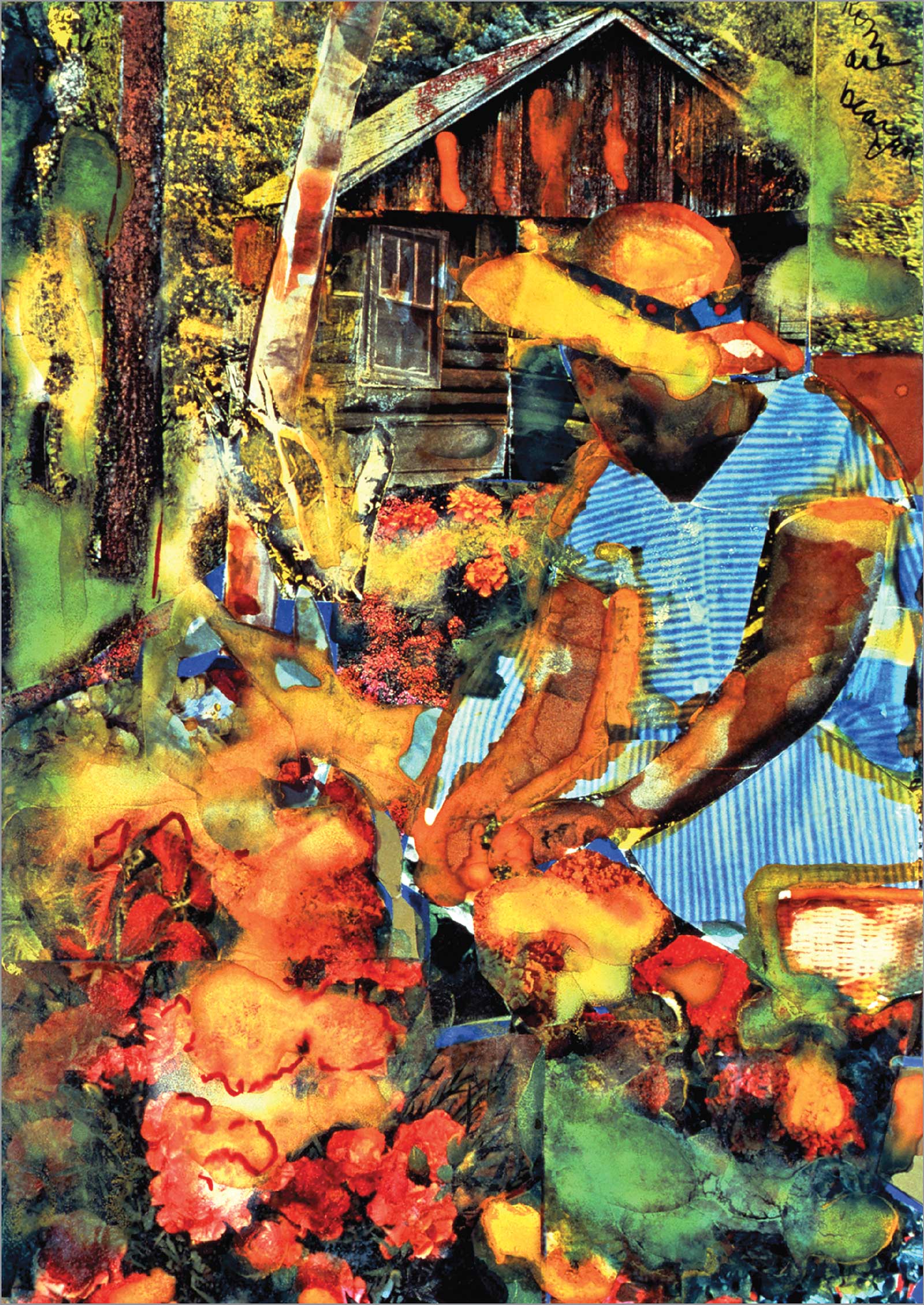 Romare Bearden (1911-1988), Profile/Part I, The Twenties: Mecklenberg County, Maudell Sleet’s Magic Garden, 1978. Collage on board. Collection of Pearson C. Cummin III and Linda Forrest Cummin. © Romare Bearden Foundation/VAGA at Artists Rights Society (ARS), New York.
Tomkins observed in The New Yorker, “Bearden believed…that the Negro was becoming something of an abstraction in the sixties, a sort of caricature or protest and injustice. For his own part, he wanted, as he said in 1964, to ‘establish a world through art in which the validity of my Negro experience could live and make its own logic.’ Bearden was concerned with art, not propaganda. ‘I have not created protest images,’ he said. ‘The world within the collage, if it is authentic, retains the right to speak for itself.’”
Bearden (who pronounced his first name as “ROH-mery”) was born in Charlotte, North Carolina, where his family lived with his paternal grandparents. The family later moved to Harlem and he would return to Charlotte for visits and to Pittsburgh to visit his maternal grandmother. His mother was an activist and their home was a magnet for people like Langston Hughes, W.E.B. DuBois and Duke Ellington who would become his first patron.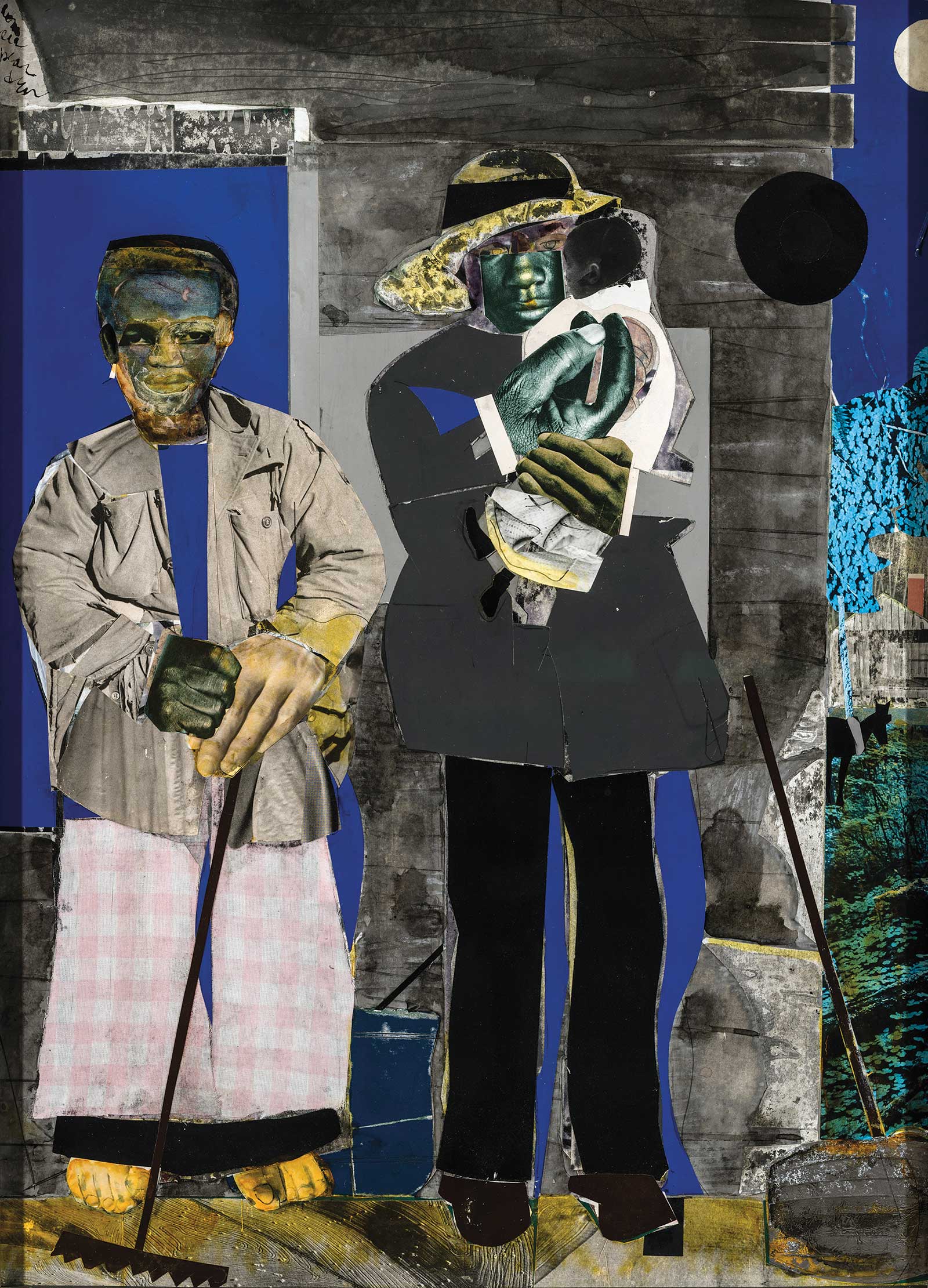 Romare Bearden (1911-1988), Profile/Part I, The Twenties: Mecklenberg County, Miss Bertha and Mr. Seth, 1978. Collage on board. Collection of Susan Merker. © Romare Bearden Foundation/VAGA at Artists Rights Society (ARS), New York. Photo by Paul Takeuchi.
The paintings in the Profile Series have subtitles written by the artist. Profile/Part I, The Twenties: Mecklenberg County, School Bell Time, has the text, “Once it was mid September again, it was back to Miss Pinkney and books, black boards, rulers and fingernail inspection.”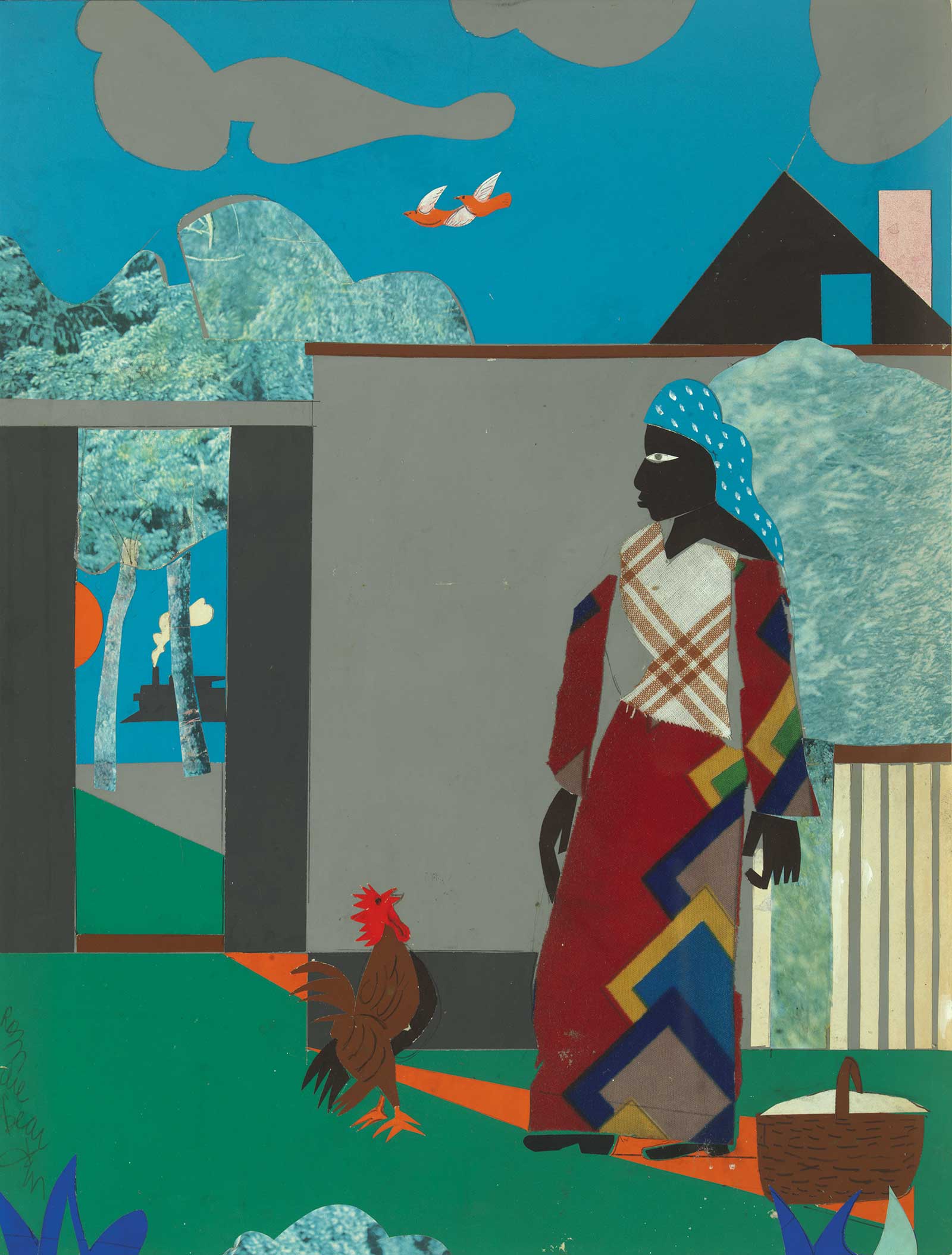 Romare Bearden (1911-1988), Profile/Part II, The Thirties: Pepper Jelly Lady, 1981. Collage on board. Joy and Larry Silverstein. © Romare Bearden Foundation/VAGA at Artists Rights Society (ARS), New York. Photo by Peter Harholdt.
For Profile/Part II, The Thirties: Johnny Hudgins Comes On, he wrote, “He was my favorite of all the comedians. What Johnny Hudgins could do through mime on an empty stage helped show me how worlds were created on an empty canvas.” For Profile/Part I, The Twenties: Mecklenberg County, Maudell Sleet’s Magic Garden he wrote the poignant phrase, “I can still smell the flowers she used to give us and still taste the blackberries.” —
Powered by Froala Editor