In the 1940s as New York became the center of the art world artists began to reject the tendencies of the past to create an “American” art that was primarily representational.
Barnett Newman (1905-1970) wrote, “We felt the moral crisis of a world in shambles, a world destroyed by a great depression and a fierce World War, and it was impossible at that time to paint the kind of paintings that we were doing—flowers, reclining nudes, and people playing the cello.”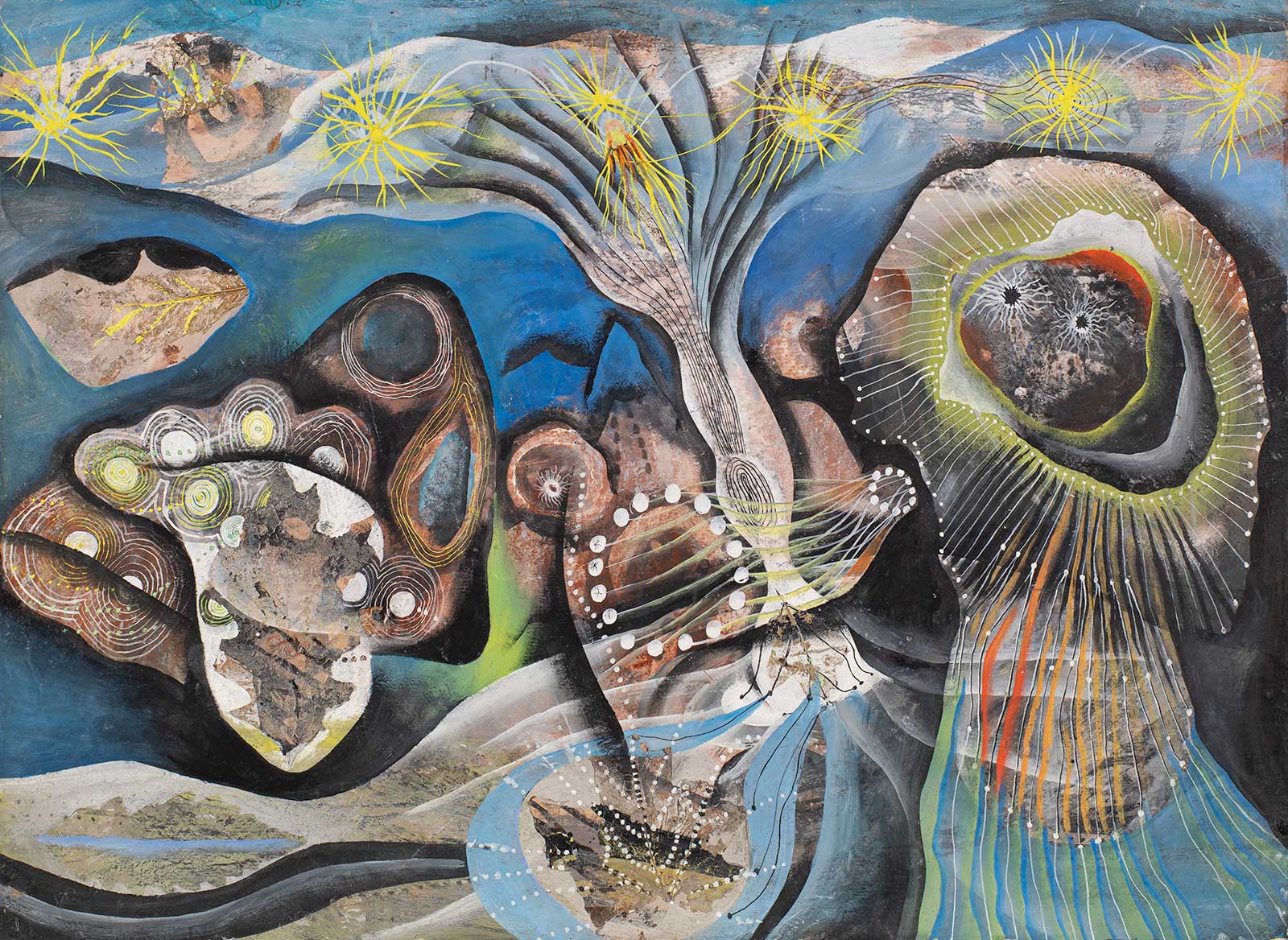 Gerome Kamrowski (1914-2004), Emotional Season #1, 1944. Mixed media with collage of painted leaves on board, 223⁄8 x 303⁄8 in., signed. Courtesy Michael Rosenfeld Gallery LLC, New York, NY.
The progressive art collective Federation of Modern Painters and Sculptors declared in 1943, “We condemn artistic nationalism which negates the world tradition of art at the base of modern art movements…Since no one can remain untouched by the impact of the present world upheaval, it is inevitable that values in every field of human endeavor will be affected. As a nation we are being forced to outgrow our narrow political isolationism. Now that America is recognized as the center where art and artists of all the world must meet, it is time for us to accept cultural values on a truly global plane.”
Michael Rosenfeld Gallery in New York is presenting the exhibition Globalism Pops BACK Into View: The Rise of Abstract Expressionism through January 25. The gallery notes, “The exhibition contextualizes a world-altering time when New York became the center of contemporary art—a time made particularly pertinent again by the isolationist and nationalist views that have now come to the fore in the political and social world of the early 21st century.”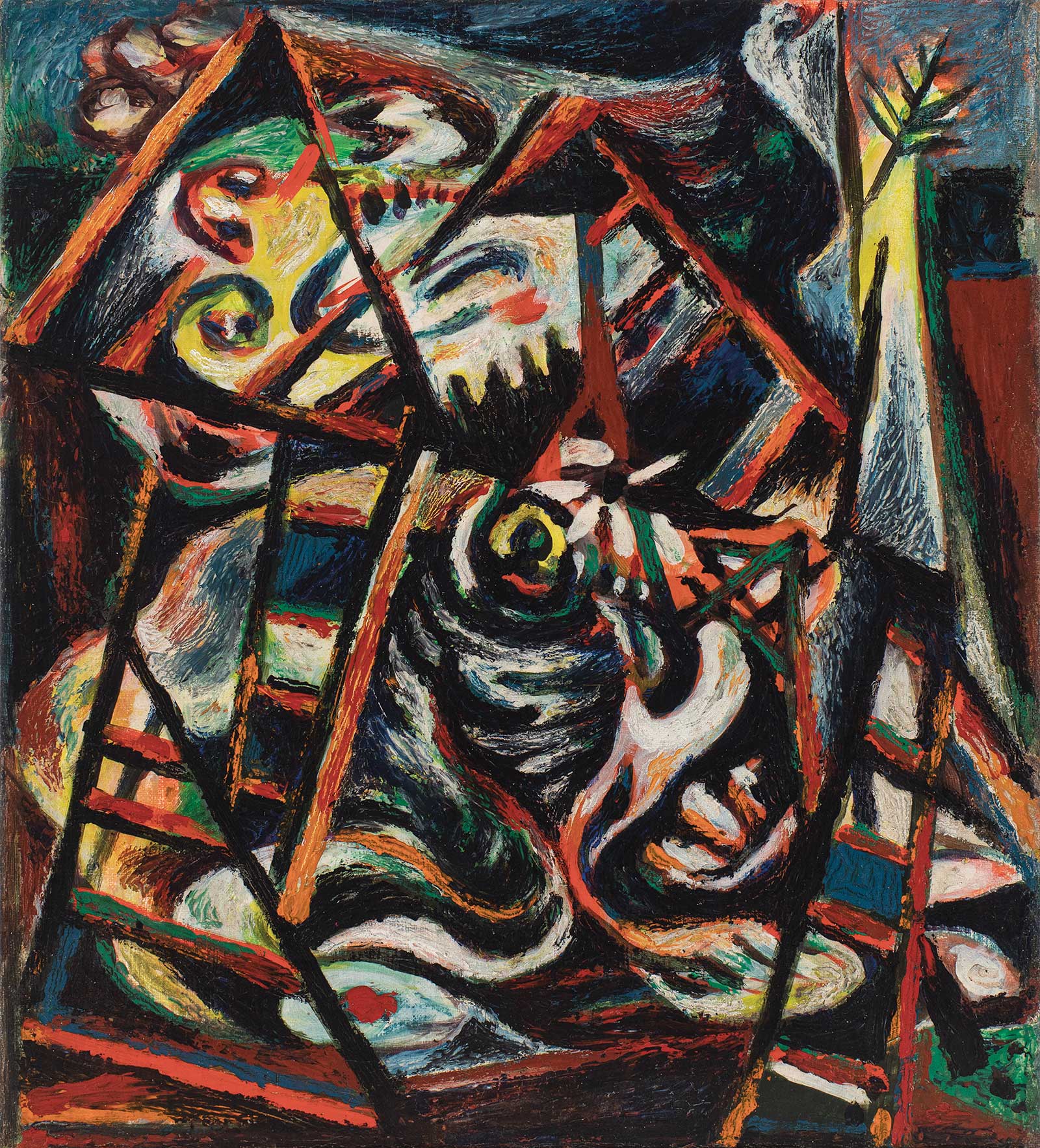 Jackson Pollock (1912-1956), Untitled (Composition with Ladders), ca. 1938. Oil on canvas, 181/8 x 163/8 in. Courtesy Michael Rosenfeld Gallery LLC, New York, NY.
The exhibition recalls the tumultuous days of the rise of abstract expressionism and is a response to scathing articles from the time by the conservative critic Edward Alden Jewell who battled it out in the pages of The New York Times with Federation artists Adolph Gottlieb, Mark Rothko and Newman. They wrote to Jewell, “We do not intend to defend our pictures. The make their own defense.”
Rosenfeld recalls abstract expressionism of the 1940s as “my entry point into American art and remains a personal passion of mine. I am grateful to Barbara Cavaliere for sharing her expertise and insight into this integral period in the narrative of abstract expressionism.”
Cavaliere, art historian and curator of the exhibition, was co-curator in 1975, of the exhibition Subjects of the Artist: New York Painting, 1941-1947 at the Whitney Museum of American Art downtown branch.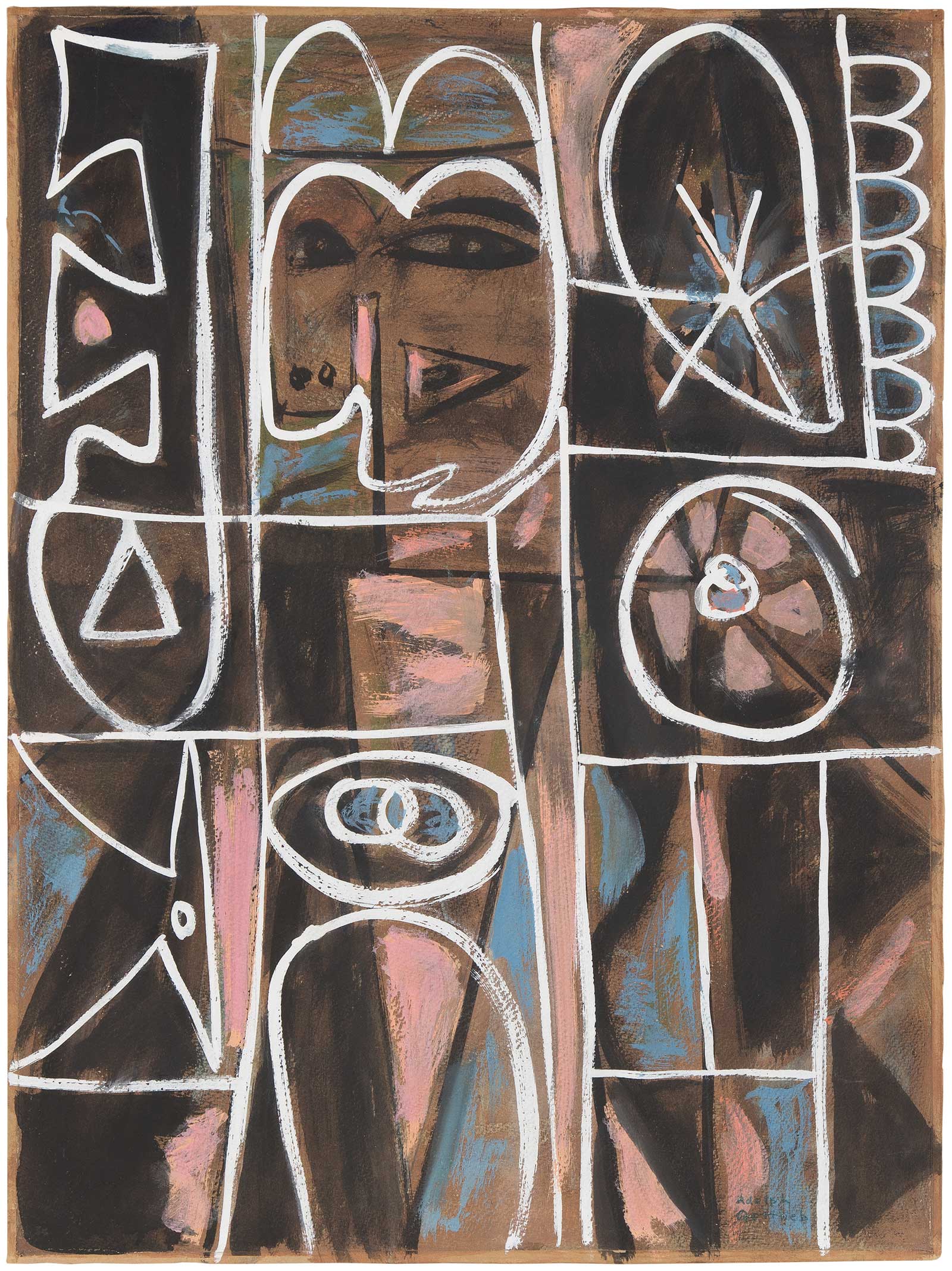 Adolph Gottlieb (1903-1974), Compartments of Memory, ca. 1949. Gouache on paper, 24 x 18 in., signed. Courtesy Michael Rosenfeld Gallery LLC, New York, NY.
Influenced by ancient symbols he saw in the Indigenous art of the American Southwest and other cultures, as well as the ideas of a “collective unconscious,” Gottlieb (1903-1974) painted a series of “pictographs” in the 1940s. In Compartments of Memory, circa 1949, calligraphic symbols are painted within a loose grid. Mary Davis MacNaughton, in her book with Lawrence Alloway, Adolph Gottlieb: A Retrospective, writes, “His pictographic images do not have specific meanings; rather, in the spirit of Jungian symbols they are deliberately ambiguous.”
In 1947 Gottlieb wrote, “The role of the artist, of course, has always been that of image-maker. Different times require different images. Today, when our aspirations have been reduced to a desperate attempt to escape from evil, and times are out of joint, our obsessive, subterranean and pictographic images are the expression of the neurosis which is our reality. To my mind certain so-called abstraction is not abstraction at all. On the contrary, it is the realism of our time.” —
Powered by Froala Editor