After World War II, Joseph Solman made ends meet by working five months a year at the pari-mutuel windows at Aqueduct and Belmont racetracks, drawing sketches of his fellow subway passengers on the journeys out and back. Solman’s $6 window (a $2 bet each on a horse to win, place or show) was popular with players for the Brooklyn Dodgers. His son, Paul, was impressed when his father would arrive home with their autographs. He writes, “Landing Jackie Robinson and Pee Wee Reese’s signatures: that was something. Meeting Bill de Kooning for a drink at the Cedar Tavern or hanging out with Milton Avery and his wife Sally: hey, they were just friends of the family.”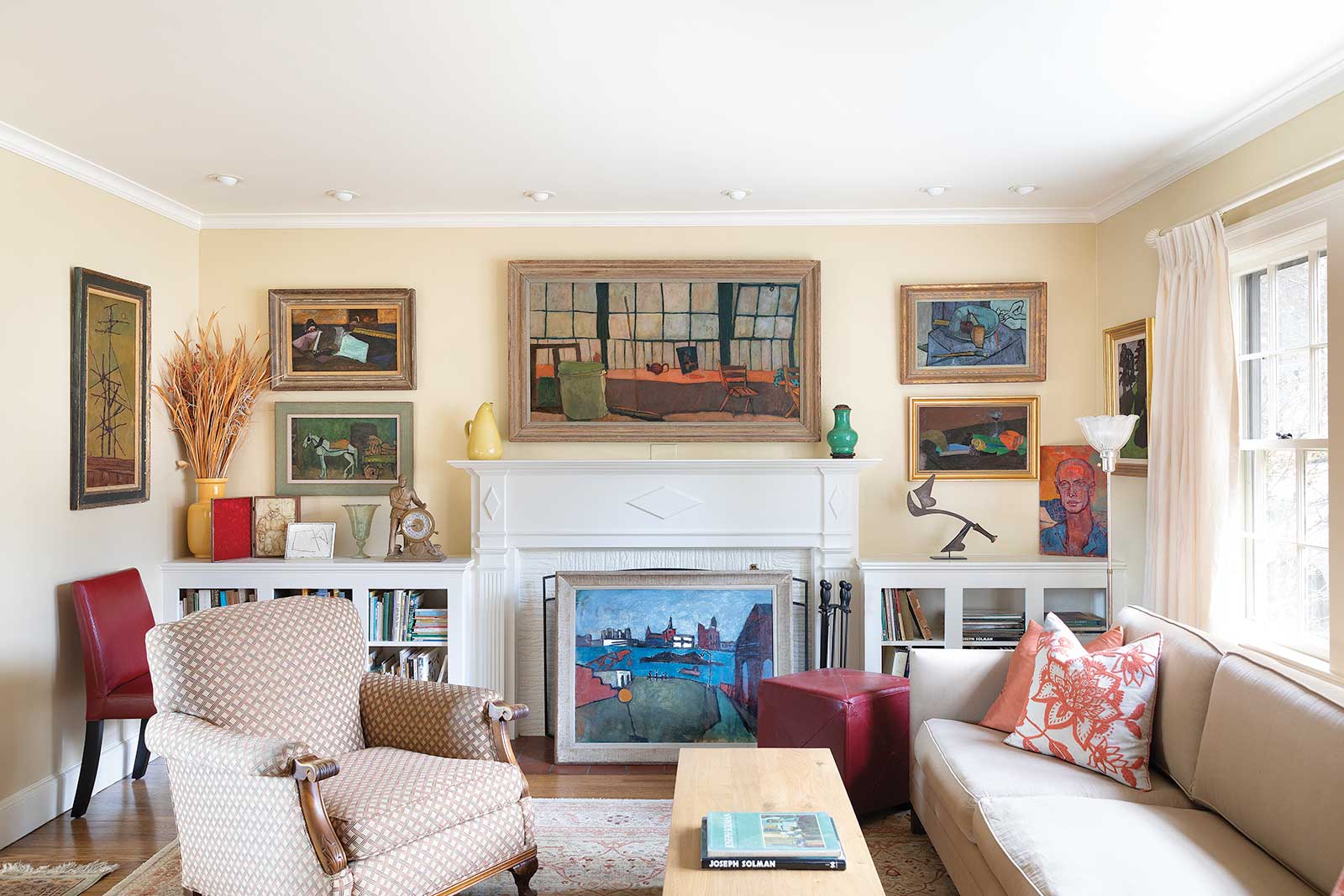 On the left is Antenna, 1961 by Joseph Solman (1909-2008). Along the top of the fireplace wall are left to right his Velasquez Print, 1942, Studio Interior, 1952 and Still Life, early 1940s. On the right on top of the bookshelf is his portrait of sculptor Peter Grippe, 1957. His painting, East River, 1935, is on the floor.
The paintings of the father who brought home autographs were bought by avid collectors such as Duncan Phillips of the Phillips Collection in Washington, DC, where one of the paintings is on display today. His work is in the collections of the Whitney Museum of American Art, the Hirshhorn Museum, the Fogg Museum at Harvard, Yale University Art Gallery and the British Museum.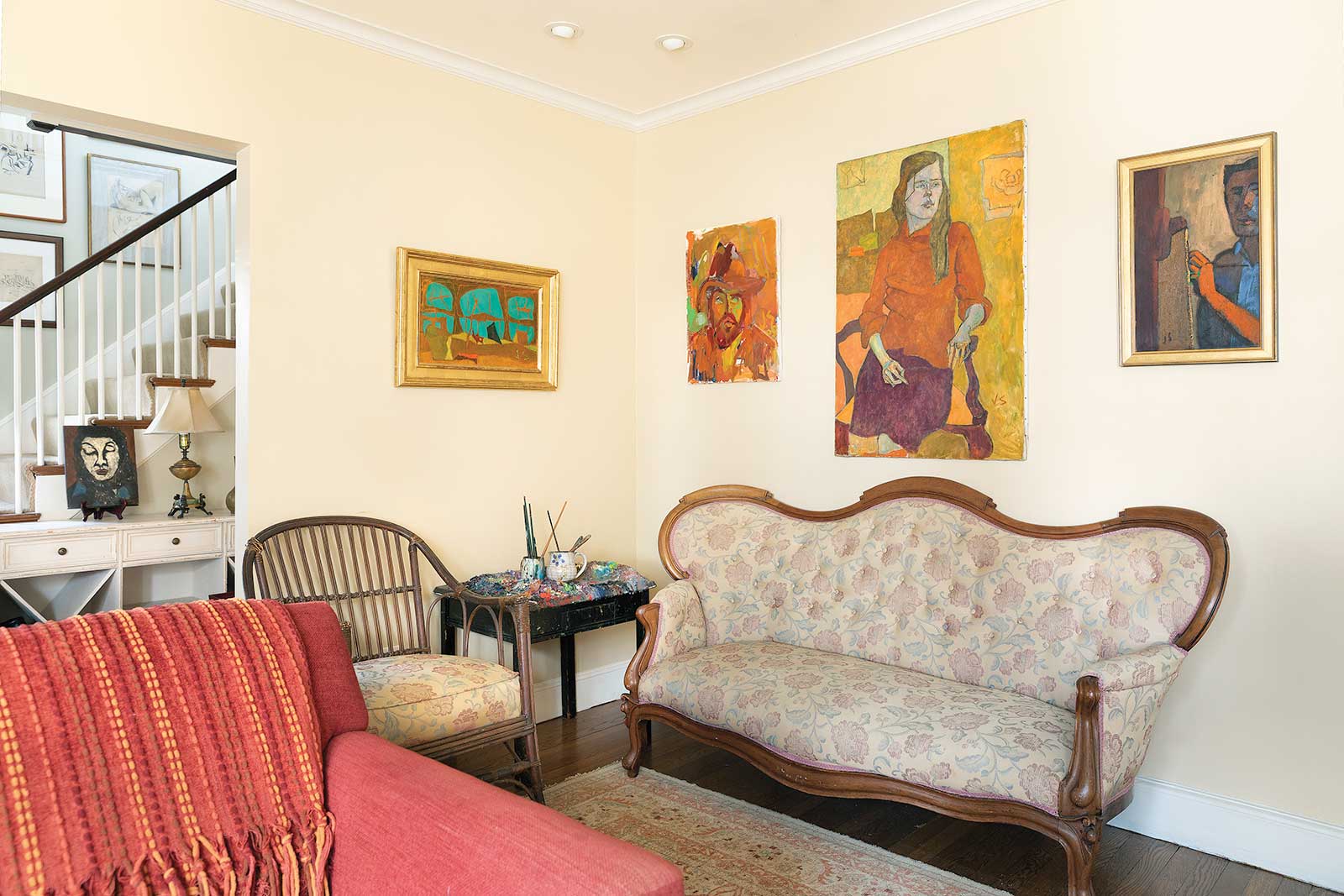 In the hallway is a portrait of Ruth Solman by Ben-Zion (1897-1987). In the foreground are four paintings by Joseph Solman (1909-2008), left to right Studio Interior, 1994, Man with Hat, 2005 (when he was 96), East Village Woman, 1973 and a Self-Portrait, 1939. The table with paint is from Joseph Solman’s “studio,” according to Paul.
Paul Solman and his wife, columnist Jan Freeman, now live with a collection of his father’s paintings and those of his contemporaries in their home near Boston. In a corner of their living room is another reminder of the artist. “The table with paint was my father’s palette in his ‘studio,’” Paul says, “the dining room of our apartment on 10th Street and 2nd Avenue in Manhattan. We moved there in the spring of 1952. My father died there, in his sleep, in 2008.”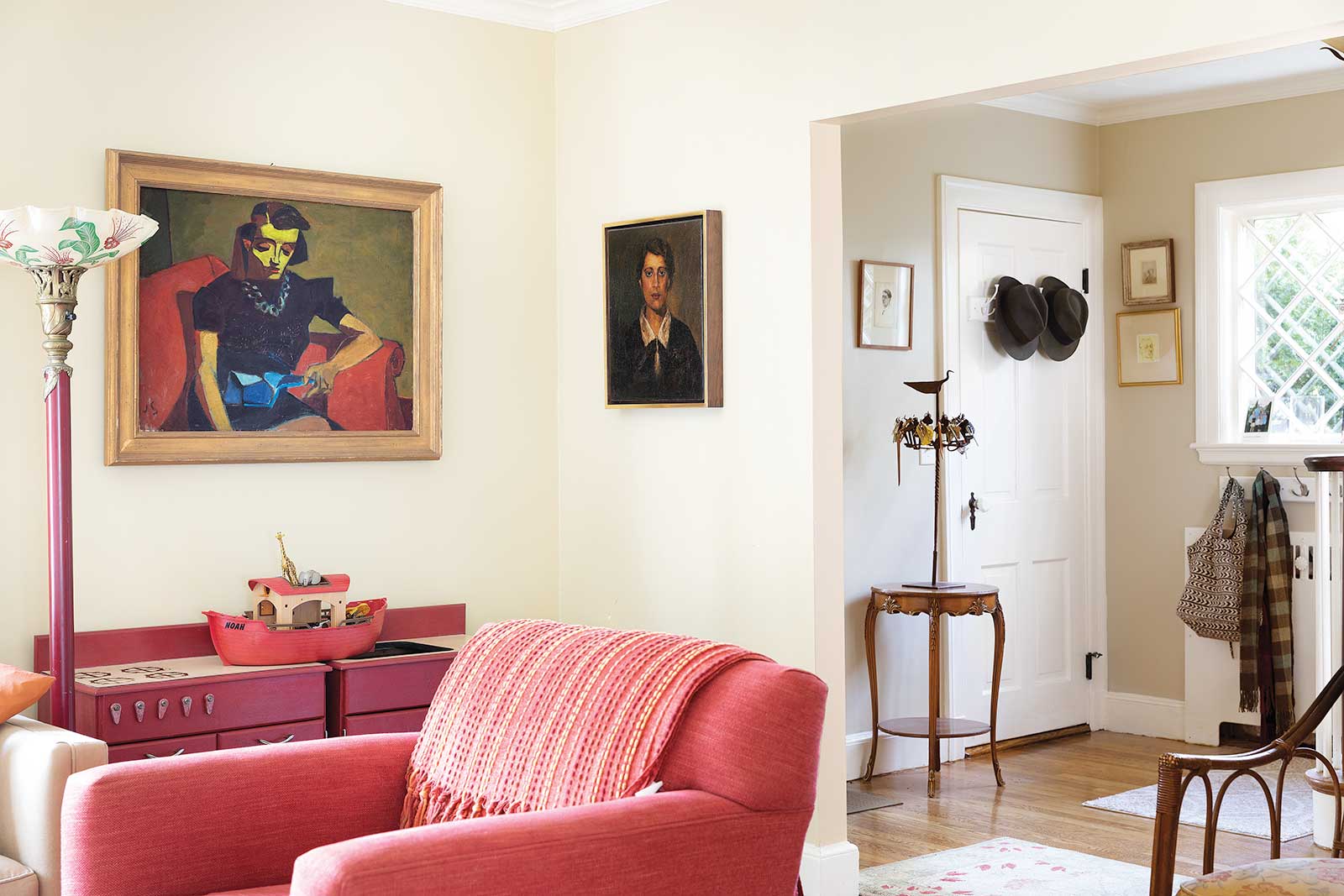 On the left are two portraits of his wife Ruth in 1931 and in 1938 by Joseph Solman (1909-2008). To the left of the door in the hallway is his Self-Portrait Sketch, 1928.
Joseph Solman was born in Vitebsk, now part of Belarus, in 1909 and immigrated to the United States with his family in 1912. He attended the National Academy of Design, even then taking the subway and sketching his fellow passengers. People “pose perfectly when they’re asleep” he observed. In 1935, he and other artists formed a group called “The Ten,” New York expressionist painters who expressed their individualism and opposition to the entrenched art world. In fact, in 1938, when the Whitney Museum was staging its annual exhibition, Paul notes, “it would reflect, in their eyes, the complacency of the art establishment. Once again, New York’s showcase of the status quo would exhibit the trendiest artists, the ones getting all the press. The tastemakers would not invite The Ten.”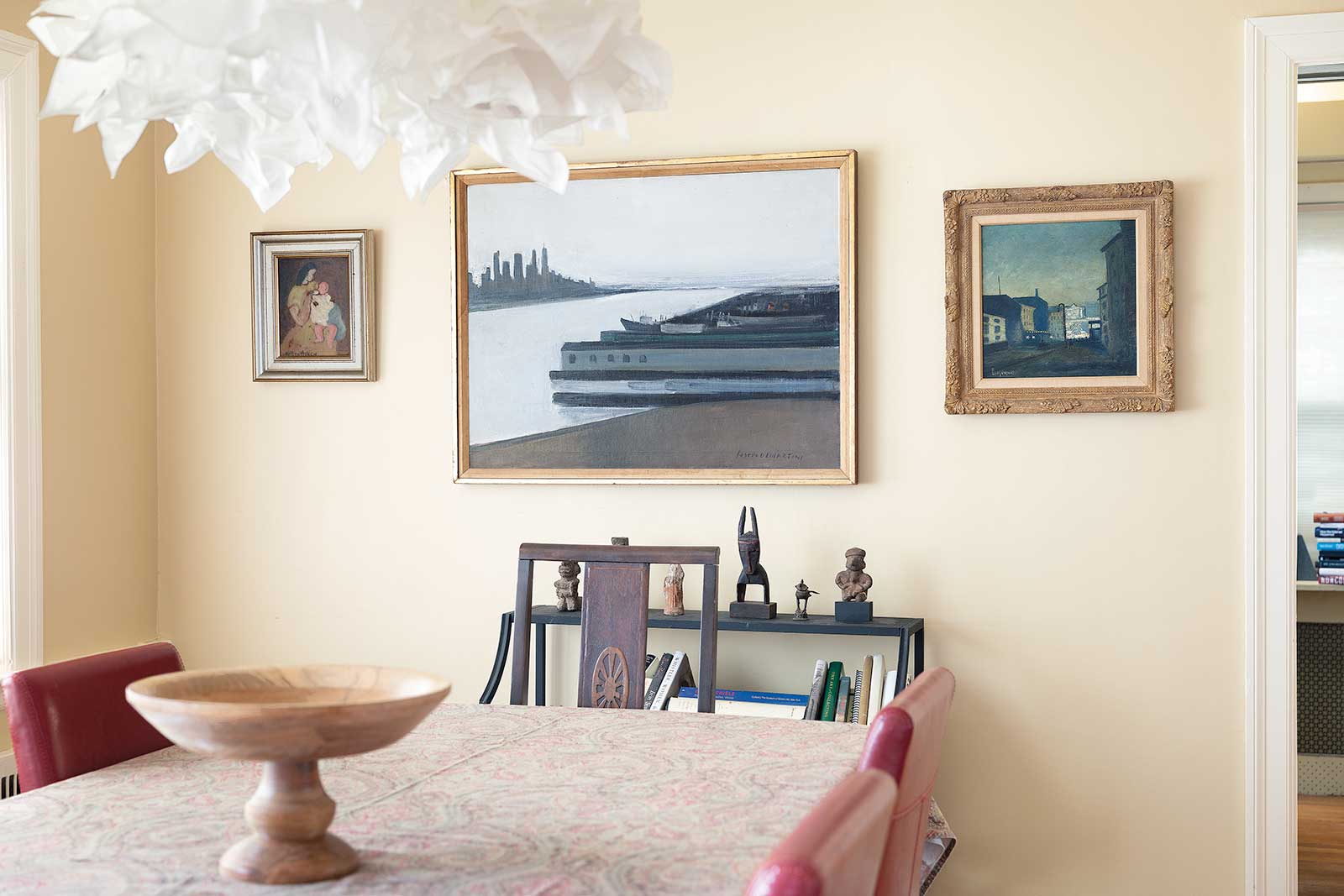 Hanging in the dining room are, left to right, Mother and Child by Milton Avery (1885-1965), a dock scene by Joseph De Martini (1896-1984) and City Scene, circa 1907, by Louis Eilshemius (1864-1941).
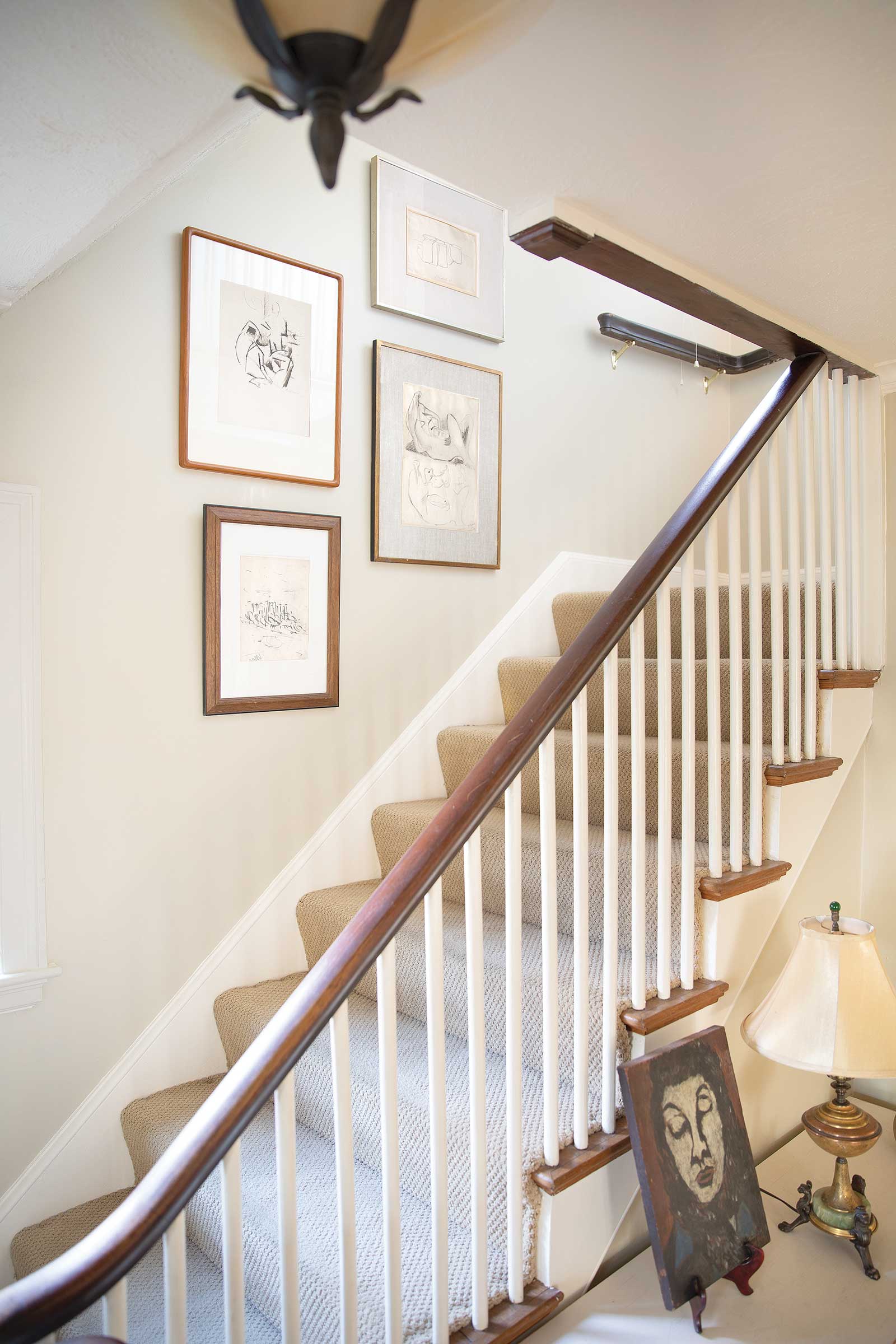 On the table below the stairs is a portrait of Ruth Solman by Ben-Zion (1897-1987). On the wall of the stairwell are—top to bottom, left to right—a drawing of figures by Roger de La Fresnaye (1885-1925), a drawing of geese by George Luks (1867-1933), a still life drawing by Giorgio Morandi (1890- 1964) and a drawing of reclining nudes by Henry Moore (1898-1986).They staged their own Salon des Refusés just down the street from the Whitney at the Mercury Galleries in the exhibition The Ten: Whitney Dissenters. The artists were Solman, Louis Schanker, Ilya Bolotowsky, Ben-Zion, Marcus Rothkowitz, Adolph Gottlieb, Nahum Tschacbasov, Lou Harris and Ralph Rosenborg.
Some of his fellow Tens wandered off into abstract expressionism (Marcus Rothkowitz became Mark Rothko). Solman, on the other hand, incorporated abstraction in his own form of realism. He wrote, “I have long discovered for myself, that what we call the subject yields more pattern, more poetry, more drama, greater abstract design and tension than any shapes we may invent.” In the ’50s he focused more on portraits. Paul writes, “On the surface, he was less abstract than before…My father thought of art itself not so much as transcendent as, in his words, ‘the greatest game in the world’: a game of line linked to color and shape, of subject matter fused with expressionism.” The family had moved to what would become the East Village in the late ’50s. In the ’60s, people began to wear bright colors—a heightened palette that appeared in his portraits. Later, the artist began making monotypes and sumi-wash paintings. Paul recalls his father sitting outside the cottage his parents had bought in Gloucester, Massachusetts, admiring the trees and remarking, “Look at the branches on that tree. Look what’s going on with them.” He then interpreted them simply in his wash drawings.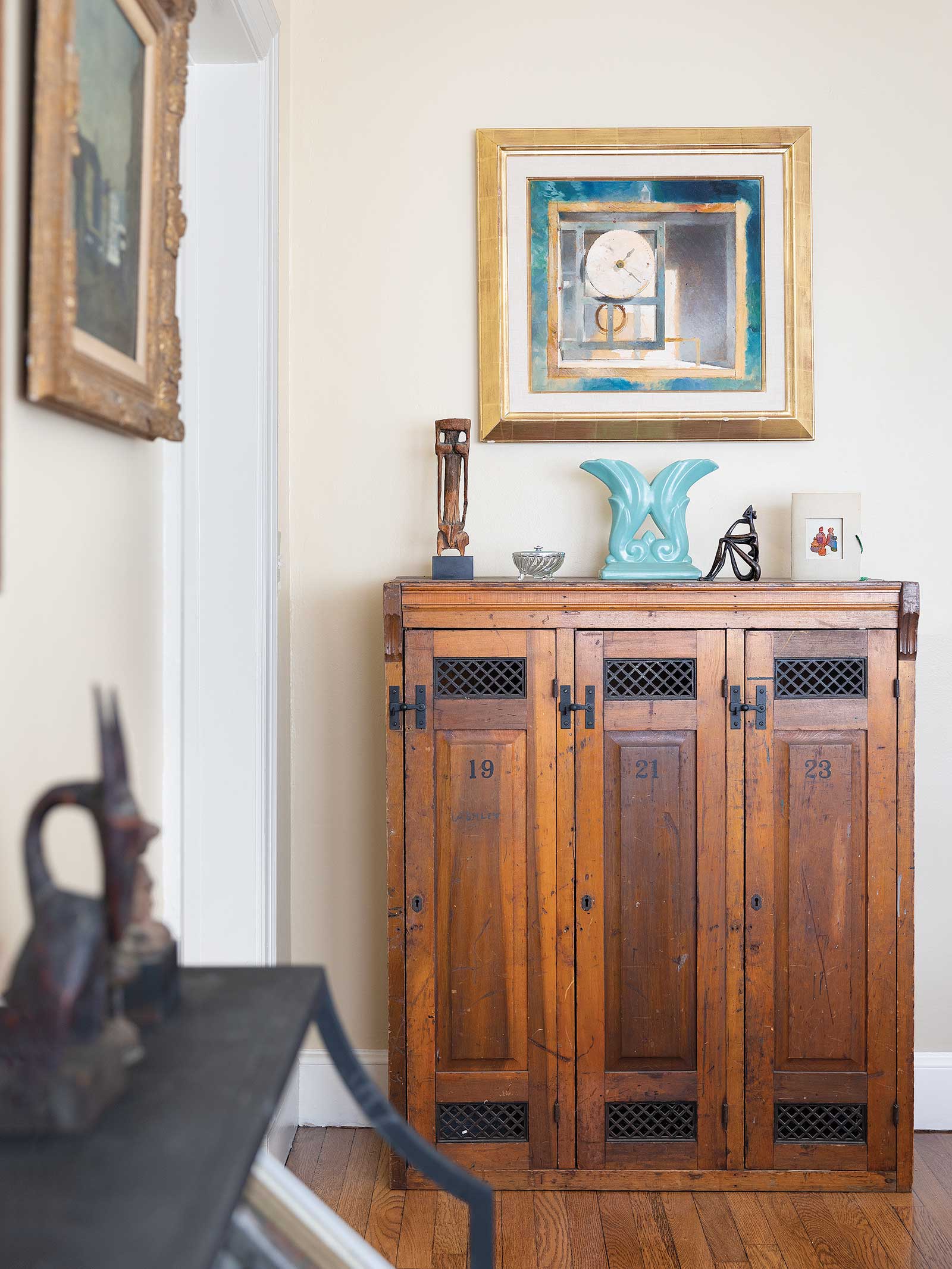 The painting on the left is City Scene, circa 1907, by Louis Eilshemius (1864-1941). Hanging above the antique school lockers is a study for a magazine cover, circa 1960, by Walter Tandy Murch (1907-1967). On top of the lockers are left to right a Dogon sculpture of a woman in wood and a bronze sculpture of a woman by Martin Craig (1906-?).
“My father was always popular with his fellow artists,” Paul explains. “In a world that was swept up in what he thought was faddish, he was always sure of his own ability reinforced by people whom he respected like Duncan Phillips, Joe Hirschhorn, Dore Ashton.”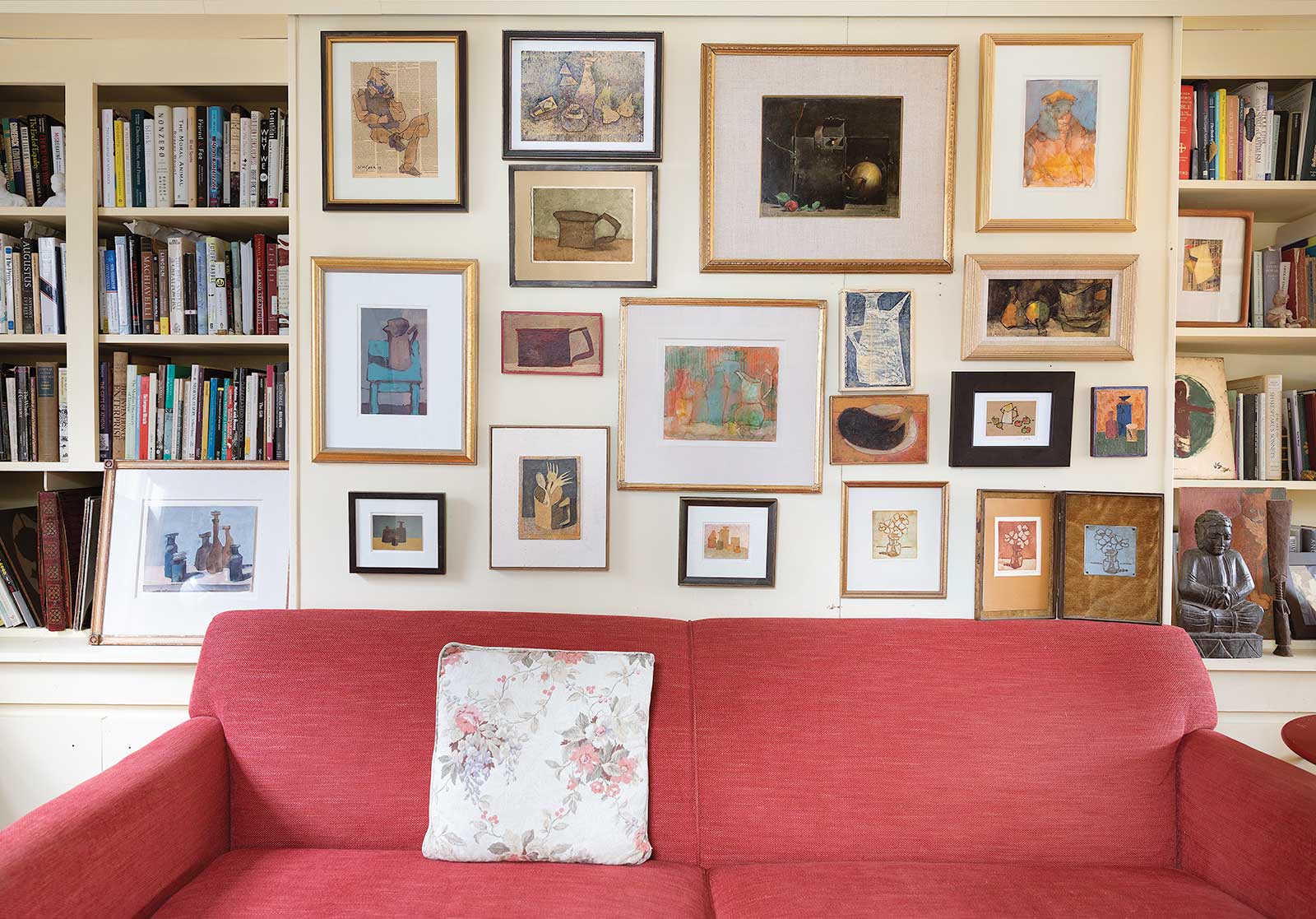 A wall of works by Hank Virgona (1929-2019).
Also prominent in the collection are the works of Hank Virgona (1929-2019). A generation younger than Joseph Solman, who was a great influence on him, Virgona “labored in obscurity,” living monastically and commuting daily from Queens to what he called his “office” in Union Square in Manhattan. For an exhibition of his work in 2019, shortly before Virgona died, Paul wrote, “His life is a testament to life, to finding beauty everywhere in it, and sharing that beauty with others through his miniature masterpieces. ‘I just feel so good about how some of these simple things affected me,’ he says. ‘And I’d like other people to feel that.’” Among those who felt that are his collectors Bernadette Peters, Billy Crystal and George Stephanopoulos, and museums such as The Metropolitan Museum of Art, The Museum of the City of New York, and the Smithsonian.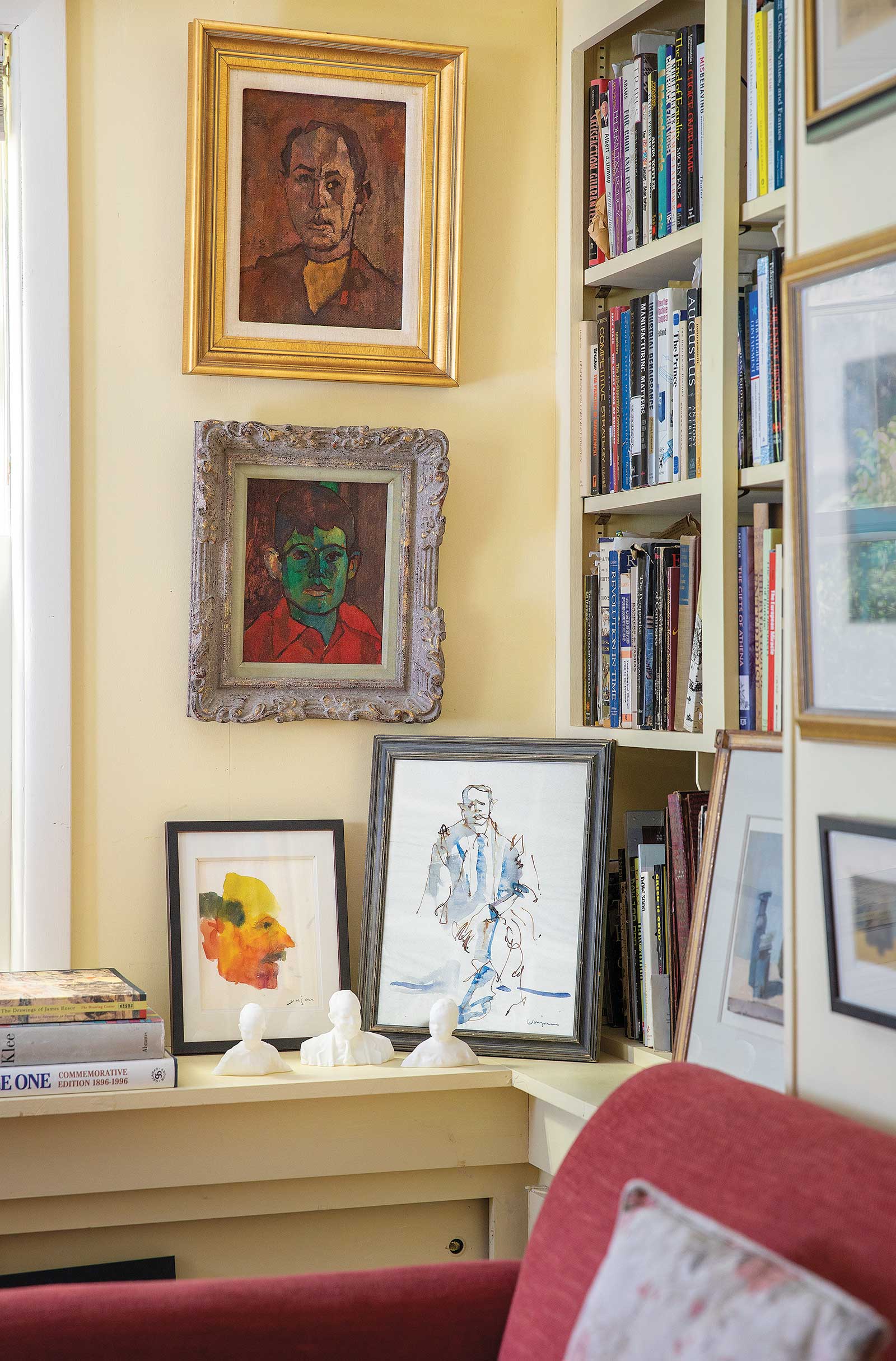 At the top is a Self-Portrait, 1960, by Joseph Solman (1909-2008). Beneath it is his portrait of his son Paul, circa 1950. On the shelf are left to right Paul Solman, circa 2005, watercolor, by Hank Virgona (1929-2019) and his portrait of Joseph Solman, circa 2000, watercolor.
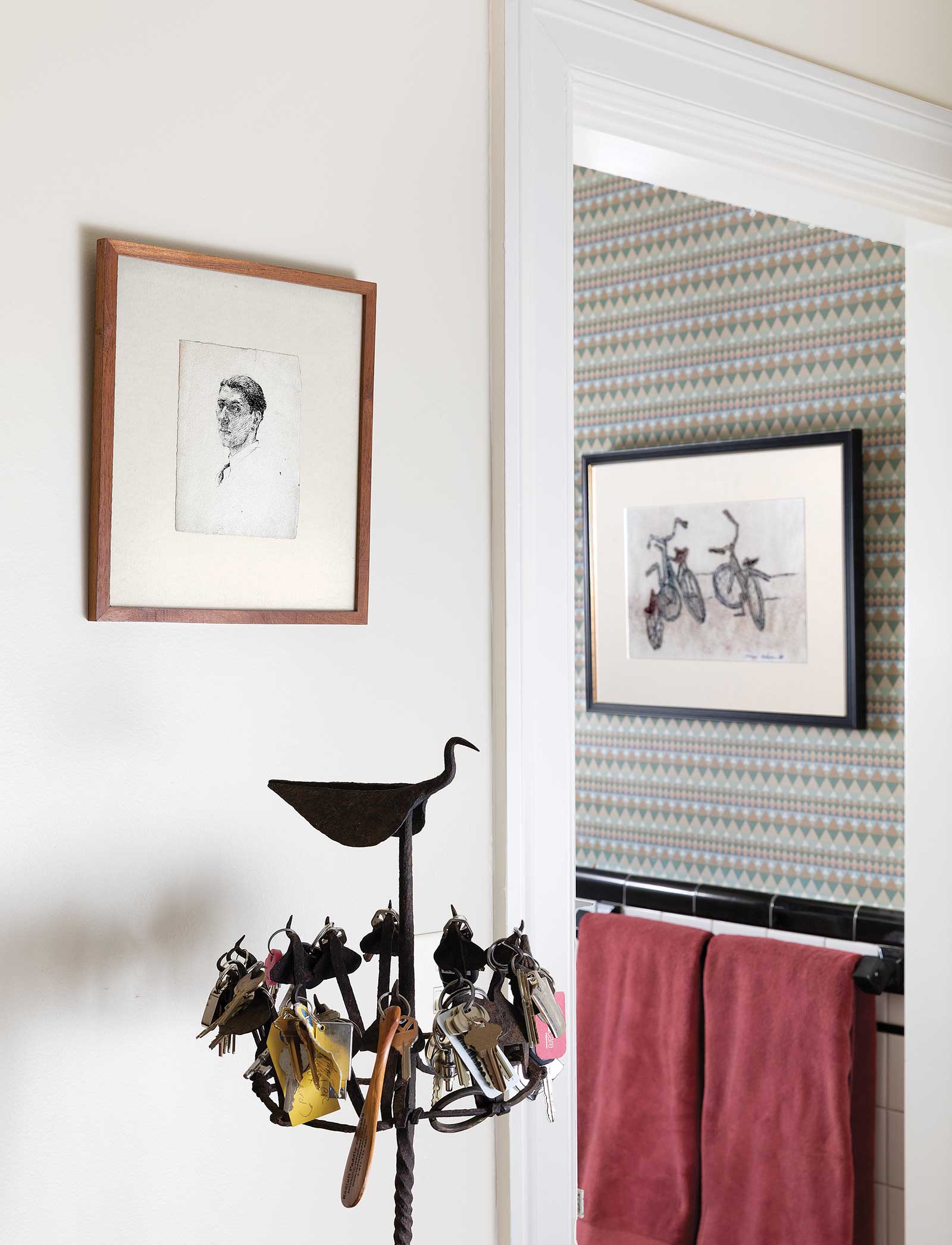 A drawing, Self-Portrait, by Joseph Solman (1909-2008) hangs on the left and through the doorway is his monotype, Motorcycles, circa 1980.Paul carries on the tradition of his father’s taking him and his sister to museums by arranging trips for his grandchildren, always with an educational intent. “The least you can do with a work of art is to really look at it and stick with it—how is it done, what do you think it’s trying to convey, what’s the feeling or the idea?
“People are intimidated by art,” he continues. “They think they’re going to like something they shouldn’t or they’re embarrassed if they don’t like what they’re seeing. These are hurdles for people to get over. We have to coax them. I want to be surrounded by things that enhance my life and make it more nourishing. There’s always more to discover.”
See more of Joseph Solman’s artwork at www.jsvirtualgallery.com. —
Powered by Froala Editor