It wasn’t easy. Becoming a practicing artist in a fledgling nation. A country that could offer little in the way of ancient history, a supportive government, an enlightened or indulgent aristocracy or church patronage. Facilities for training were meager or unavailable. Instead of artists’ studios, there were cold and inconvenient rooms, often perched at the top of a house where the noises of everyday life intruded on the contemplative environment necessary for creative thinking. (It was only in 1835 when New York University built their first substantial building on Washington Square, that plausible studios were created at the top of the corner towers.) 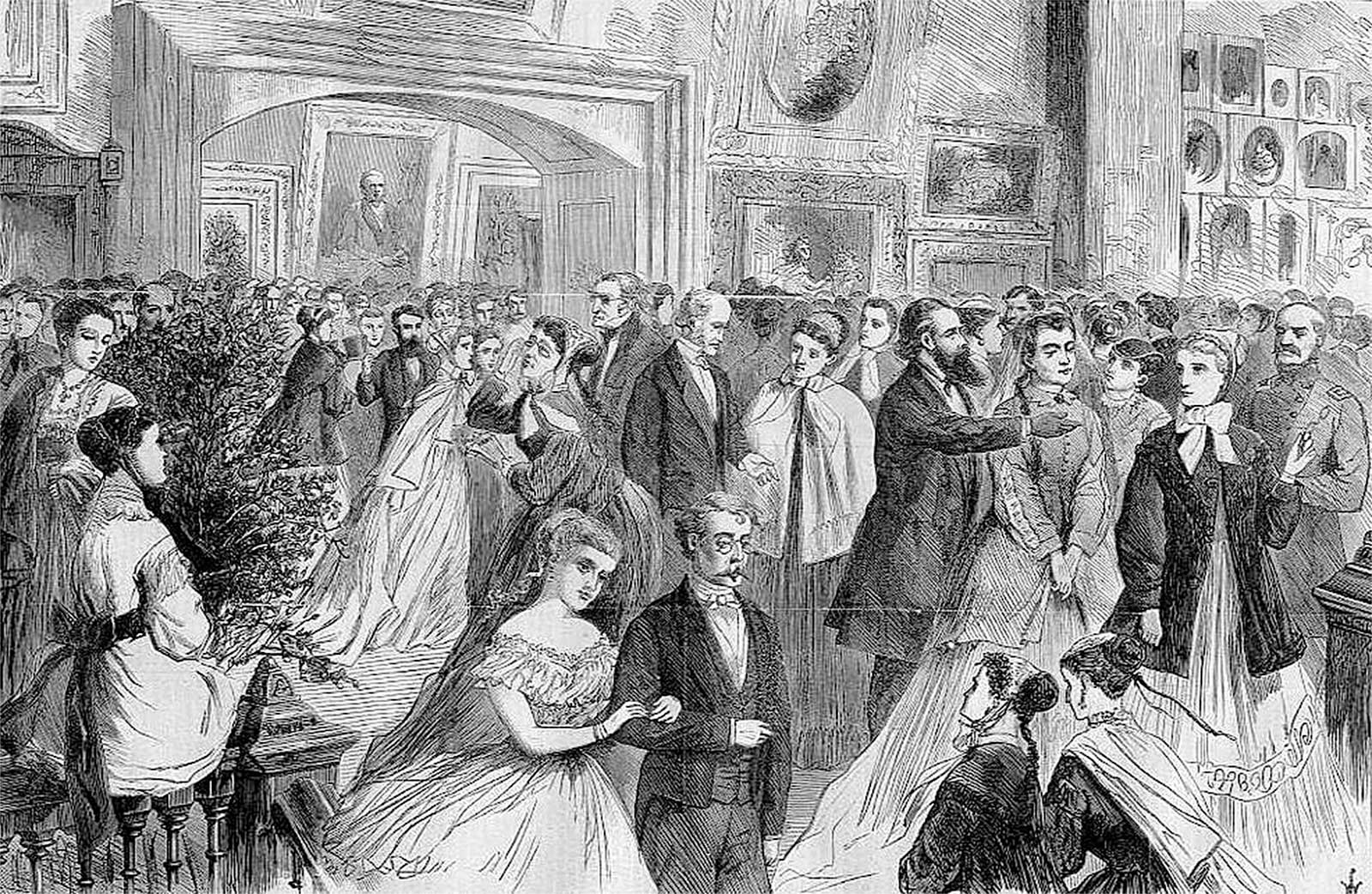 Annual Reception at the National Academy of Design, New York, a wood engraving from a sketch by W. S. L. Jewett, published in Harper’s Weekly, May 1868.
And if one succeeded in producing work of merit, there were few venues for exhibiting and, more importantly, for selling work. No critics to endorse or even excoriate the artist’s achievement. No wonder artists tended to cluster together and seek solace and support from their fellows.
In a letter to his wife in 1780, John Adams had summarized the generational leap that would likely occur before an effective artistic community might develop: “I must study politics and war, that our sons may have liberty to study mathematics and philosophy. Our sons ought to study mathematics and philosophy, geography, natural history and naval architecture, navigation, commerce and agriculture in order to give their children a right to study painting, poetry, music, architecture, statuary, tapestry and porcelain.”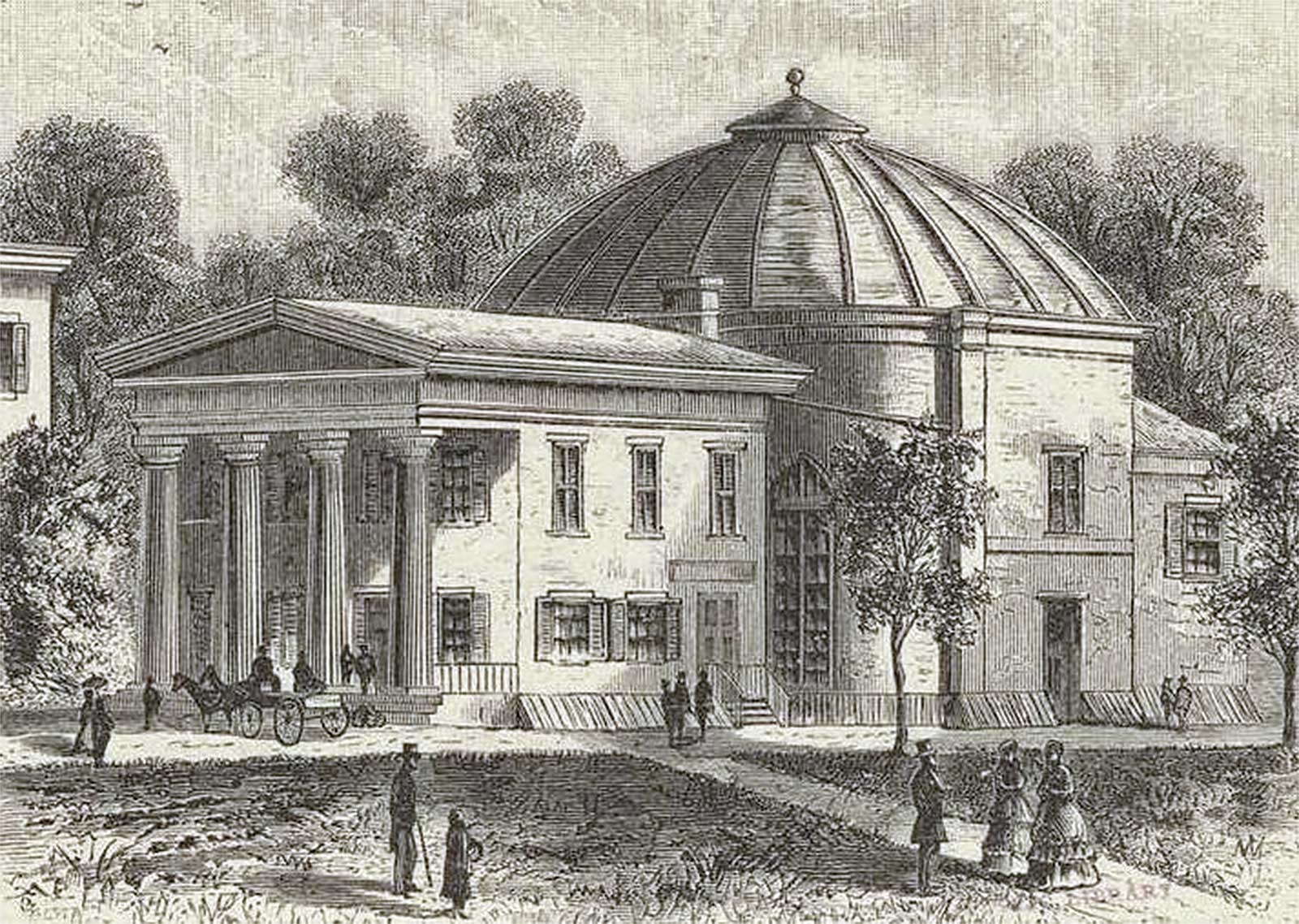 Wood engraving of the Rotunda, New York, by an unidentified artist. Private collection.
By the second quarter of the 19th century, America and New York seemed on the verge of fulfilling that vision. New York was still, at best, neutral about the role of art in American life but it would prove to be there that John Adams’ vision would play out most prominently. The physical and economic growth of the city during the 19th century was truly astounding. From a provincial and essentially conservative center, it took hold of all the opportunities afforded by advances in transportation and technology, converting itself into an economic capital during the century. New York assumed leadership from Boston and Philadelphia, in both art, and its commercial leadership was guaranteed by the completion of the Erie Canal in 1825. Accompanying this rapid expansion was the exponential growth of art communities within the city. There were, to be sure, false steps along the way.
Philadelphia and New York, the leading commercial centers, both hosted institutions focused on the fine arts that failed to garner sufficient private or public support. For its part, Boston had established an Atheneum which was principally a private subscription library although it planned a museum component that included both natural history specimens and works of art. As the Atheneum expanded, public exhibitions briefly became an attraction and a financial windfall before the audience grew tired of seeing the same material repackaged on a regular basis. Ultimately, the Atheneum would play a major role in the development of Boston’s Museum of Fine Arts.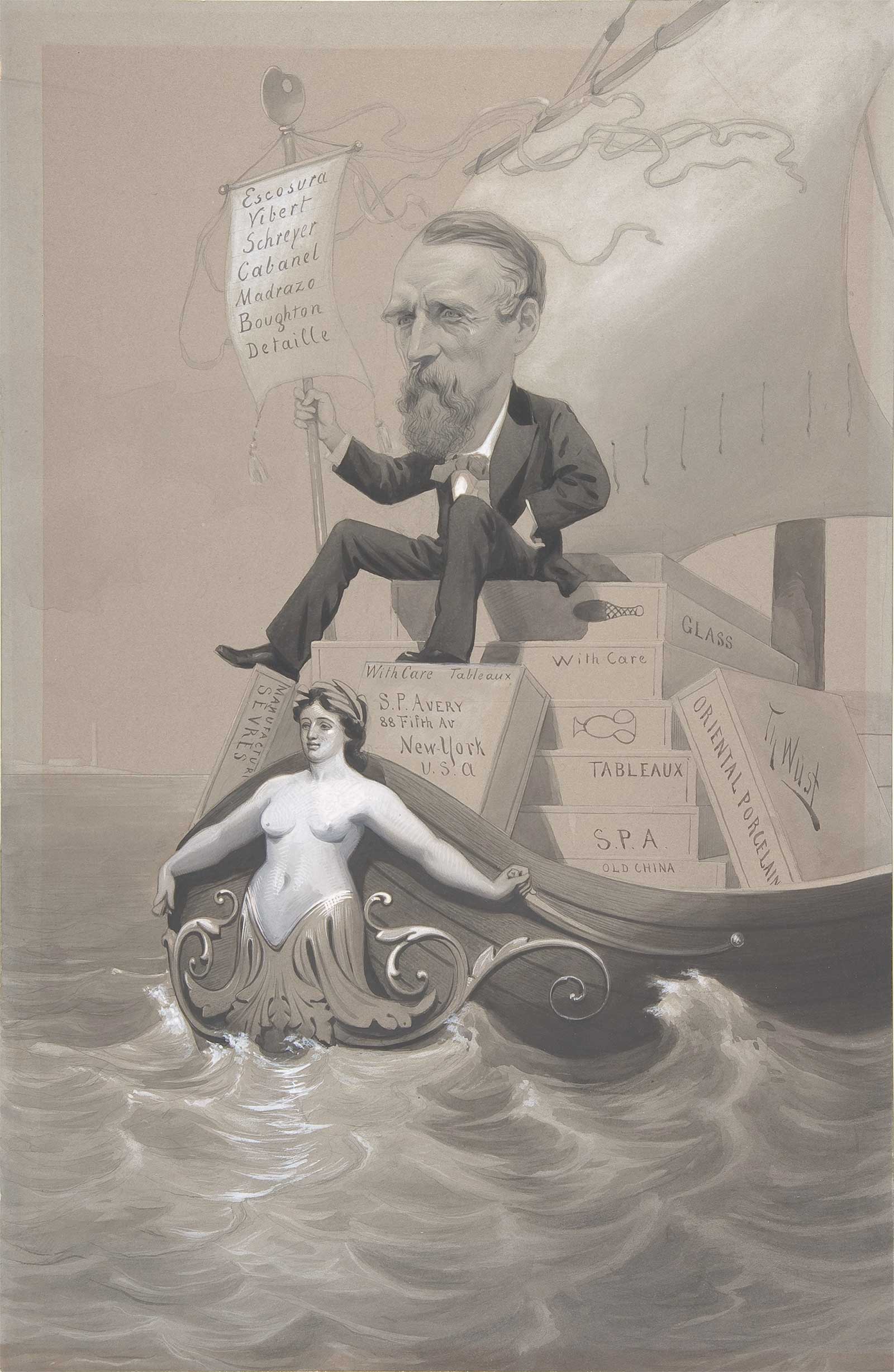 Theodore Wust (1853-1915), Samuel P. Avery Transporting His Treasures Across the Sea, ca. 1875-80. Graphite, ink and gouache on gray paper, 161/8 x 10½ in. Courtesy Metropolitan Museum of Art. Gift of Emma Avery Welcher and Amy Ogden Welcher and Alice Welcher Erickson, 1967.
During the first half of the 19th century, there were, in fact, no museums dedicated exclusively to the visual arts. (The Wadsworth Atheneum in Hartford, Connecticut, founded in 1842 as a multifaceted institution, exists now as the oldest continuously operating art museum in the country.) The Pennsylvania Academy of Fine Arts, established in 1805 by artists and businessmen, appeared to have bright prospects by building a collection, initiating public exhibitions and offering art training. By contrast, in New York the American Academy of the Fine Arts, established in 1802 by a patron class of merchants and dilettantes, had foundered due to lack of support and an ultimate disregard for the artist community. In 1825, it was superseded by the National Academy of Design (NAD), an artist-run organization. The Academy would foster education for artists and become the major venue for public exposure to the work of New York-based artists through its annual exhibitions. Election to associate and full membership in the Academy involved the donation of a portrait of the artist as well as a representative work. Today the Academy, which has experienced financial vicissitudes over its nearly 200-year history, is reconfiguring its role while it shepherds a collection of around 8,000 works of American art. A sampling of 100 of those has been touring in an exhibition entitled “For America.” While the NAD was on a pathway to public success, the tight-knit artist community moved to create a more intimate opportunity for artistic discourse. They hoped to capitalize on that cordiality by creating informal associations.
A few years after the NAD’s founding, on a wintry night in January 1829, a group of artists and writers came together in New York to organize such a group that would provide solace for what they considered American neglect of creative activity. Thus, the Sketch Club, a loose assembly of artists, writers and a few enlightened gentlemen became an important component in the evolving creative universe of the city. It replaced a somewhat similar organization, the Bread and Cheese, that had disbanded when its founder, James Fenimore Cooper, moved abroad. The Sketch Club members would convene at the home of different members with the purpose of encouraging their brethren in imaginative discourse while furthering their artistic discipline. It provided an opportunity to discuss and, in fact, criticize fellow members’ work. In the club’s early years, the host would choose a topic or concept to be drawn by the artists and briefly essayed by the writers. Their goal was mutual support, combined with spirited and friendly banter as well as some creative amusements.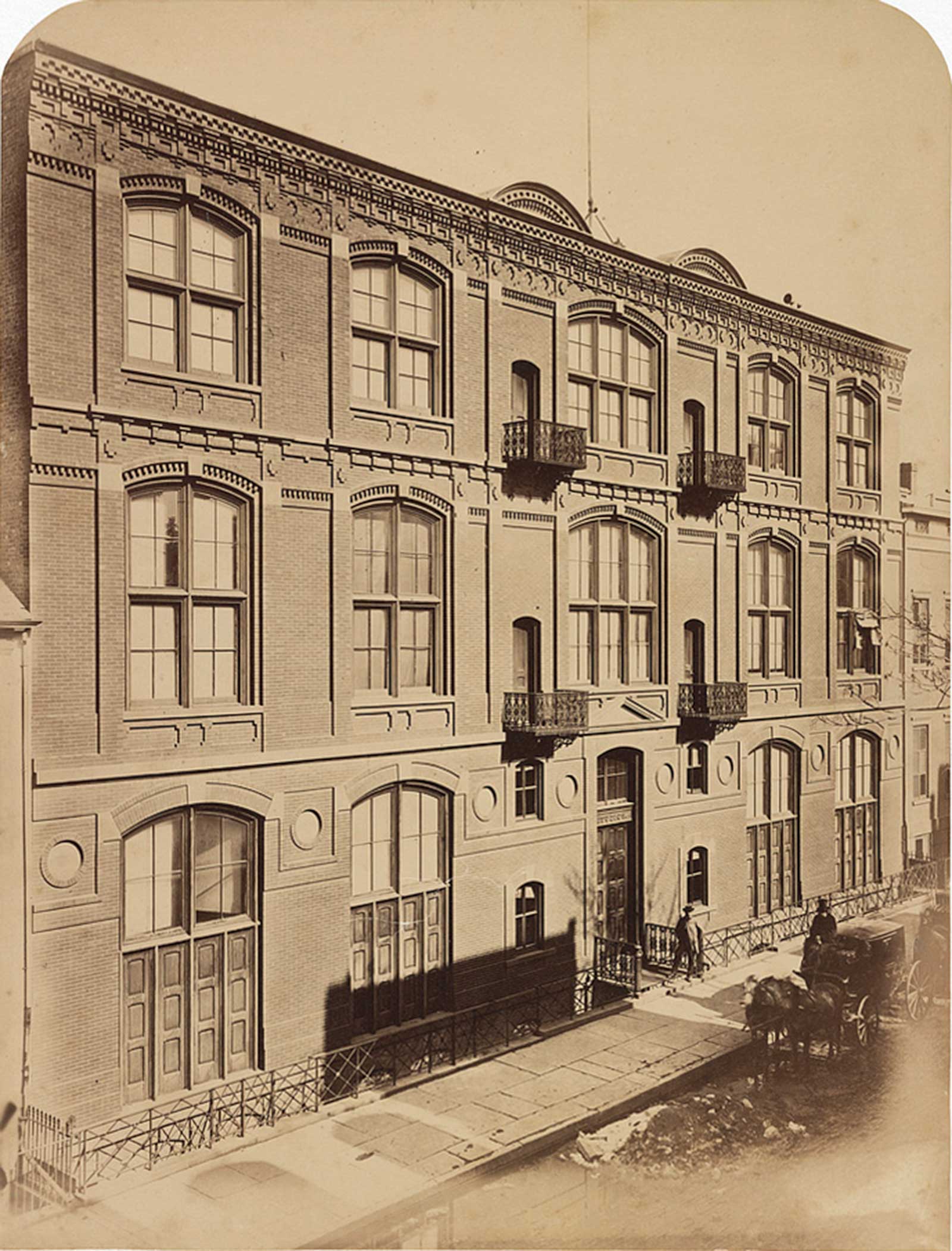 Tenth Street Studio Building, 51 West 10th Street between Fifth and Sixth Avenues, New York, New York (photographed 1870), photographic albumen print. Gift; American Institute of Architects / American Architectural Foundation; 2010. Courtesy Library of Congress Prints and Photographs Division Washington, DC.
Patronage had been, at best, haphazard and artists had to struggle to break the bonds of portraiture and develop other forms of expression. John Vanderlyn, the first American artist to study at the Ecole in Paris, who was celebrated when Napoleon awarded him a medal at the Salon in Paris, found it difficult to make a living on his return to America. In 1818, hoping to capture an audience more engaged by novelty and spectacle, he built, at his own expense, the Rotunda, a circular building based on the Pantheon in Rome and suited to exhibiting painted panoramas of foreign sites or natural wonders. (Panoramas had become something of a side-show, for which artists created massive canvases which they exhibited around the country. John Trumbull had earlier tried his hand at this with his rendering of Niagara Falls, but the project was never realized and only two large studies survive, recently exhibited at the New-York Historical Society in a capsule survey of this phenomenon titled Panoramas: The Big Picture.) For his panorama, Vanderlyn rented land from New York City adjacent to City Hall, for one peppercorn a year, and exhibited a series of paintings. The enterprise was modestly successful until the city refused to renew his lease.
The building subsequently became the home of the New York Gallery of Fine Art which was planned to serve as a full-fledged museum for American art. It was centered around the pioneering collection of Luman Reed, a successful dry goods merchant who during the early 1830’s had become an important patron of Thomas Cole, Asher Durand, William Sidney Mount and George Whiting Flagg. He was also one of the first to open his private gallery to the public, one day a week. When the New York Gallery of Fine Art was disbanded in 1849 the collection ultimately passed to the New-York Historical Society which, with its addition became the first successful art museum in New York.
Thomas Cole’s presence in the Reed collection also reflected the increasing importance of landscape painting in American art. Cole moved to New York in 1825 and displayed some of his first landscape efforts in a book shop window. (They were sold to artists William Dunlap, Asher Durand and John Trumbull.) Between then and his death in 1848, Cole succeeded in establishing landscape as a compelling form of American artistic expression. In his 1836 essay “American Scenery,” Cole had described the importance of the natural landscape as both an emotional center for creative life and the only true antiquity of which America could boast. Cole enjoyed the patronage of a small and disparate group of patrons who enabled his work not only on ambitious American landscape paintings but also in the production of a series of large allegorical canvases such as The Voyage of Life and The Course of Empire.
While artists sought to engage the public, they also continued to relish the close association with their colleagues. These were ultimately achieved in New York in two ways: the founding of the Century Association in 1847 and the building of the Studio Building in 1857.
At a Sketch Club meeting in 1846, it was suggested that an expansion beyond the limits of a living room was in order and a list of about 100 candidates to form the core of a new association was drawn up. In January 1847, in the rooms of the Rotunda, the very building that was a surviving monument to the failure of John Vanderlyn’s ambitious artistic dreams a new, more formal club was agreed. It was dubbed the Century not only to reflect the notion of the 100 men first enlisted for membership but also to underscore the contemporaneity of the enterprise which was conceived as modern and progressive, of this century. The club would in fact, be an association, suggesting parity and mutual support of the membership and with this mandate and the securing of premises it was launched in 1847.
The ranks filled quickly, and within a decade something more permanent was envisioned. With an official state charter, and grander premises than the early rented rooms, the Century was fully established in 1857. The walls of the club offered an opportunity for artist members to be exhibited on a frequent basis and to show works in a variety of media. What began as the casual decoration of the club house became an extensive collection through gifts, loans and purchases. Henry Hobson Richardson’s renovations to the clubhouse provided a more formal gallery space and gradually, a program of regular exhibitions emerged, staged around the monthly meeting. Artist members showed their own works ranging from highly finished studio compositions to the slightest sketch, and, along with private collectors, lent works by other members to these exhibitions.
This stirred an on-going dialogue amongst the painters (little in the way of sculpture was shown until the turn of the century) and the literary and critical brotherhood who shared the friendly ambiance of the club. The exhibitions at the Century felt more intimately related to the domestic scale of a private collection and had an immediate appeal for collectors who could envision these works within their own domestic context.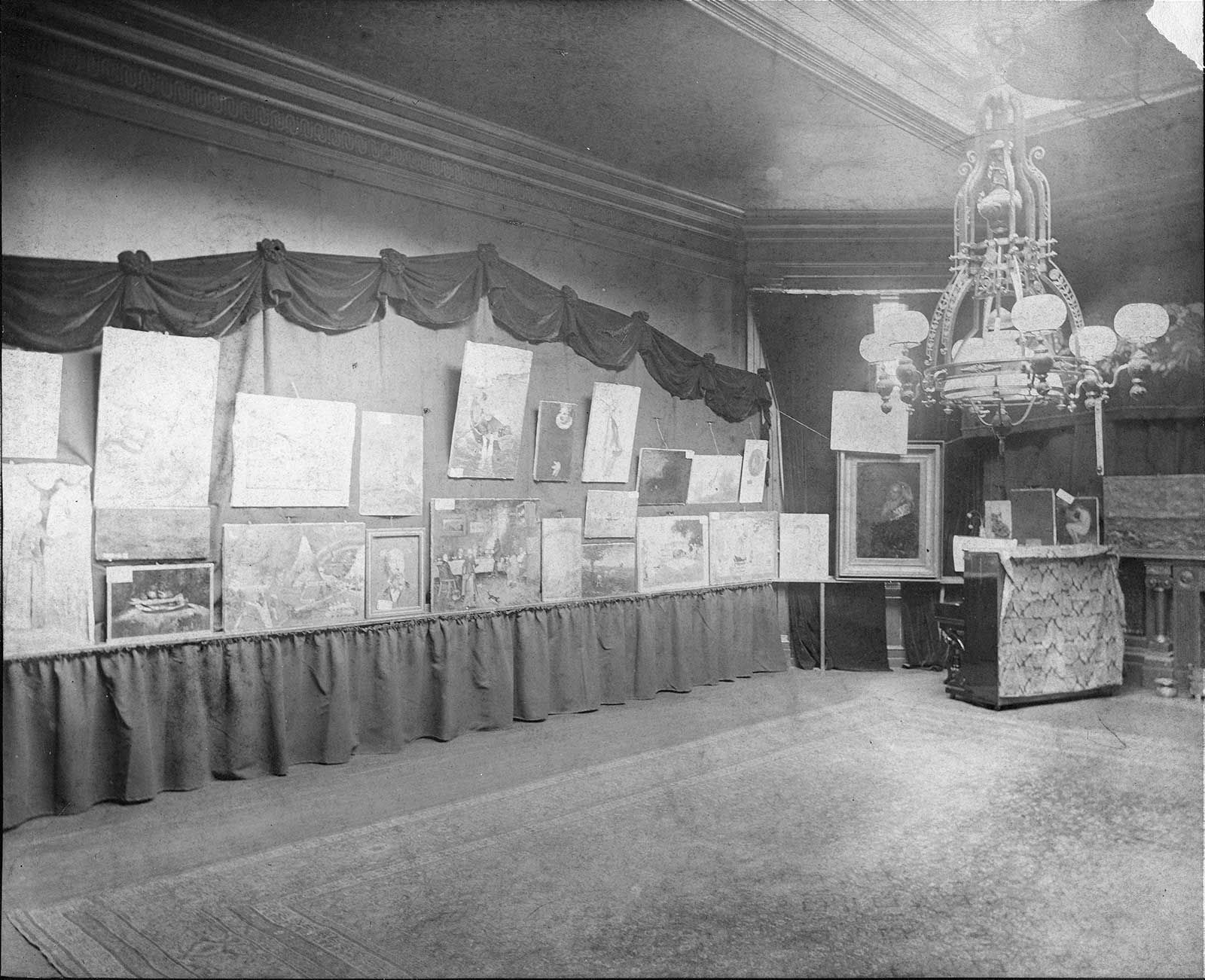 Century Association Gallery, 109 E. 15th Street, last quarter of the 19th century. Courtesy the Century Association.
1857 also saw the creation of the Studio Building, designed by Richard Morris Hunt, who had trained at the Ecole des Beaux Arts. He was the first of a generation of architects to bring French formalism to the design of public and private buildings that would dominate the second half of the 19th century in America. This was the first studio building in New York, and it provided both ample and well-lit studio spaces for artists and writers but also featured a central exhibition gallery where joint displays could be mounted. Studio receptions were staged attracting a broad audience that included collectors and critics as well as the general public. The artists’ own studios were often opened at the same time. Sales from these exhibitions became an important arena for the marketing of American artists’ work. The opportunity to view each other’s work was a bonus which, according to John Fergusson Weir, a tenant who would become the head of the Yale School of Art, founded in 1869 as the first collegiate art school in the country: “There is no way of breaking the silence as to one’s own work in art than by indicating what others, especially fellow artists, may have said or thought about it at any stage of progress or achievement…” and the conversation in the Studio Building afforded that opportunity.
For the artists, the Century’s exhibitions provided a similar opportunity to both test new ideas and styles in their work and to reach the collecting and critical communities. Typically, it was only work by club members that was exhibited. Over the years, it was often artists of lesser reputation today who exhibited most frequently, so we find that James Wells Champney and James C. Nicoll each showed more than 500 works. Well-regarded artists also took advantage of the opportunity. Eastman Johnson showed more than 400 works and Winslow Homer clocked in at more than 300. Other frequent exhibitors were Worthington Whittredge, Thomas Moran, George Henry Hall, Edward Lamson Henry, John La Farge, George H. Smillie, William Henry Beard, Albert Bierstadt, Henry A. Ferguson, Daniel Huntington, Jervis McEntee, Enoch Wood Perry, Walter Satterlee, and Thomas W. Wood.
The Century exhibits freed the artist from interruptions as they worked in their studios. Over the years, as the Century exhibitions expanded, artists’ studio receptions declined in importance. Such club exhibitions provided a significant transition from the self-conducted marketplace to the dealer-driven one that emerged at the end of the century, By that time, the Century, which also included many members of the NAD on it rolls, had become became more conservative in its membership and had moved away from its founding imperative towards a more traditional club-like atmosphere.
New studio buildings began to fragment the sense of community and other clubs such as the Salmagundi Sketch Club, founded in 1871 and focusing specifically on artist membership, served as an attractive alternative to the Century where only three artists have ever served as president. In 1875, a group of younger and more adventuresome artists formed the Art Students League, leaving the NAD which they deemed too conservative and unwelcoming to new ideas.
For collectors and critics, winds of change had begun, shifting emphasis away from the native school. By the end of the Civil War, rejecting what was seen as homely American work, many increasingly embraced European art that was deemed more sophisticated or more advanced, much to the detriment of the native school. The handful of dealers such as Samuel P. Avery, who actively promoted American art, shifted focus to the work of European painters appealing to a newly rich community that now travelled abroad regularly and viewed the accumulation of European art as a badge of culture. (See illustration).
Criticism of the work of the heroic generation of American landscape painters such as Frederic Church and Albert Bierstadt and their compatriots began to appear. The annual National Academy of Design exhibitions were widely discussed in the newspapers and journals. Century exhibitions were private and available only to members and invited guests. And if, on occasion, they did receive press attention, the tide of taste could render the work of club artists shown there or at other clubs where they were members, in an unfavorable light. Reviewing an exhibition in December 1887 at the Union League Club, a writer in the Art Amateur noted:
“Albert Bierstadt’s coarse painting of disporting seals on Farallon Island and F.E. Church’s gaudy Tropical Landscape were interesting as examples of the dreadful things which were considered good art less than a generation ago.”
And it was at this time that the term Hudson River School was first applied to the earlier generation of landscape painters. This appellation implied a certain naivete and perhaps a primitive ambition for historic American art. This view was in the minds of those civic leaders who sat down in the later 1860’s to plan the Museum of Fine Arts in Boston and the Metropolitan Museum of Art in New York, each founded 150 years ago this year. —
Powered by Froala Editor