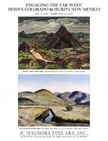
Artists of different traditions and backgrounds reflect and shape our view of the American West, land of the rancher and the cowboy. So, when I was given the opportunity to offer collectors the Western paintings of two successful American artists working during the Great Depression and World War II, I could not resist. The resulting exhibition is an exploration of the paintings of Adolf Dehn (1895-1968) in Colorado from 1938 into the 1960s and Peter Hurd (1904-1984) in New Mexico from 1928 forward. The 25 paintings hung in our gallery create a kind of a conversation between two artists who both captured the authentic West. These paintings provide more than a comparison and contrast of two very different Western landscapes; they are a narrative of an artist’s journey. Looking outward to select what the artist wants you to see, the artist also takes a journey inward. That journey reveals each artist’s personality expressed through his selection of subject, painting style, artist tools and choice of medium. The journey sculpts and shapes the art. These two artists stretch our thinking about Western landscapes.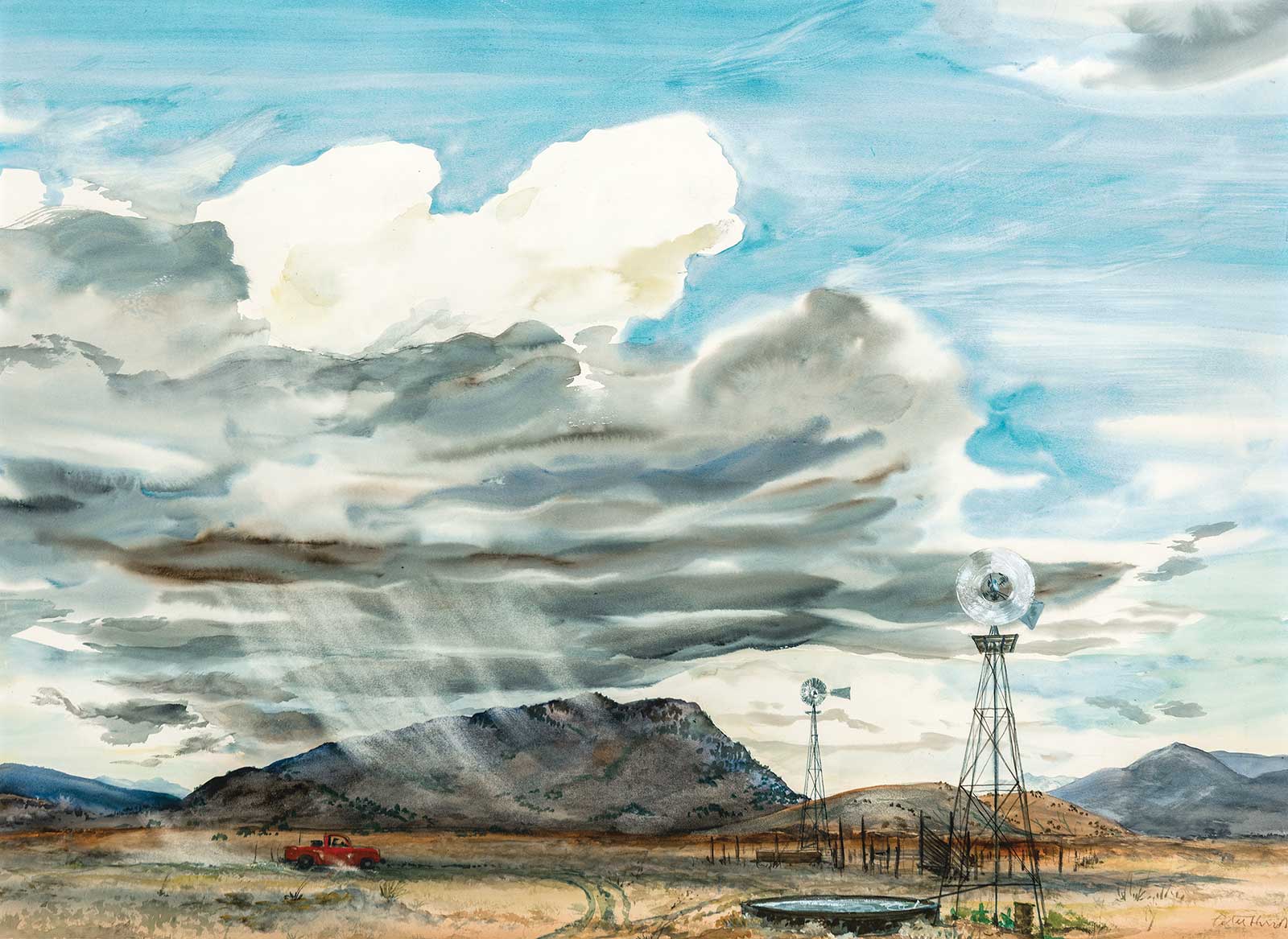 Peter Hurd (1904-1984), Finishing Chores Before the Rain. Watercolor on paper, 22½ x 30 in.
As a youth in Waterville, Minnesota, Dehn knew he wanted to be an artist. He attended the Minneapolis School of Art from 1914 to 1917 and then accepted a scholarship to the Art Students League in New York, which he attended from 1917 to 1919. In 1939 Dehn was awarded a Guggenheim Fellowship for travel in the Far West and Mexico. One of Dehn’s stops was a visit to Boardman Robinson who was teaching art at the Fountain Valley School and heading the art program at the Broadmoor Art Academy (now the Colorado Springs Fine Arts Center), which combined an art school, museum and theater. This ambitious program was successful because Colorado Springs was a major cure center for tuberculosis filled with wealthy patrons. At the Colorado Springs Fine Arts Center, Robinson created an art print shop run by Lawrence Barrett, a master printer, who had come to Colorado Springs to recover from tuberculosis and stayed. Dehn had come to Colorado already a printmaker as well as a painter. At the Fine Arts Center, Dehn and Barrett connected and experimented with varied textures in Dehn’s lithographs to enhance their realism. The work forged a partnership between Dehn and Barrett that lasted a lifetime. In Colorado Springs, Dehn reshaped his art from European-inspired figural social satire into landscape art of the new American scene style as seen in Cows Grazing in Gunnison Valley, 1941. With Pikes Peak, the Garden of the Gods and the Rocky Mountains at its door, Dehn could paint an America that exists outside of time, class or political affiliation. Dehn’s style transformation was aided by the Colorado Springs Fine Arts Center’s artist-in-residence program which attracted artists who were instrumental in developing the American scene style. 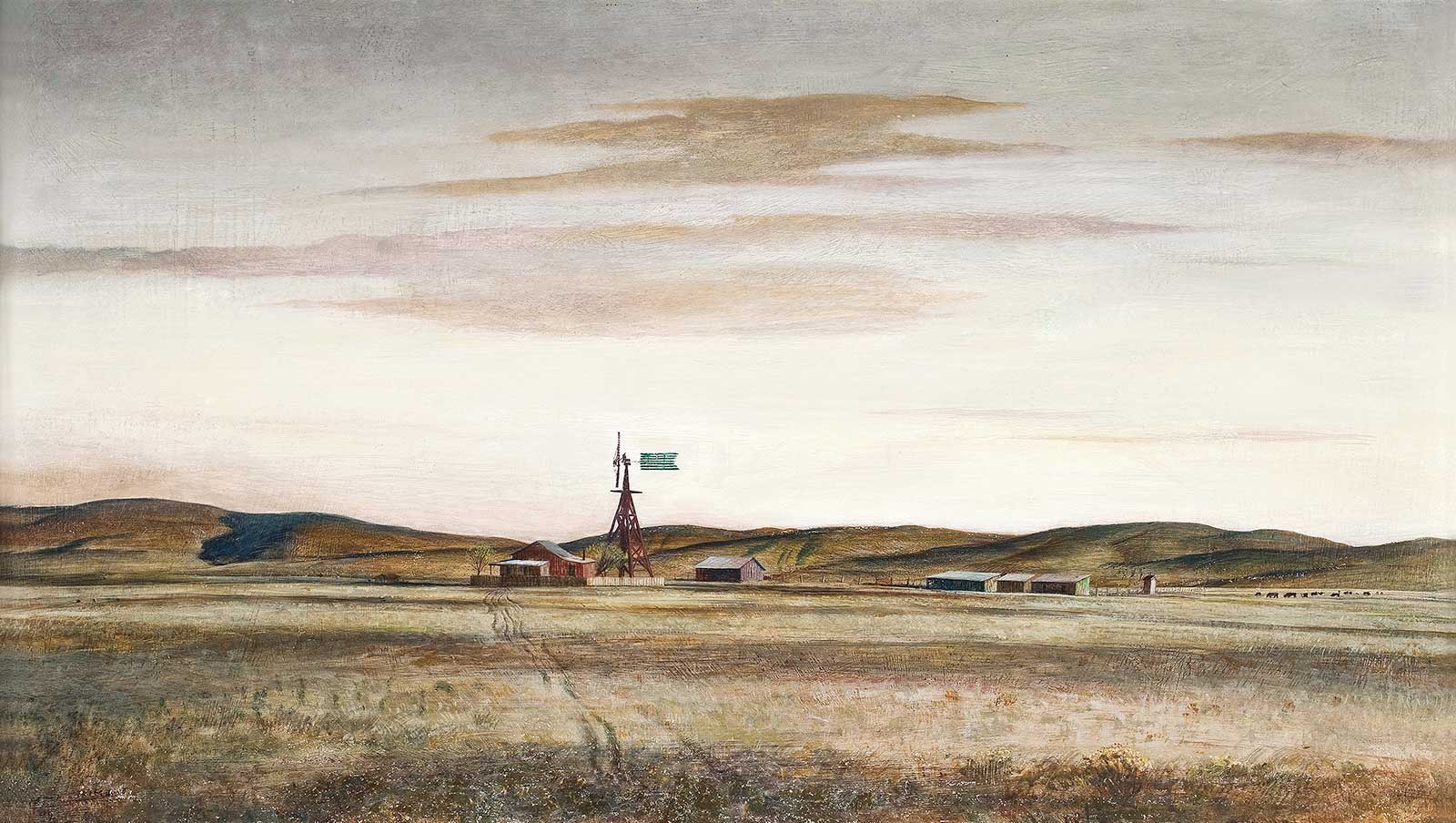 Peter Hurd (1904-1984), Rancho del Charco Largo, 1939. Tempera on panel, 241/8 x 42 in.
Painting the mountains and lakes required Dehn to go beyond the subject. He needed to think of big masses of color, light and dark, eliminating some detail for the sake of the composition, and even ignore the color before him at times to create a more exciting arrangement of color to evoke a certain mood or reaction to a scene. Dehn worked from an outdoor sketch, taking from 10 minutes to two hours, depending on the complexities of the subject. He used either a soft pencil or lithographic crayon and a sketch book of smooth paper. Generally he did not make a finished drawing as his main interest was recording data for the painting he would later execute in the studio. Any part of the scene that was complex or difficult in its construction, he developed more completely. In the studio, Dehn considered the result of his color choices in different kinds of lighting, judging how a color and its different shades looked in the subdued light of a room, harsh light of overhead lighting, and in daylight. For the Colorado paintings, Dehn developed skill in the mediums of casein such as Mountain Landscape and watercolor such as Remote Ranch. Printmaking had taught Dehn to achieve a rich spectrum of tonalities and textures that blossomed in his Colorado paintings as seen in Gunnison Valley. By 1941 Dehn had such a sure hand as a painter that Life magazine made his art a feature in its August issue. 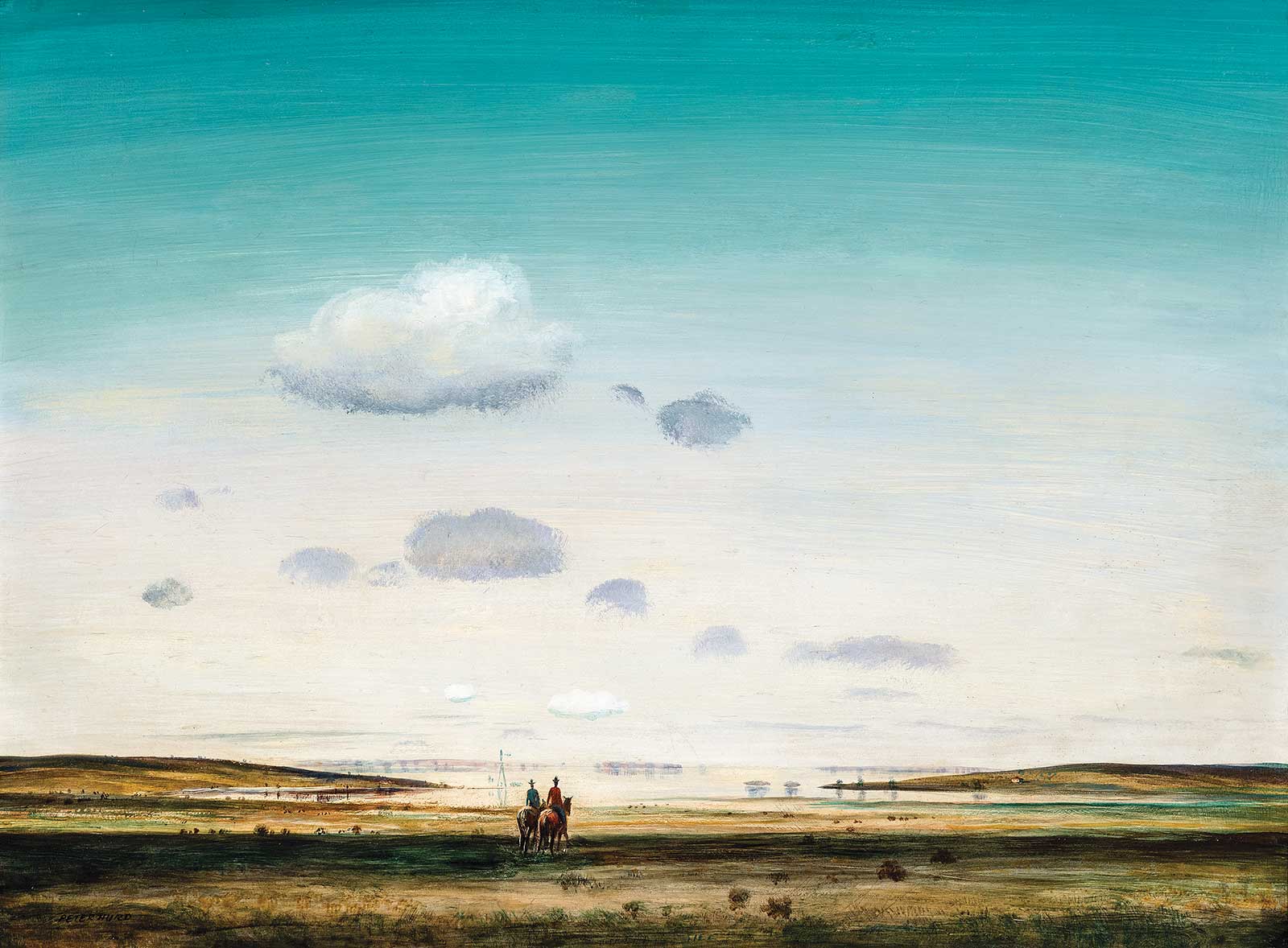 Peter Hurd (1904-1984), The Mirage, 1947. Tempera on panel, 22½ x 30¼ in.
Hurd grew up in Roswell, New Mexico. His father, Harold Hurd, a Boston lawyer, came to Roswell as he was threatened with developing tuberculosis. Hurd focused on painting and drawing from youth. His education at the New Mexico Military Institute led him to spend two years at West Point as a cadet in 1921 to 1922. In 1923 Hurd transferred to Haverford College realizing he did not want a military career. While there, Hurd met N.C. Wyeth and with persistence became his apprentice. To improve his drawing, Hurd enrolled at the Pennsylvania Academy of the Fine Arts along with Wyeth’s daughter, Henriette. In 1927 Hurd became engaged to Henriette and began to exhibit his paintings at the New Mexico Military Institute and the Wilmington Society of the Fine Arts.
Hurd brought his new bride to New Mexico in 1929. San Patricio’s ranch country and people became Hurd’s subject. All through the 1930s the Hurds traveled east to Chadds Ford for Wyeth family visits or to fulfill commissions for portraits, advertising and book illustration.
Like Dehn, Hurd was a painter of the American scene. To paint New Mexico, Hurd had to develop practices and materials that gave him what he wanted. In New Mexico the earth forms assume a sharper contour, shadows are denser. Sunward surfaces are fixed in a dazzle of light. Heat waves in the summer make roads shimmer. In the spring, winds bring weeks of heavy blowing dust. Our exhibition includes several paintings that speak of these moments of change so common in New Mexico. They include The Mirage and Finishing Chores Before the Rain. Hurd described himself as “a painter of what occurs around me.” The spirit of his landscapes is one of lyrical delight in the un-posed form, movements, and designs found in real life. From N.C. Wyeth, Hurd learned to focus and become for a time whatever he was painting. 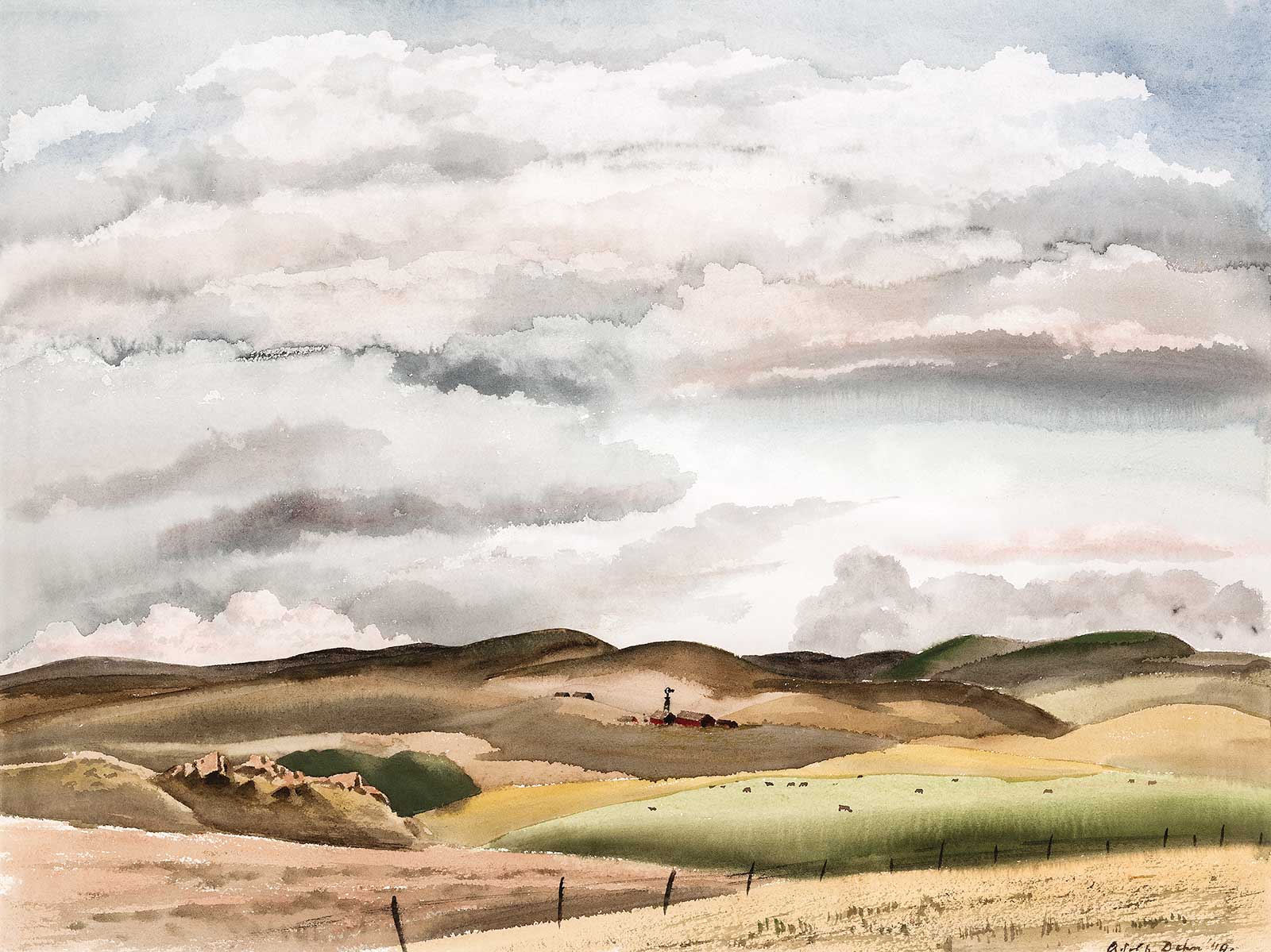 Adolf Dehn (1895-1968), Remote Ranch, 1948. Watercolor on paper, 18 x 24 in.
To translate what he saw in New Mexico, Hurd perfected the technique of painting in gesso with oil paints and egg tempera. Upon receiving his 1933 mural commission for the New Mexico Military Institute, Hurd traveled to Mexico City as well as Cuernavaca and Taxco to see the work of the Mexican muralists. There he got Diego Rivera’s fresco formula, his type of brushes, paints, and advice from a Mexican fresco painter Ramon Montes. Hurd was attracted to dry fresco (the application of tempera onto dry plaster) as it combines all the brilliance of watercolor with the advantage of being readily wiped or dry sand papered out so passages could be redone. All sorts of efforts were possible using the dry fresco medium such as washes, stippled effects, smeared color, thin palette knife impasto and glazes. The luminosity of the gesso ground creates the atmospheric brilliance essential to painting the light of New Mexico as seen in Rancho del Charco Largo. Hurd fashioned his own gesso panels with pots of hot sizing and marble dust applied to board paneling that he sandpapered many times. Hurd ground his own mineral colors. Hurd was so excited about this medium that he taught his brother-in-law Andrew Wyeth the technique as well. 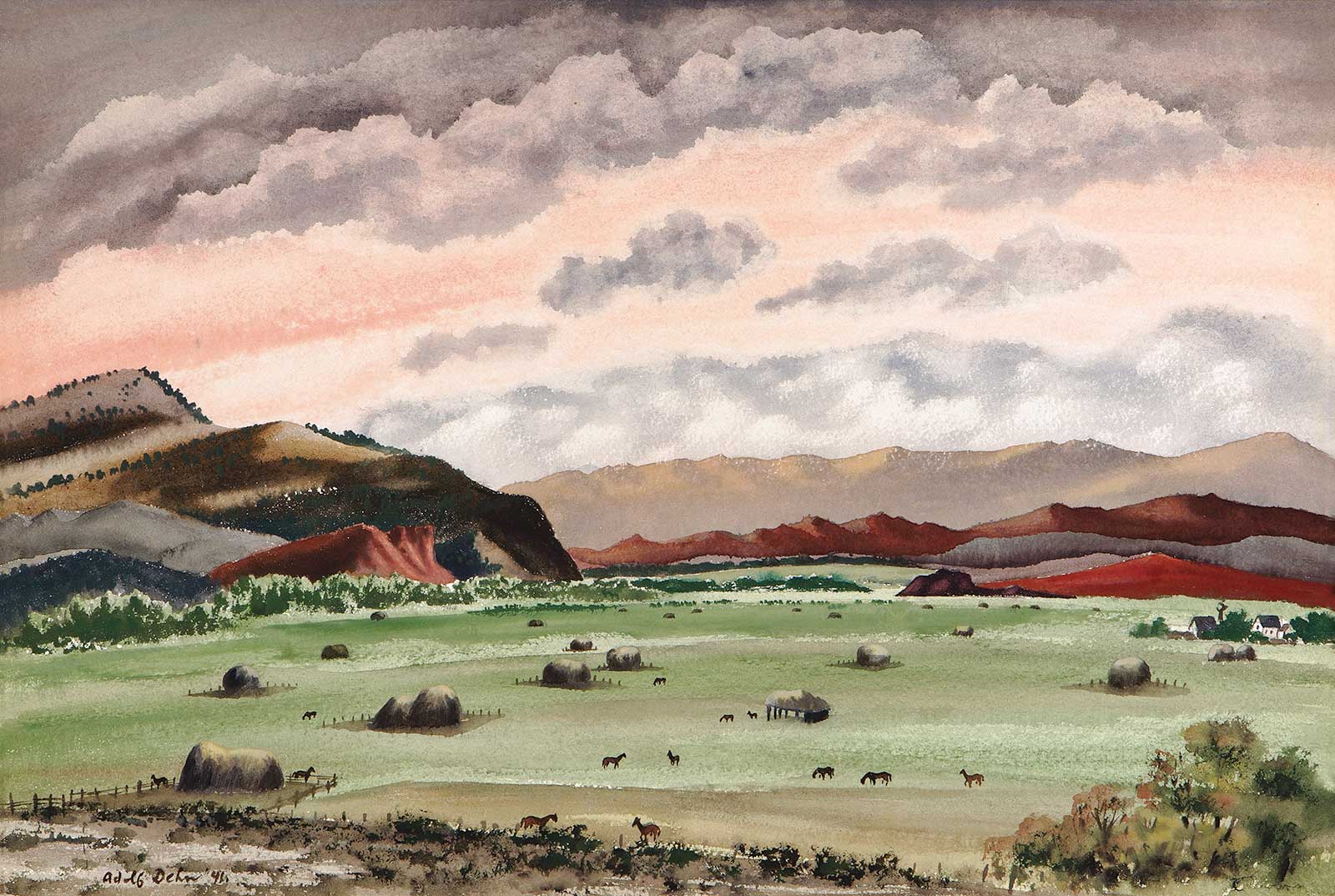 Adolf Dehn (1895-1968), Gunnison Valley, 1941. Watercolor on paper, 14¾ x 21½ in.
While innovative in his painting techniques, Hurd aimed to subordinate material to subject, achieving this by the handling of space and objects in a spare way. To find subjects that moved him to paint them, Hurd drove a wide windowed camper truck over roadless plains and up flood carved arroyos in search of subjects. Hurd’s farmscapes such as Rancho del Charco Largo were painted as symbols of human wishes, effort and accomplishment. These abstract values are conveyed in his paintings and there is an undercurrent of acceptance of the fugitive in life. Hurd studied his designs for a painting in his mind’s eye and rehearses his color in thought—sometimes steadily looking at an unfinished work for hours considering changes to make and effects to be carried further to establish that would bring the picture alive as a whole.
Success as an artist grew for Hurd during the 1930s and 1940s. His first museum invitational was at the Corcoran Gallery in 1932. He had his first solo exhibition at Macbeth Gallery in 1934. In 1937 the Art Institute of Chicago purchased Hurd’s El Mucho. Life magazine sent a photographer to photograph Hurd at his San Patricio ranch in 1939. Hurd felt that it was not until he attracted the interest of the editors of Life magazine that he became known to the American public. In 1939, the Metropolitan Museum purchased Rancheria. Further cause for celebration were the two landscapes and a lithograph commissioned for Abbott Chemical Company’s collection, a Life magazine commission, two commissions for Lucky Strike tobacco and the cover of Collier’s magazine. In 1942 Hurd was made a member of the National Academy.
With America entering World War II, Hurd became an accredited war correspondent for Life magazine as a captain in the Army Air Corp. For one assignment, Hurd spent three months on an operational air station in England and executed nine portraits of combat crew members. When the portraits were published in Life magazine in the July 26, 1943, issue, Hurd received 100 letters from the airmen’s families and friends. For a second assignment for Life magazine, Hurd spent six months traveling with the Air Transport Command in 1943 to 1944, leaving him away from his ranch for eight months. President Eisenhower appointed Hurd to the Commission on Fine Arts in 1959 and he painted a portrait for Lyndon B. Johnson for the White House Historical Association in 1966. Through all these adventures, Hurd was most happy painting in San Patricio. —
Powered by Froala Editor