Thomas Moran and Thomas Cole spent their early years in the same small city in England: Bolton. Their parents worked in the weaving trade—Moran’s family specialized in textile designs; the Coles were known as fine weavers. Bolton was a hive of cottage industries. But the invention of textile mills transformed the city in a few short years. As children, Moran and Cole would have seen the undying fires of the mills and breathed in the fug of billowing smoke. They witnessed their parents’ craft—their art and livelihoods—made superfluous. Their parents took jobs in the mills that required them to work long hours for little money in oppressive conditions. The mills might have controlled Bolton, but poverty reigned. In response Ned Ludd and his Luddites rose in armed, bloody rebellion. It was enough to make any impressionable child become an adult who lights out for the wilderness.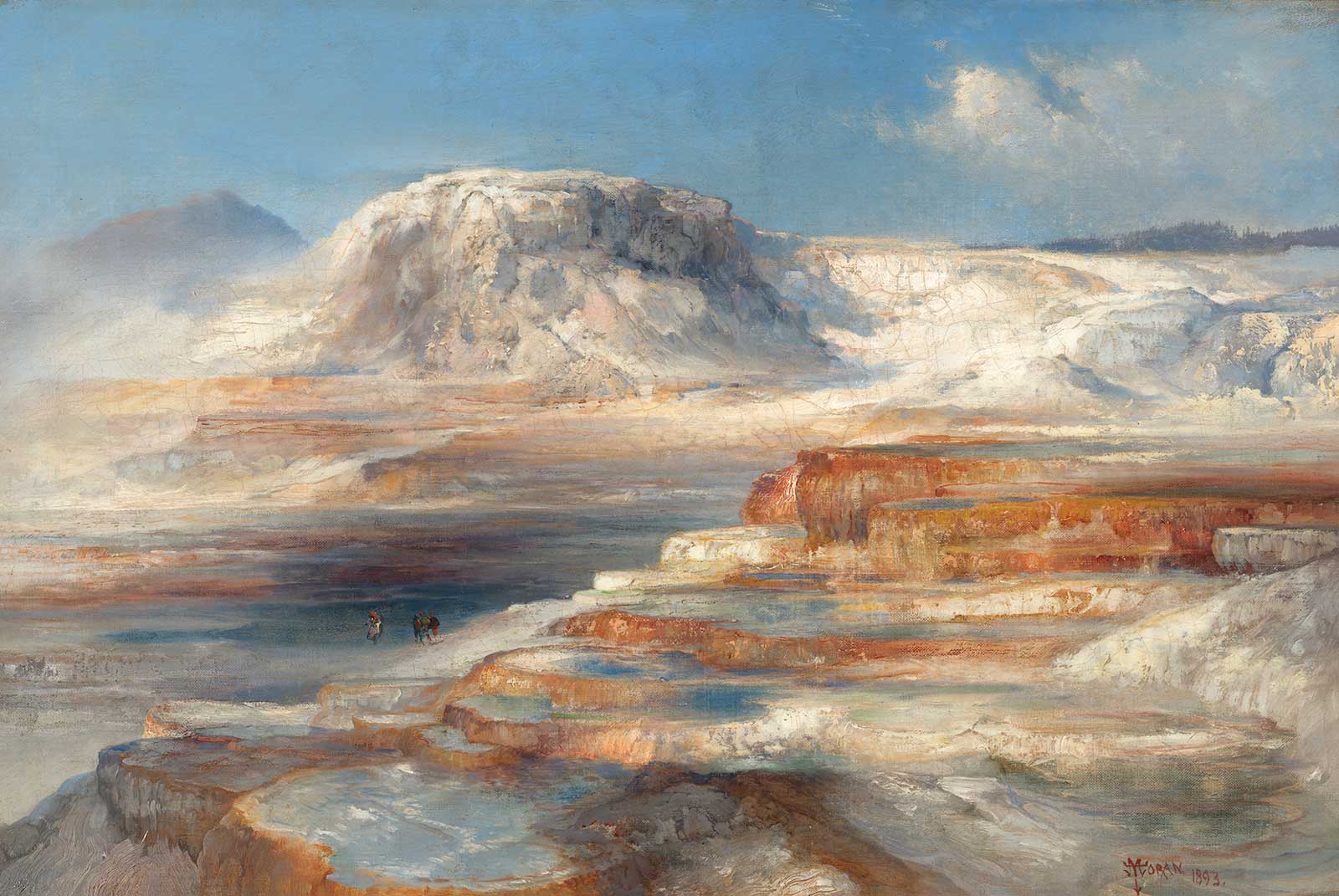 Thomas Moran (1837-1926), Great Hot Springs Yellowstone Park, 1893. Oil on canvas, 19½ x 29½ in. Gift of the Thomas Gilcrease Foundation, 1955. 0126.2342.
Author Ray Bradbury wrote, “You must stay drunk on writing so reality cannot destroy you.” Substitute painting for writing, and you have some idea of what I am thinking, not only about Moran and Cole’s responses to the dehumanizing effects of industrial Britain, but about the birth of modern horror, fantasy and science fiction (hence the Bradbury quote) that runs alongside the romantic, transcendental turn to nature in philosophy and the arts. In fact, I would argue that the weird, as exemplified by, say, Poe and Hawthorne, and the deism of, say, Ruskin and Thoreau, are two sides of the same coin, two opposite aesthetic responses to the same cataclysmic shift in scale from human-centered to machine-centered.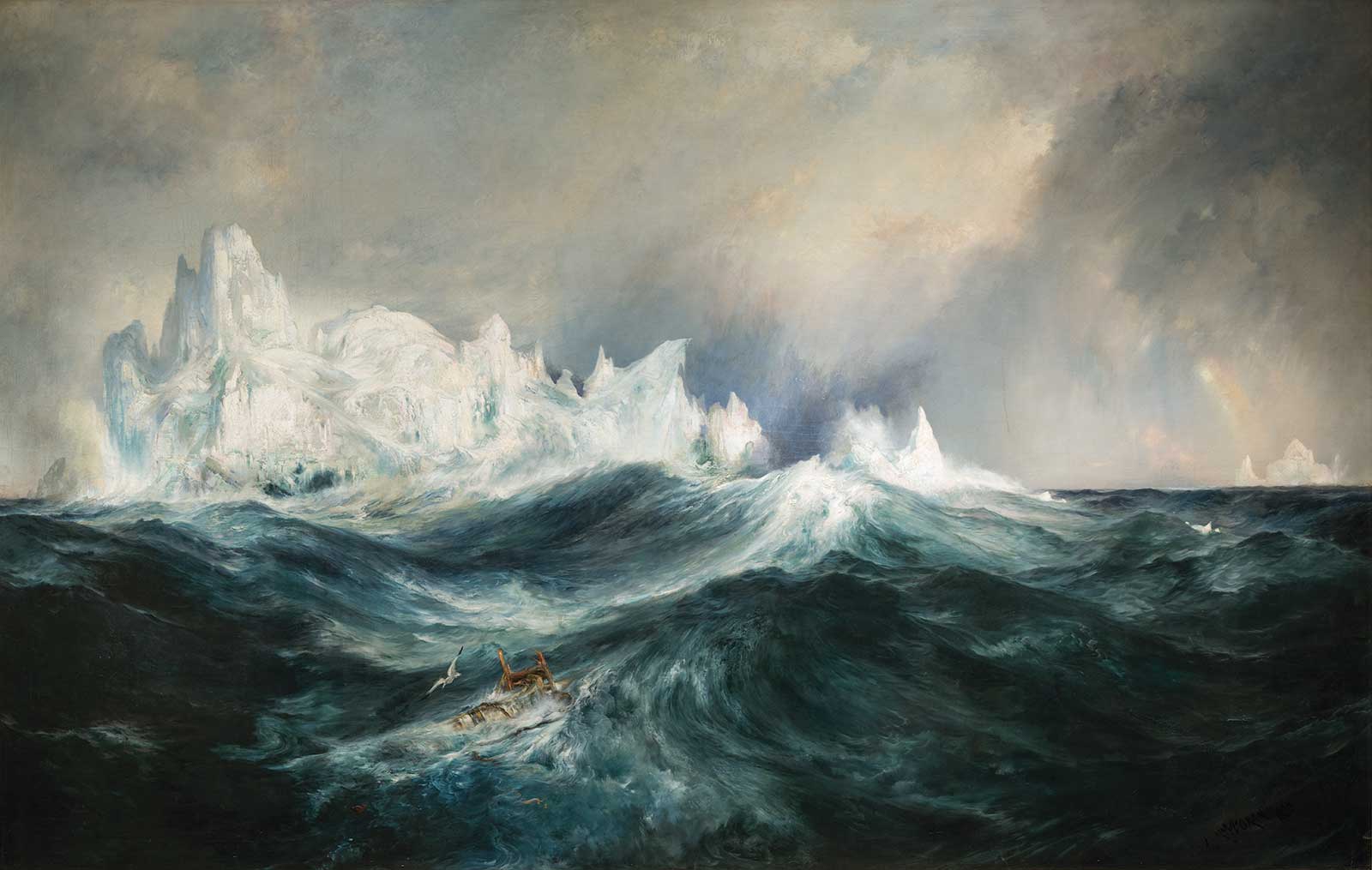 Thomas Moran (1837-1926), Spectres from the North, 1890. Oil on canvas, 741⁄2 x 118¼ in. Gilcrease Museum, Tulsa, Oklahoma. GM 0126.2340.
Mary Shelley’s Frankenstein epitomizes the fear of tampering with Nature and the tragic hubris that inevitably ensues. Darker even than this, perhaps, is the new interest in the weird, the kind of cosmic horror that H. P. Lovecraft would codify in his 1927 essay, “Supernatural Horror in Literature.” Works of art that fall into the embrace of cosmic horror describe the revolt of Nature against our puny human notions of dominance, improvement and progress. These can take many forms, Herman Melville’s novel Moby-Dick, or the entire subgenre of shipwreck paintings such as Thomas Moran’s 1890 masterwork at the Gilcrease, Spectres from the North.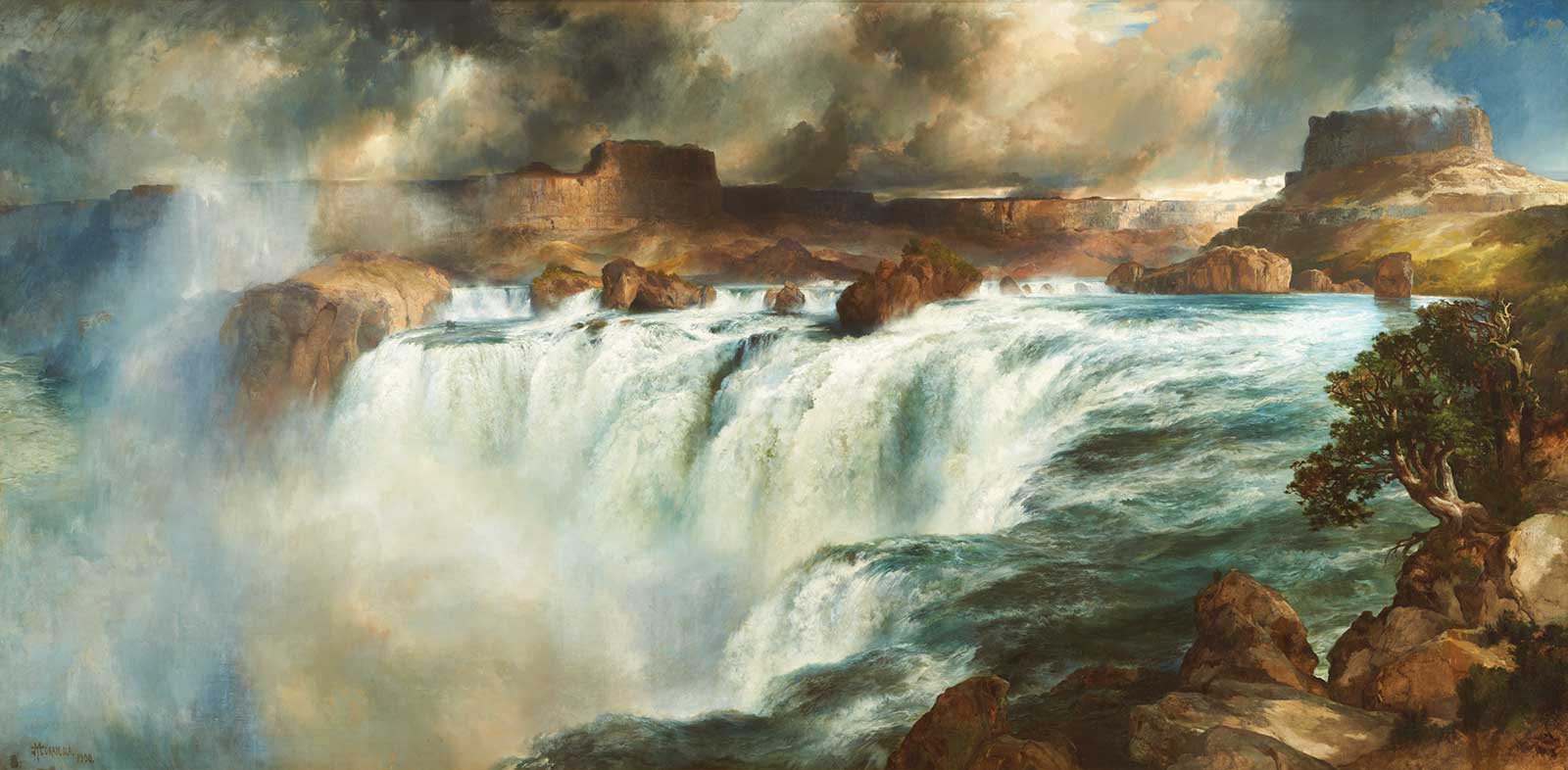 Thomas Moran (1837-1926), Shoshone Falls on the Snake River, 1900. Oil on canvas, 71 x 144 in. Gift of the Thomas Gilcrease Foundation, 1955. 0126.2339.
More even than his great paintings of Green River and the Grand Canyon, when you stand at a certain distance Spectres from the North, seems to curve around you like a section of one of the tremendous circular panorama paintings that preceded motion pictures. But the composition of the painting put me immediately in mind of Poe, particularly his sole effort in the novel The Narrative of Arthur Gordon Pym. In the novel, Pym, a stowaway, is shipwrecked and rescued several times, moving ever southward toward the Antarctic. At the end, having traversed a region of ice, Pym sees, or seems to, the edge of the world as the oceans fall into a hole that suggests the “hollow earth” theory—long discredited now, apart from YouTube cranks, but one that had some currency then. There is a suggestion of walls—a rampart—rising in distance, a wonder that may be a mirage or a glimpse of the afterlife. Pym writes: “March 9. The white ashy material fell now continually around us, and in vast quantities. The range of vapour to the southward had arisen prodigiously in the horizon, and began to assume more distinctness of form. I can liken it to nothing but a limitless cataract, rolling silently into the sea from some immense and far-distant rampart in the heaven. 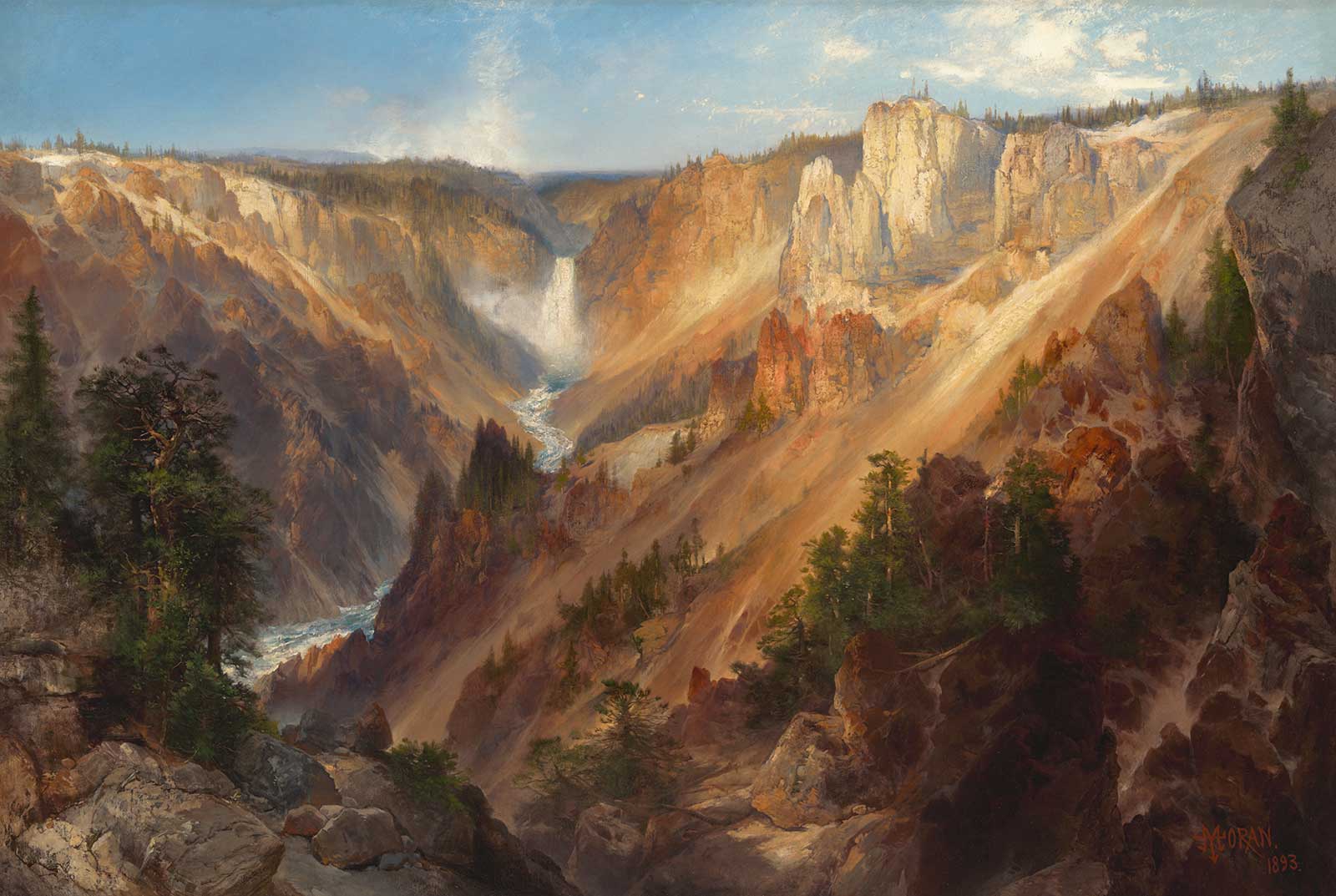 Thomas Moran (1837-1926), Lower Falls, Yellowstone Park, 1893. Oil on canvas, 395/8 x 59¼ in. Gilcrease Museum, Tulsa, Oklahoma. GM 01.2344.
The gigantic curtain ranged along the whole extent of the southern horizon. It emitted no sound.” And there it is in Spectres from the North, all of it, the white city of ice in the distance, touched by a rainbow, the last vision of the sailors whose limbs flail in the sea beside a fragment of a ship that looks like a four-poster bed. Above, a living albatross—a symbol of good fortune to mariners—hovers. You can hear the native in Pym’s narrative crying “Tekeli-li!” breaking the silence—Lovecraft would pay homage to this in his Antarctic fiction At the Mountains of Madness, where an ill-fated expedition discovers the ruins of an extraterrestrial civilization older than man under the towering peaks of ice.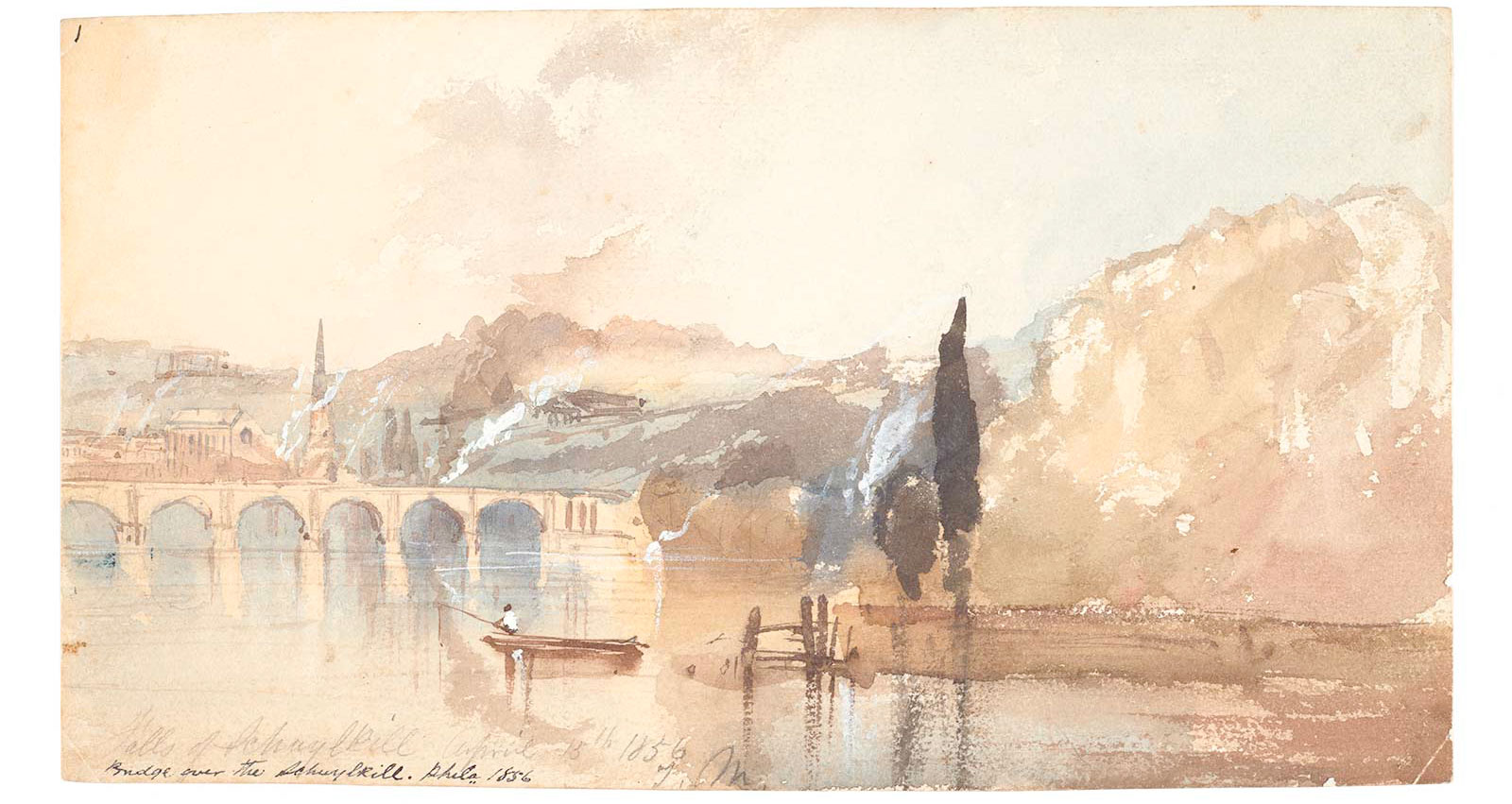 Thomas Moran (1837-1926), Bridge Over the Schuylkill, Philadelphia, 1856. Watercolor on paper, 6½ x 115/8 in. Gilcrease Museum, Tulsa, Oklahoma. GM 0226.798.
It’s hard to imagine Moran not having read Poe. He loved Byron and Hawthorne and gravitated toward the supernatural in fiction and poetry. He regularly painted and engraved haunted houses and ruined castles. You would think, then, that most of his work arose as products of his imagination. You, like me, would be wrong. He also followed, with keen interest, the 19th century’s great era of exploration and accompanied a number of expeditions to the American West.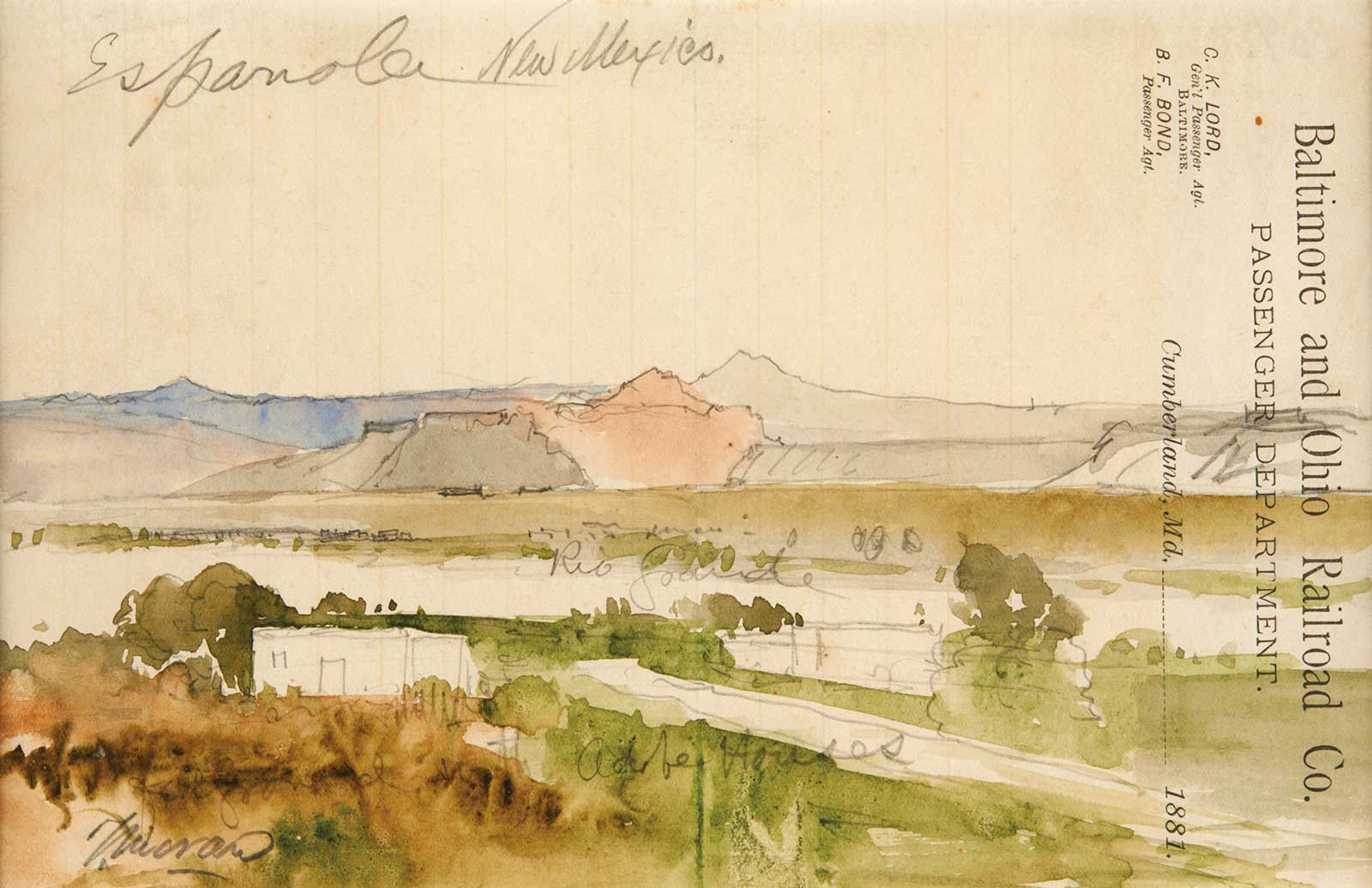 Thomas Moran (1837-1926), Espanola, New Mexico, late 19th-century. Watercolor and pencil on paper, 5¾ x 87/8 in. Gilcrease Museum, Tulsa, Oklahoma. GM 0236.848.
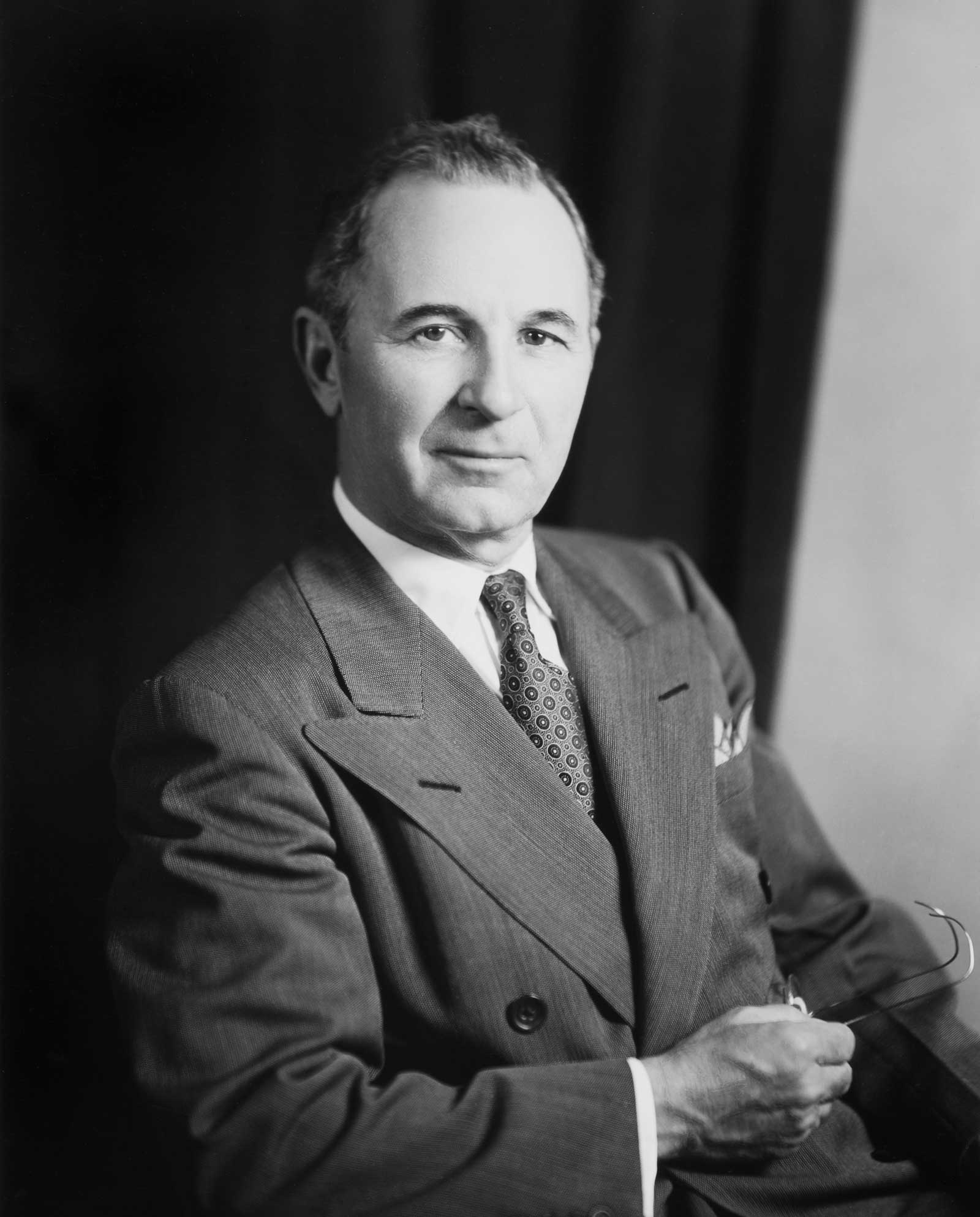 Thomas Gilcrease. Photograph. Gilcrease Museum Archives, Tulsa, Oklahoma. GM 4327.9154.
In short. Thomas Moran traveled. And traveled. And traveled.
I traveled recently, to Tulsa, where I saw and had a chance to tour the Gilcrease Museum with curator Laura Fry. This is where I stood in front of Spectres from the North and had the uncanny, sublime sensation of being surrounded by the scene, drowned, as it were, in the icy waves. I also visited the archives, where head archivist and librarian Renee Harvey showed me some of the Gilcrease’s many treasures. Moran’s daybook, his painter’s diary is there, and she had opened it to a page dating from one of Moran’s trips by steamship across the Atlantic. In the entry, he describes seeing icebergs and references the painting that would become Spectres from the North. Moran’s apparent devotion to surfaces, to recording the world he sees, as he sees it, masks—at least at times—another interest, an interest in reading (and creating) hidden messages, codes beneath surfaces, the patterns in nature—and in supernature. Realism, for Moran, isn’t an end in itself, it isn’t a genre after all, it’s a tool, a strategy, another way in, another way for art to cope with, to respond and to counter the dark realities born out of the increasingly industrialized, mechanized, dehumanized and denatured Western World. But Nature—large and small N—resists the artist’s eye, hand, skill. You see it in Moran’s working sketches, in a sketch like Green River, September 20, 1881. The work is haunted—as all art is haunted—by the artist’s inability to capture and transmit what he sees. Read his corrections, instructions, omissions. John Ruskin, the fons et origo of the turn back to nature in art knew that art would fall short of nature, by definition, by virtue of the simple yet profound gaps between the artist’s perception, intention and creation.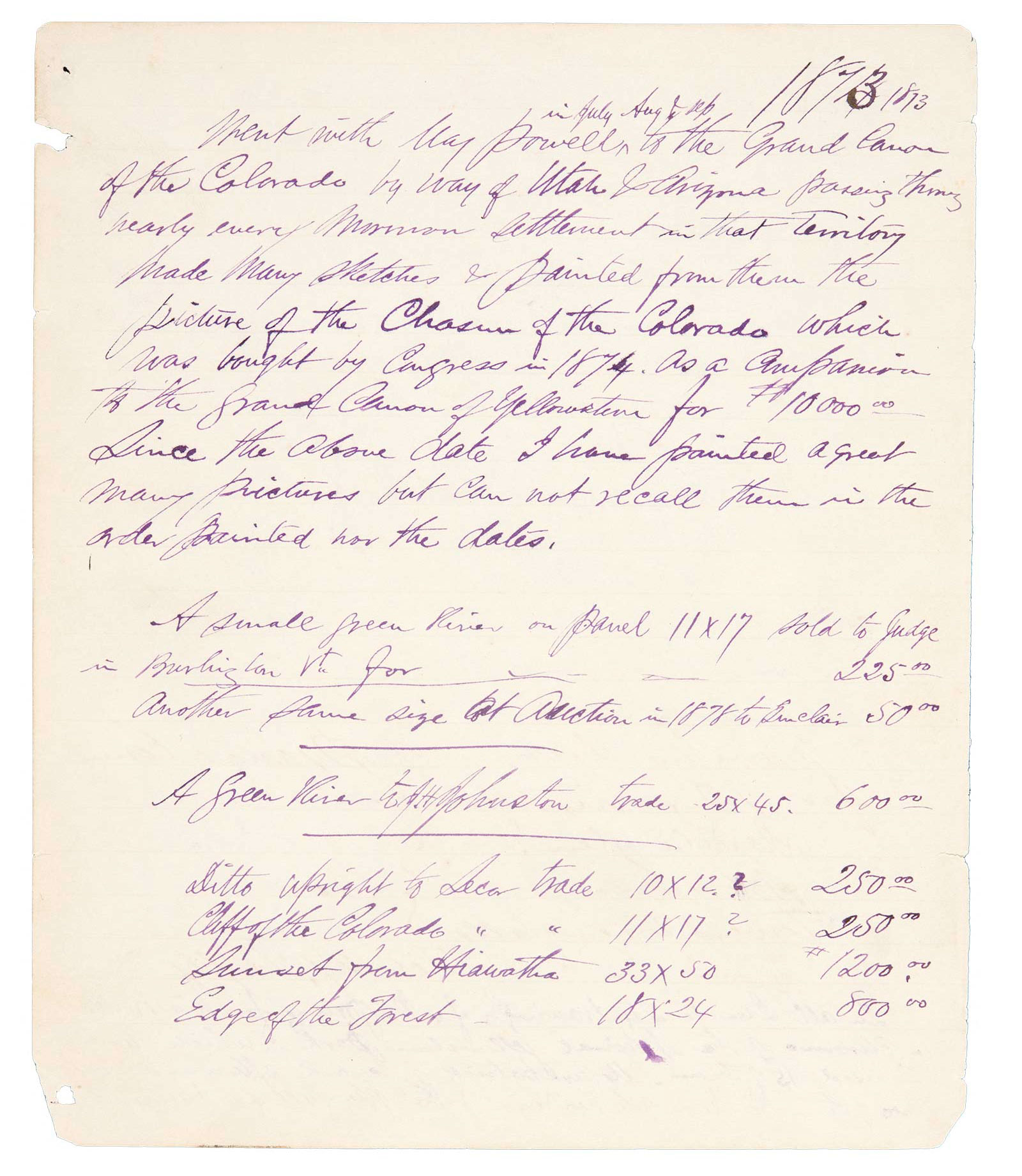 Thomas Moran, Book of Lists, page 31. Gilcrease Museum Archives, Tulsa, Oklahoma. GM 4026.4048.
Into these gaps imagination, vision, dream and nightmare creep and flood. Unless. Unless the notes on the sketch don’t describe Moran’s failings but his desires. Make the “rain orange.” Make the “shadow” on the butte “green at bottom.” And so on. Maybe imagination was there all along, a priori.
Moran’s sketched incessantly. The man’s hand must have been moving even while he was asleep. The Gilcrease alone has over 1,000 works by Moran (and his wife, Mary, whose specialty was printmaking). Consider Espanola, New Mexico, a small, beautiful watercolor sketch on railroad stationery, gives some idea of the artist’s drive and passion to create. But visions and dreams are all over Moran’s paintings, even those we see as realistic views of places in the American West and elsewhere. Deep time scales in the eroded rocks of Green River tower like the ruined battlements of forgotten empires above the ghosts of Native Americans Moran never saw. These ghosts are then doubled and reflected in Alice in Wonderland fashion in the mirror of the river. It is as if Moran picked up where Thomas Cole’s tremendous cycle, The Course of Empire, left off—with Desolation as nature reclaims empire—as if Moran pulled the camera back to embrace eons of instead of centuries.
Paintings of nature, or perhaps we should amend that to say paintings that find their inspiration in nature, serve as reminders, emblems, perhaps, of the enormous, greater-than-human forces that are truly in charge.
Throughout the 19th century, running alongside the rise of the machine, the secret fabric of Nature revealed itself to science. Old mysteries and relationships between humankind and Nature thinned out. Some snapped altogether. Just as the industrial cities made men feel insignificant, a theory such as Darwin and Wallace’s evolution made men feel irrelevant. As the heretofore awesome forces of nature were reduced to formulae, it became clear that they were indifferent to man, that neither nature, nor the larger universe, nor God—whose very existence and identity quavered uneasily—needed us. Not only did it suddenly seem that Nature—with its newly acquired capital N—had no need of God. Nature, in fact, might be God, and thus have no need for homo sapiens. The Earth we depend on doesn’t need us at all and might even be better off without us. Tough concepts to grapple with. Then and now. Artists of all stripes sought mystery elsewhere or created mystery wherever and whenever it couldn’t be found. Think of Lewis Carroll, Ambrose Bierce and hosts of others.
For Thomas Moran, the mystery never ended. In his biography, Thomas Moran, Artist of the Mountains, author Thomas Wilkins writes about Moran’s last moments: “The end came on August 25, 1926, in Moran’s ninetieth year. ‘He died looking at the cracks in the ceiling,’ wrote his daughter, ‘making Venice out of their patterns, just as, all his life, he had lingered at marble panels and stained wood, seeing pictures in the lines.’”
Pictures in lines and stains, faces in clouds—patterns in nature. There’s a name for this: paredolia. To an artist it means finding meaning in what is, apparently, random. To an artist, there’s always a shadow scuttling away from the light, and there’s always a mystery hiding in it. —
Powered by Froala Editor