When asked about Winslow Homer, one might think of scenes from the sea or pastoral depictions of country life.
But before he became known for his oil paintings and watercolors, Homer reported from the front lines of the Civil War. His sketches of the fighting were engraved and printed in Harper’s Weekly, where they were seen by hundreds of thousands of people on the Union side of the conflict.
The works from this early period of Homer’s early career are the subject of the exhibition Winslow Homer: Eyewitness at Harvard Art Museums, on view through January 5, 2020. 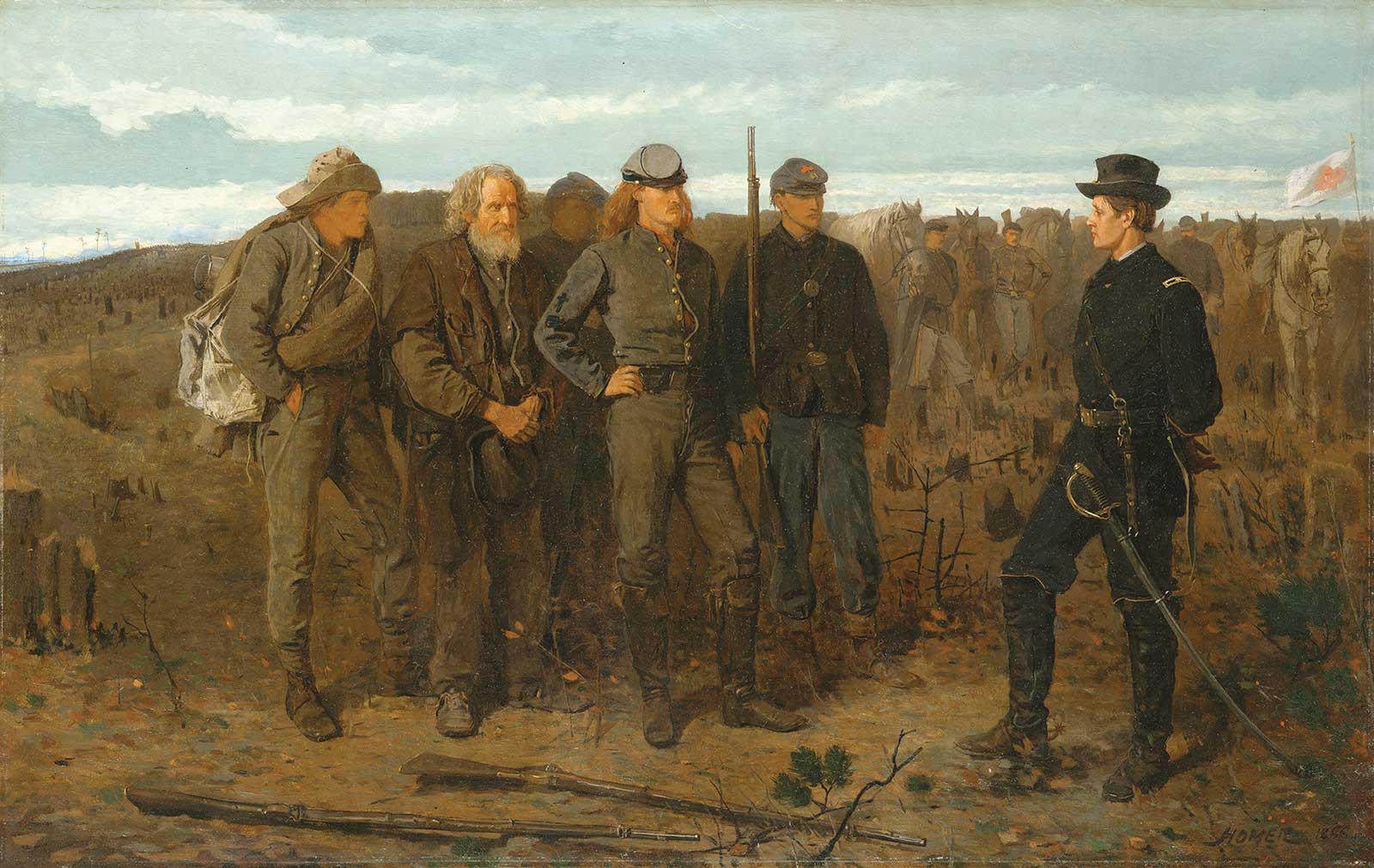 Winslow Homer (1836-1910), Prisoners from the Front, 1866. Oil on canvas, 24 x 38 in. Lent by The Metropolitan Museum of Art. Gift of Mrs. Frank B. Porter, 1922 (22.207) TL42108.
“We’d been having a conversation about Winslow Homer at Harvard for many years, and we have a number of great Civil War historians on campus,” says Ethan Lasser, formerly of the Harvard Art Museums and now the chair of Art of the Americas at the Museum of Fine Arts, Boston. He co-curated the exhibition with Makeda Best, the Richard L. Menschel Curator of Photography at Harvard Art Museums. “We had the good fortune to borrow Musée d’Orsay’s Summer Night a few years ago. I think that led us to start thinking harder about our own holdings and the stories we could tell with them.”
Today, there is constant concern over whether a piece of news is “real” or “fake,” but this question of reliability isn’t a new one. In his role as an illustrator, Homer was tasked with creating true and compelling narratives for an audience that couldn’t see the front lines for themselves. 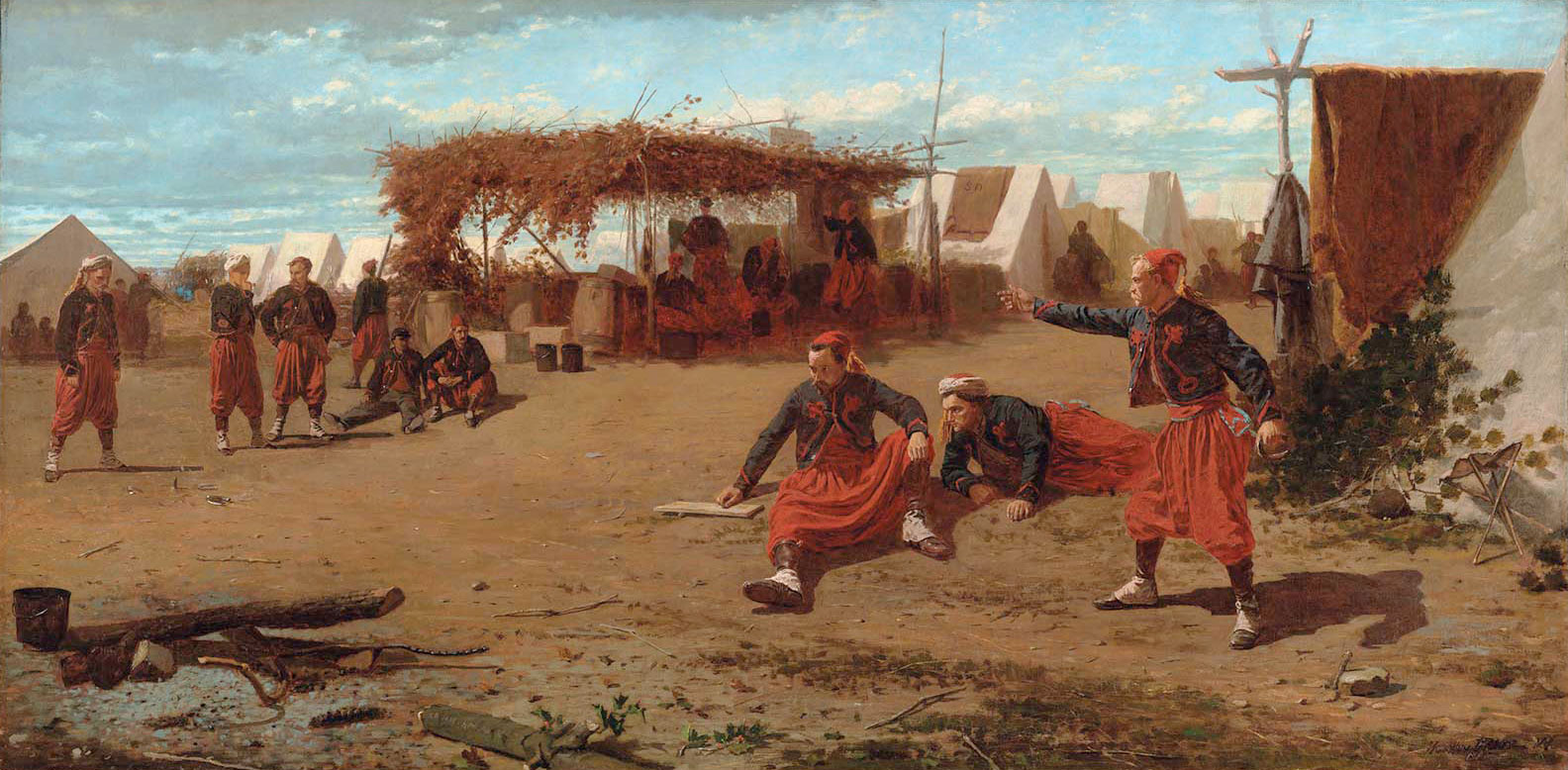 Winslow Homer (1836-1910), Pitching Quoits, 1865. Oil on canvas, 26¾ x 53¾ in. Harvard Art Museums/Fogg Museum. Gift of Mr. and Mrs. Frederic Haines Curtiss. 1940.298.
Homer is positioned as a witness, and Lasser says, “We’re thinking about all of the pressures on him as an illustrator of a magazine and how he developed a journalistic eye that he then takes into his career as a fine artist.”
Painted shortly after the end of the Civil War, Prisoners from the Front is a reckoning of all that Homer saw during his time reporting from the battlefield, even though it isn’t based on any specific incident. In it, a polished Union soldier keeps close watch on a group of haggard Confederate prisoners. Despite the brutality of the war, the painting maintains a sense of civility and hope that the two sides will be able to move past the conflict. 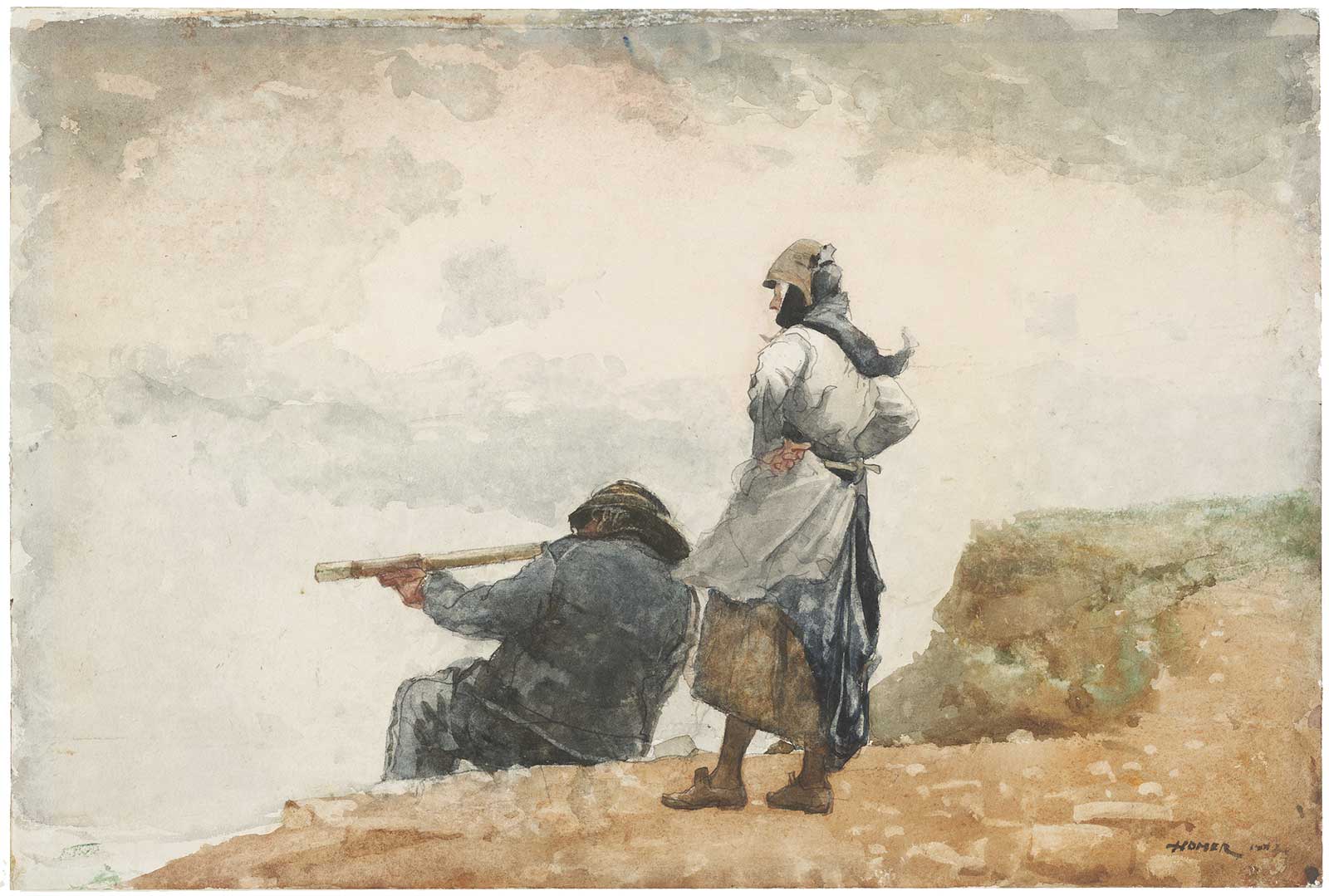 Winslow Homer (1836-1910), The Lookout, 1882. Watercolor over graphite on heavy white wove paper, 145/8 x 217/8 in. Harvard Art Museums/Fogg Museum. Anonymous gift. 1939.231.
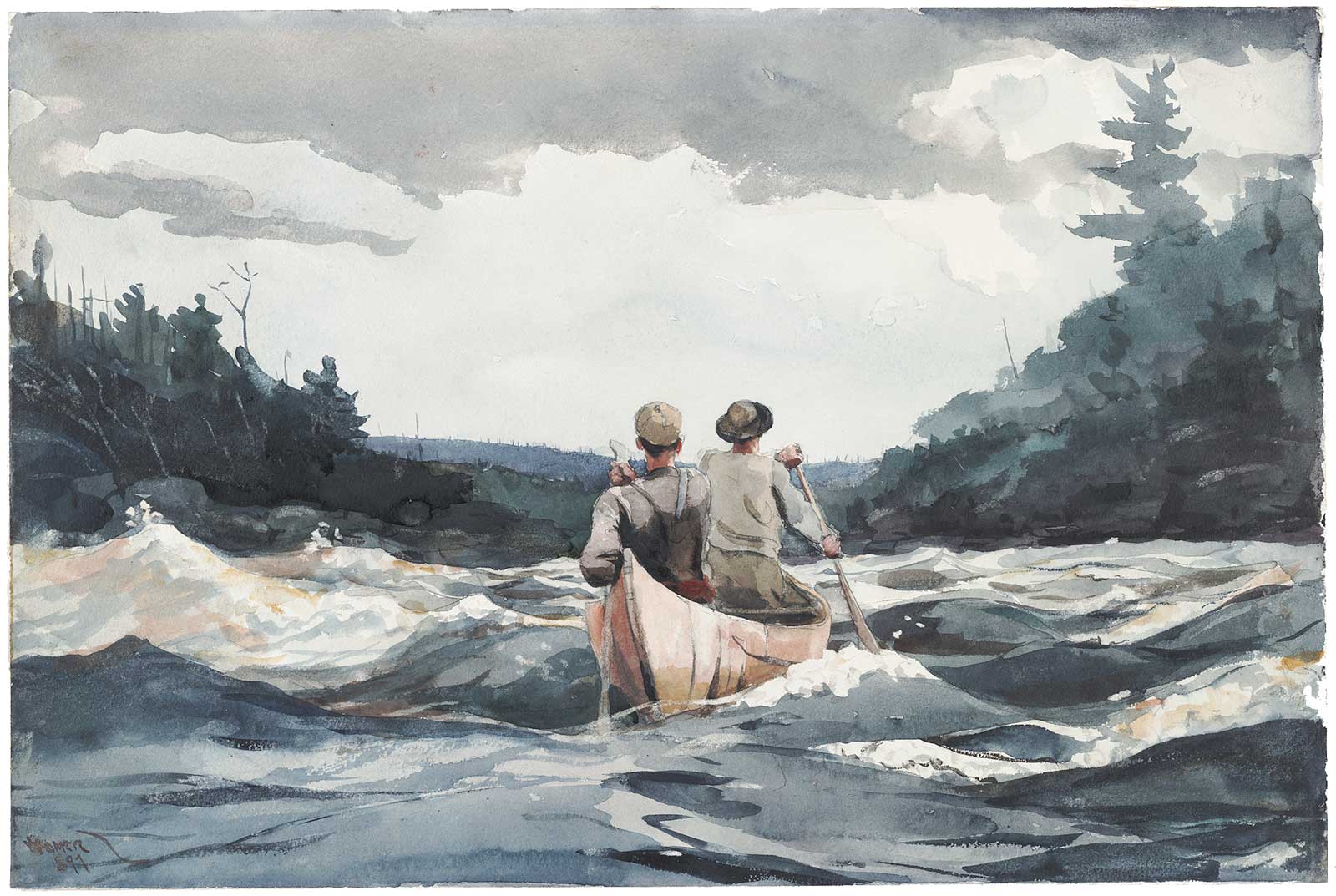 Winslow Homer (1836-1910), Canoe in Rapids, 1897. Transparent watercolor and graphite on off-white wove paper.
Harvard Art Museums/Fogg Museum, Louise E. Bettens Fund, 1924.30. Photo: Harvard Art Museums; © President and Fellows of Harvard College.
Eyewitness isn’t limited to the illustrations and paintings Homer created to depict the war. Works from later in his career, including The Lookout from 1882, are also on view. This watercolor shows a man and a woman keeping watch on a foggy sea. Like his illustrations from the Civil War, The Lookout showcases Homer’s skill as a documentarian while still maintaining a sense of drama. 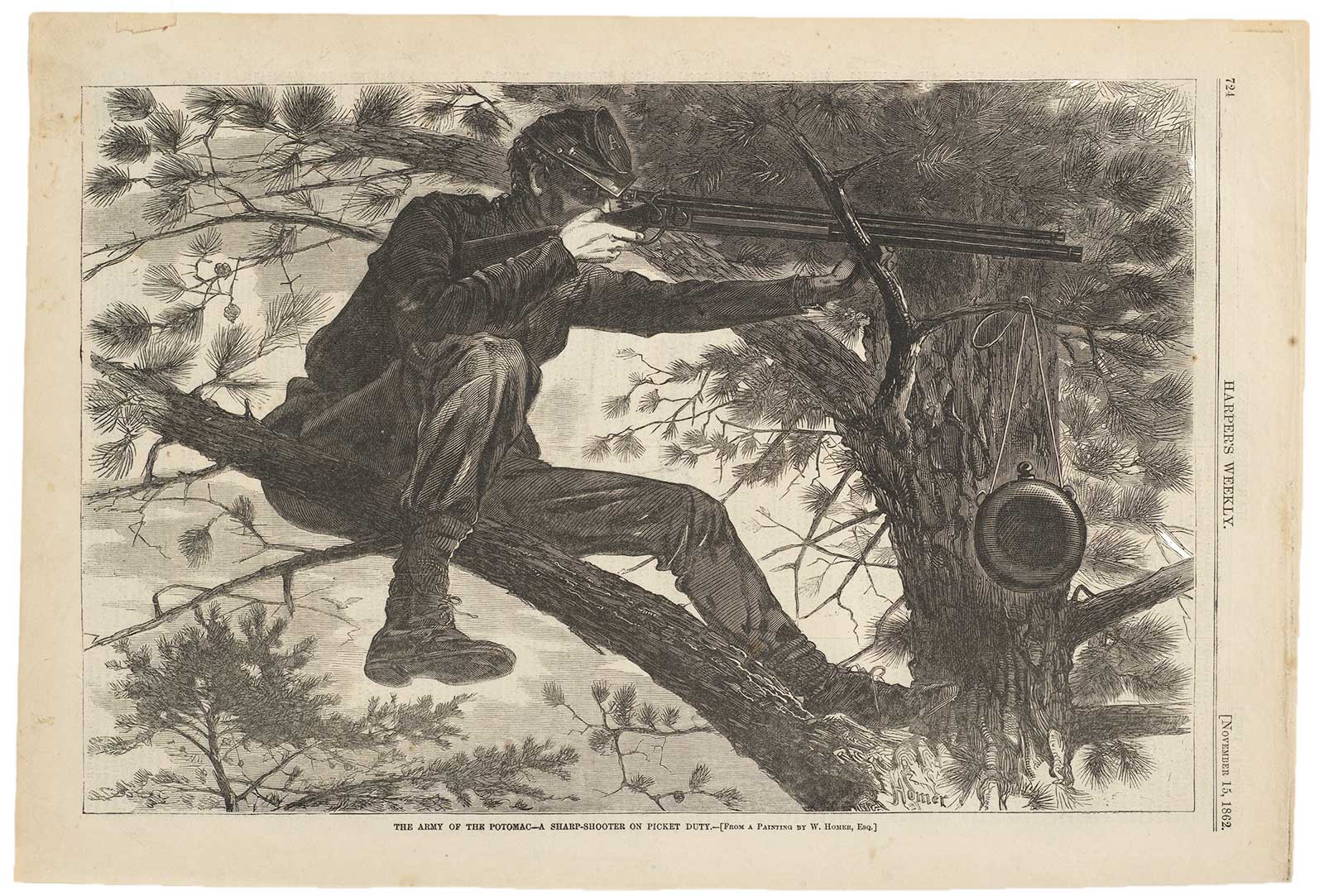 After Winslow Homer, engraved by unidentified artist, The Army of the Potomac - A Sharp-Shooter on Picket Duty - [From a Painting by W. Homer, Esq.], 1862. Wood engraving and letterpress on cream laid paper, image: 91/8 x 13¾ in., sheet: 107/8 x 1513/16 in. Harvard Art Museums/Fogg Museum, Anonymous Fund for the Acquisition of Prints Older than 150 Years. 2018.238.
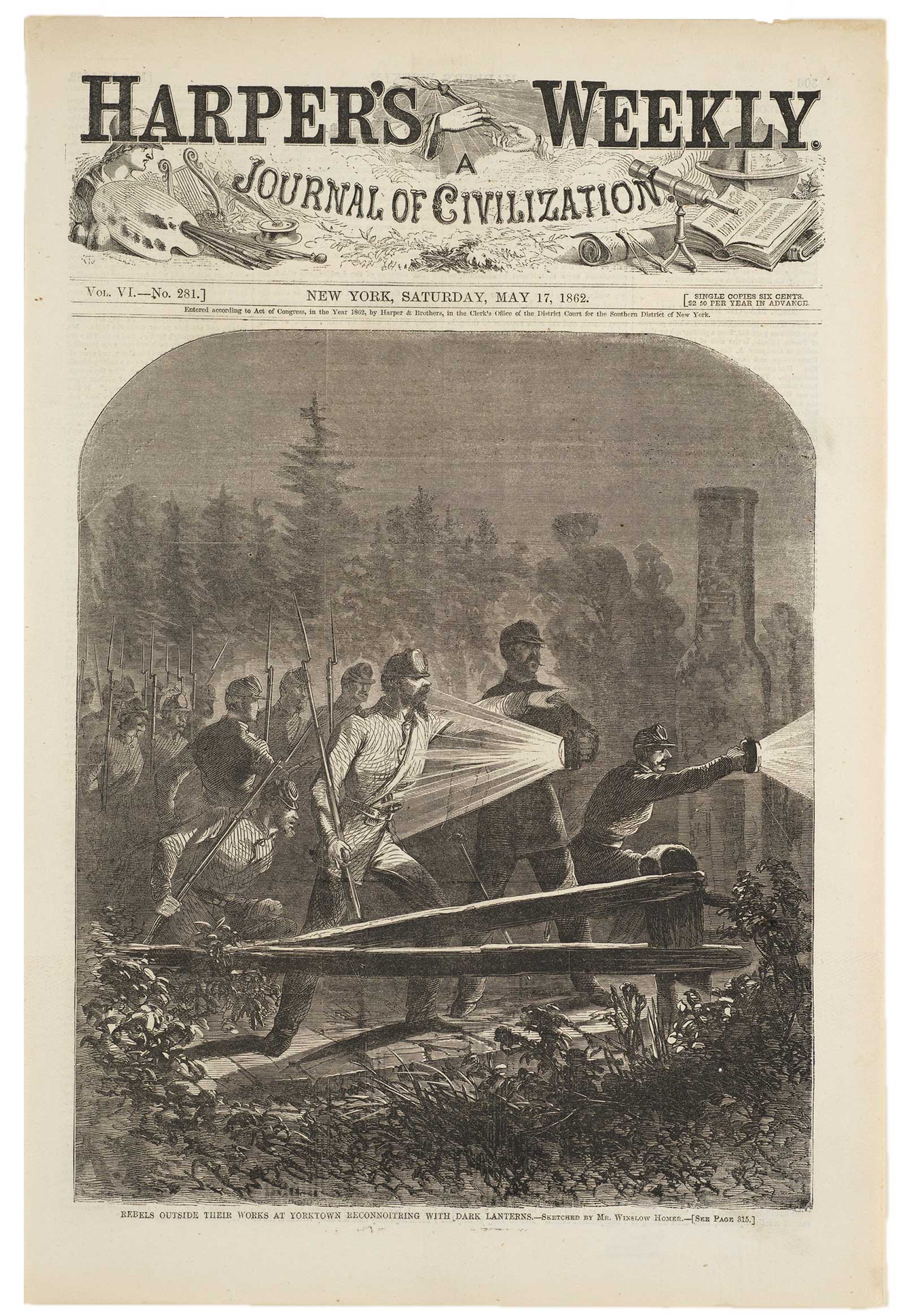 After Winslow Homer, engraved by unidentified artist, Rebels Outside Their Works at Yorktown Reconnoitring with Dark Lanterns - Sketched by Mr. Winslow Homer, 1862. Wood engraving and letterpress on off-white laid paper, block: 1015/16 x 93/16 in., sheet: 16 x 1013/16 in. Harvard Art Museums/Fogg Museum. Gift of W. G. Russell Allen. M9303.
"We want people to think in new ways about Homer’s career as an illustrator and think harder about the impact that his time as an illustrator had on his career as a painter and watercolorist,” Lasser says.
Winslow Homer: Eyewitness runs concurrently with Homer at the Beach: A Marine Painter’s Journey at the Cape Ann Museum. —
Powered by Froala Editor